Got contracts to review? While you're here for contracts, let Cobrief make contract review effortless—start your free review now.
Customize this template for free
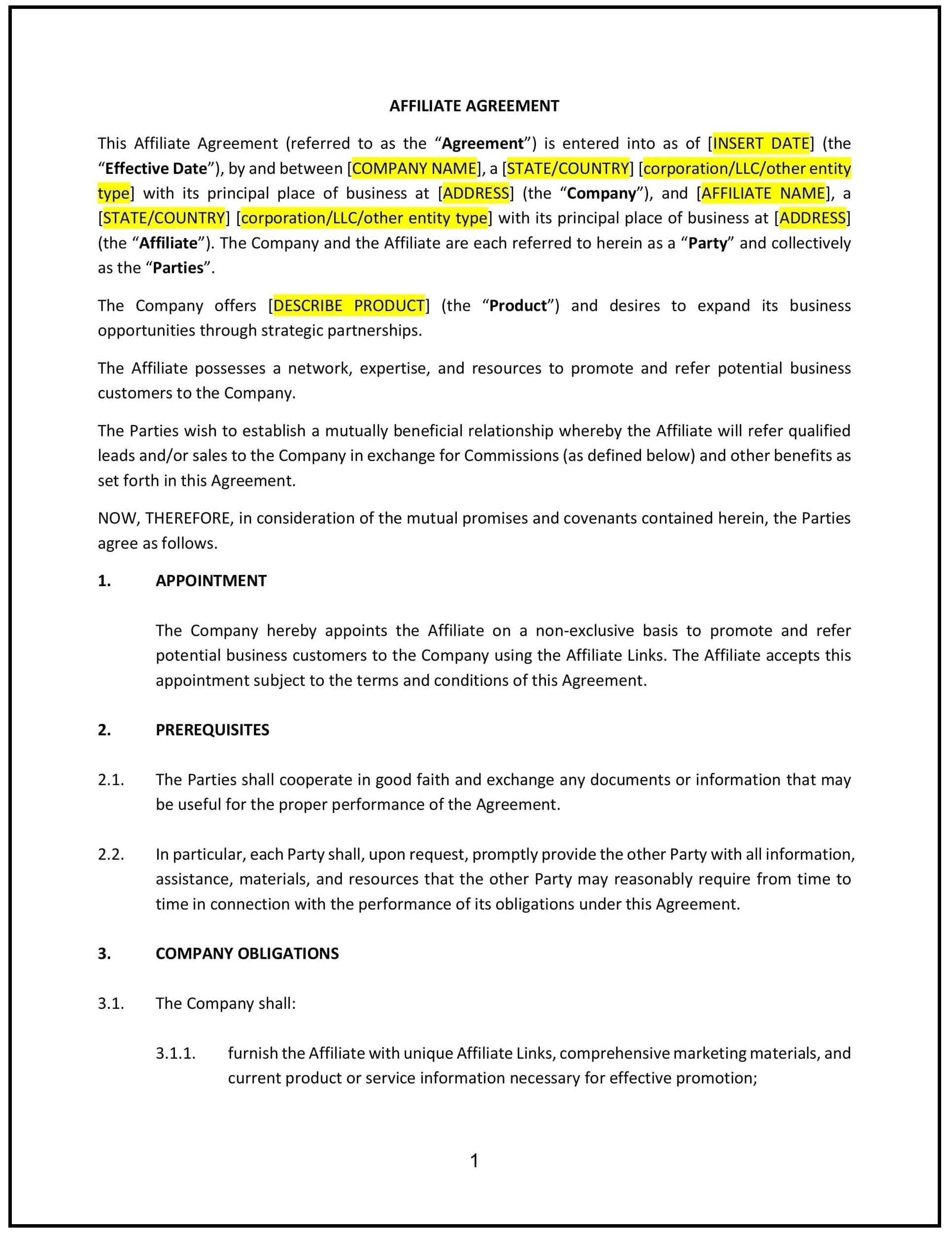
Affiliate Agreement (California)
An Affiliate Agreement is a legally binding contract between a business (the "Merchant" or "Advertiser") and an affiliate (the "Affiliate" or "Publisher") that outlines the terms under which the Affiliate promotes the Merchant’s products or services in exchange for compensation. In California, Affiliate Agreements are widely used in industries such as e-commerce, digital marketing, software, entertainment, and healthcare. California’s robust consumer protection laws, strict data privacy regulations (e.g., CCPA), and adherence to the Uniform Commercial Code (UCC) make it essential to draft agreements that comply with state-specific legal requirements.
For example, a Los Angeles-based fashion retailer might use an Affiliate Agreement to collaborate with influencers on Instagram, while a San Francisco-based tech startup might partner with affiliates to drive app downloads. A well-drafted Affiliate Agreement ensures clarity on commission structures, promotional guidelines, and compliance with California’s stringent legal framework.
Tips for drafting and maintaining an Affiliate Agreement in California
- Define the relationship: Clearly specify that the Affiliate is an independent contractor and not an employee or agent of the Merchant. This distinction is critical in California, where worker classification is heavily regulated under laws like AB5 and Proposition 22.
- Example: “The Affiliate is an independent contractor and shall not be considered an employee, partner, or agent of the Merchant for any purpose.”
- Outline approved promotional methods: Specify the channels and strategies the Affiliate may use to promote the Merchant’s products, such as social media, blogs, email campaigns, or paid advertisements. Ensure compliance with California’s Unfair Competition Law (UCL) and the Federal Trade Commission (FTC) guidelines, which require clear disclosures of affiliate relationships.
- Example: “The Affiliate must disclose their relationship with the Merchant in all promotional materials using language such as ‘This post contains affiliate links’ or similar disclosures.”
- Establish commission terms: Detail how the Affiliate will be compensated, whether through a percentage of sales, flat fees, or other arrangements. Include payment schedules, reporting procedures, and conditions for earning commissions. Transparency in pricing and payment terms is essential to comply with California’s consumer protection laws.
- Example: “The Affiliate will earn a 10% commission on all verified sales generated through their referral link, payable within 30 days of the end of each month.”
- Address intellectual property usage: Clarify the ownership of trademarks, logos, and other branding materials provided by the Merchant. Ensure compliance with federal and California state laws regarding intellectual property rights.
- Example: “All intellectual property provided by the Merchant, including trademarks and logos, remains the exclusive property of the Merchant and must be used strictly in accordance with the guidelines provided.”
- Set performance expectations: Include minimum performance standards, such as generating a certain number of leads, clicks, or sales, to ensure the Affiliate actively promotes the Merchant’s products. Performance metrics should be realistic and clearly defined to prevent disputes.
- Example: “The Affiliate agrees to generate at least 100 qualified clicks per month or risk termination of this agreement.”
- Include termination provisions: Define the circumstances under which the agreement can be terminated, such as breach of terms, failure to meet performance metrics, or mutual consent. Include provisions for winding down the partnership, such as ceasing the use of promotional materials.
- Example: “Either party may terminate this agreement with 15 days’ written notice if the other party fails to comply with the terms outlined herein.”
- Comply with California laws: Ensure the agreement adheres to California’s contract laws, including the California Uniform Commercial Code (UCC) for transactions involving goods. Additionally, address compliance with the California Consumer Privacy Act (CCPA), which regulates the collection and use of personal data, and other relevant statutes.