Business Collaboration Agreement (Kansas): Free template
Got contracts to review? While you're here for contracts, let Cobrief make contract review effortless—start your free review now.
Customize this template for free
Business Collaboration Agreement (Kansas)
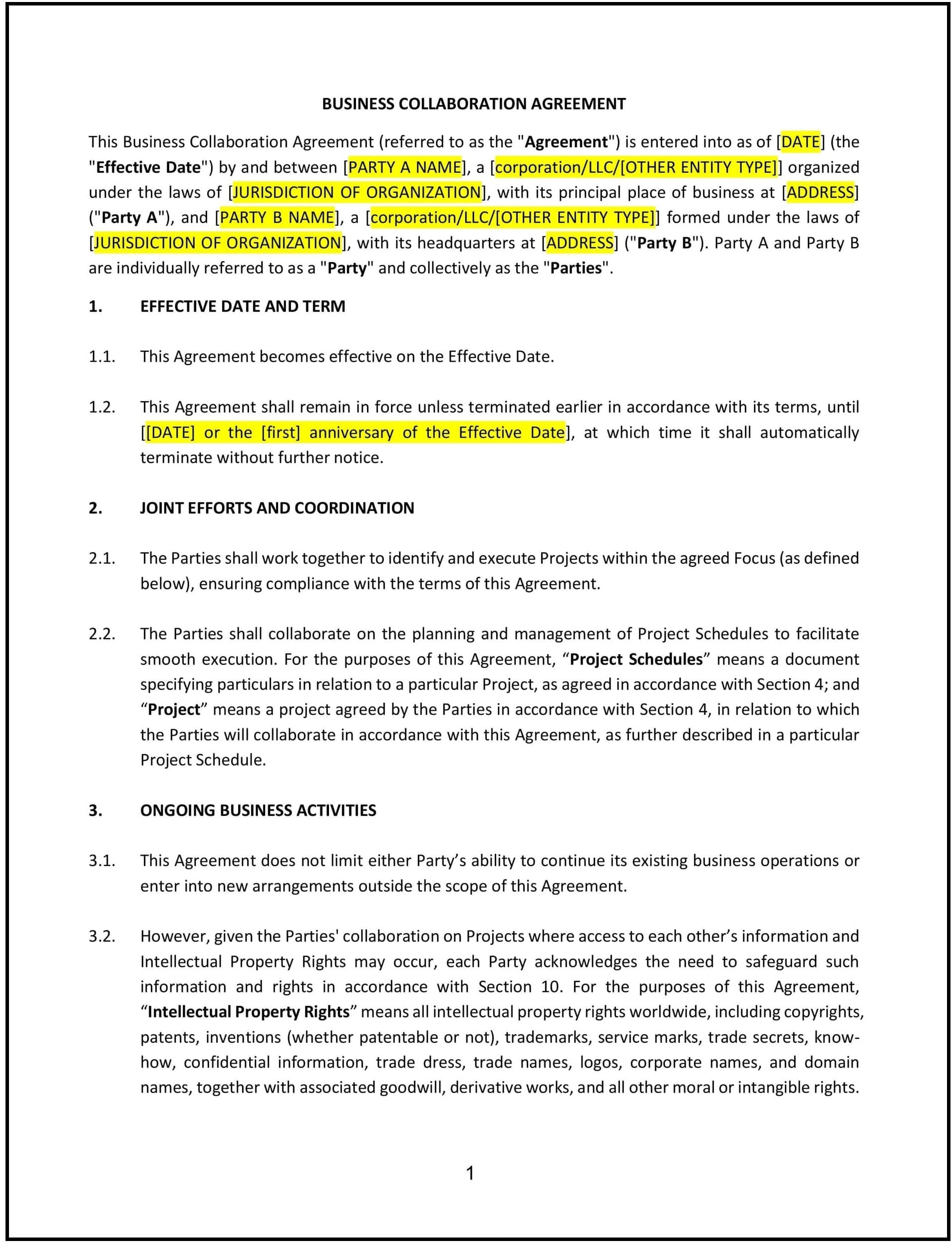
A Business Collaboration Agreement is a legal contract between two or more parties that outlines the terms and conditions of their partnership to collaborate on a specific project, venture, or business activity. In Kansas, this agreement must comply with state laws regarding contracts, partnerships, and business operations. A well-drafted agreement ensures clarity, minimizes disputes, and protects the interests of all parties involved.
For example, a tech startup in Wichita might collaborate with a marketing agency to develop and promote a new software product. A clear agreement specifies the roles, responsibilities, financial contributions, intellectual property rights, and other critical details.
Tips for drafting and maintaining a Business Collaboration Agreement in Kansas
- Identify the parties: Clearly specify the names, contact information, and roles of all parties involved in the collaboration.
- Example: “This Business Collaboration Agreement is entered into by [Party A Name], located at [Address], and [Party B Name], located at [Address].”
- Define the purpose: Explain the reason for the collaboration, such as developing a product, launching a service, or achieving a shared goal.
- Example: “The purpose of this agreement is to outline the terms under which [Party A] and [Party B] will collaborate to develop and market [Project/Product/Service].”
- Specify the roles and responsibilities: Outline the specific tasks, duties, and obligations of each party.
- Example: “Party A agrees to handle product development, while Party B agrees to manage marketing and sales efforts.”
- Address financial contributions: Define the financial contributions or resources each party will provide.
- Example: “Party A agrees to contribute $50,000, and Party B agrees to contribute $30,000 toward the project.”
- Include intellectual property provisions: Specify ownership and usage rights for any intellectual property created during the collaboration.
- Example: “All intellectual property developed during the collaboration shall be jointly owned by both parties unless otherwise agreed in writing.”
- Add dispute resolution mechanisms: Include provisions for resolving disputes, such as mediation or arbitration.
- Example: “Any disputes arising under this agreement shall first be resolved through mediation in [City], Kansas.”
- Include termination provisions: Specify the conditions under which the agreement can be terminated.
- Example: “This agreement may be terminated by either party with 30 days’ written notice.”
- Outline governing law and jurisdiction: Ensure the agreement specifies that it is governed by Kansas law and identifies the appropriate courts for dispute resolution.
- Example: “This agreement is governed by the laws of the State of Kansas. Any disputes shall be resolved in the courts of [County], Kansas.”
- Include signatures: All parties must sign and date the agreement to make it legally binding.
- Example: “IN WITNESS WHEREOF, the parties have executed this Business Collaboration Agreement as of the date first written above.”