Consultancy Agreement (Pro-Customer) (Virginia): Free template
Got contracts to review? While you're here for contracts, let Cobrief make contract review effortless—start your free review now.
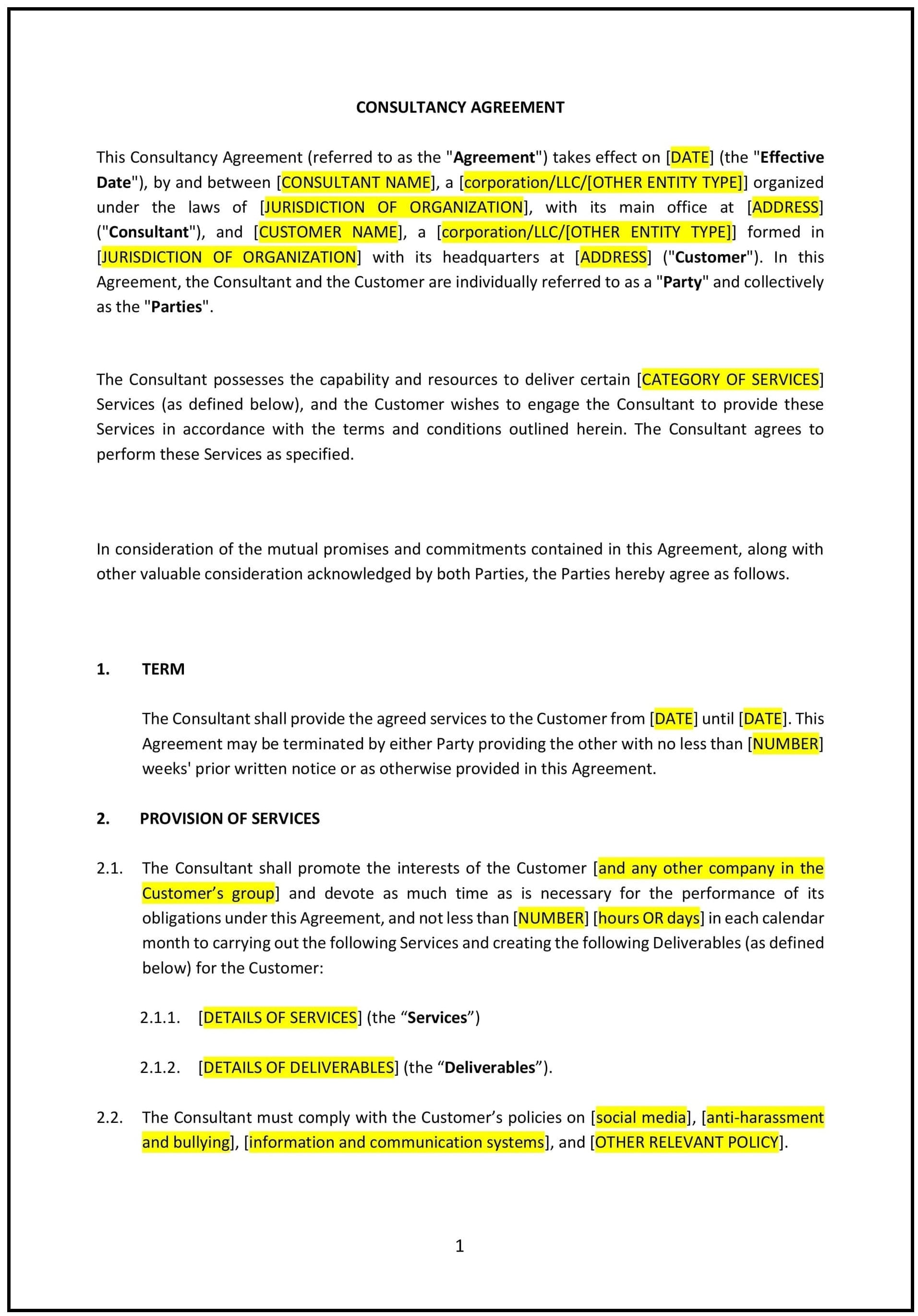
Customize this template for free
Consultancy Agreement (Pro-Customer) (Virginia)
A Consultancy Agreement (Pro-Customer) in Virginia is a legally binding contract that establishes the terms under which a consultant provides services to a business while prioritizing protections for the hiring company. This agreement ensures that services are delivered according to defined expectations, reducing risks related to performance, confidentiality, and liability.
Virginia businesses use consultancy agreements to engage specialized expertise while safeguarding their interests. These agreements help companies clarify service expectations, payment structures, intellectual property (IP) ownership, and confidentiality obligations. Virginia law requires businesses to properly classify consultants to avoid misclassification risks under Virginia employment laws and IRS independent contractor guidelines.
Industries such as technology, healthcare, financial services, and government contracting in Virginia frequently engage consultants to improve business operations, develop strategies, and provide expert insights. A well-drafted agreement protects businesses from risks related to contractor liability, payment disputes, and ownership of deliverables.
Tips for drafting and maintaining a Consultancy Agreement (Pro-Customer) in Virginia
- Clearly define the scope of work to prevent disputes over project deliverables and expectations. Virginia businesses should include measurable objectives to ensure clarity.
- Specify payment terms, including hourly rates, fixed fees, invoicing procedures, and penalties for late payments. Virginia law enforces written payment terms, making them essential for enforceability.
- Include a strong independent contractor clause to prevent misclassification under Virginia labor laws. The consultant should retain control over work methods and avoid company-imposed schedules.
- Protect confidential information by incorporating non-disclosure obligations, ensuring that proprietary business details remain secure. Virginia law upholds NDAs when they are reasonable in scope and duration.
- Clarify intellectual property ownership, ensuring that any work product created during the engagement belongs to the business unless otherwise agreed upon. Virginia businesses should specify whether deliverables are classified as "work made for hire."
- Include a dispute resolution clause specifying whether conflicts will be resolved through Virginia courts, arbitration, or mediation. Virginia contract law generally favors alternative dispute resolution methods for efficient resolution.