Digital Content License Agreement (Virginia): Free template
Got contracts to review? While you're here for contracts, let Cobrief make contract review effortless—start your free review now.
Customize this template for free
Digital Content License Agreement (Virginia)
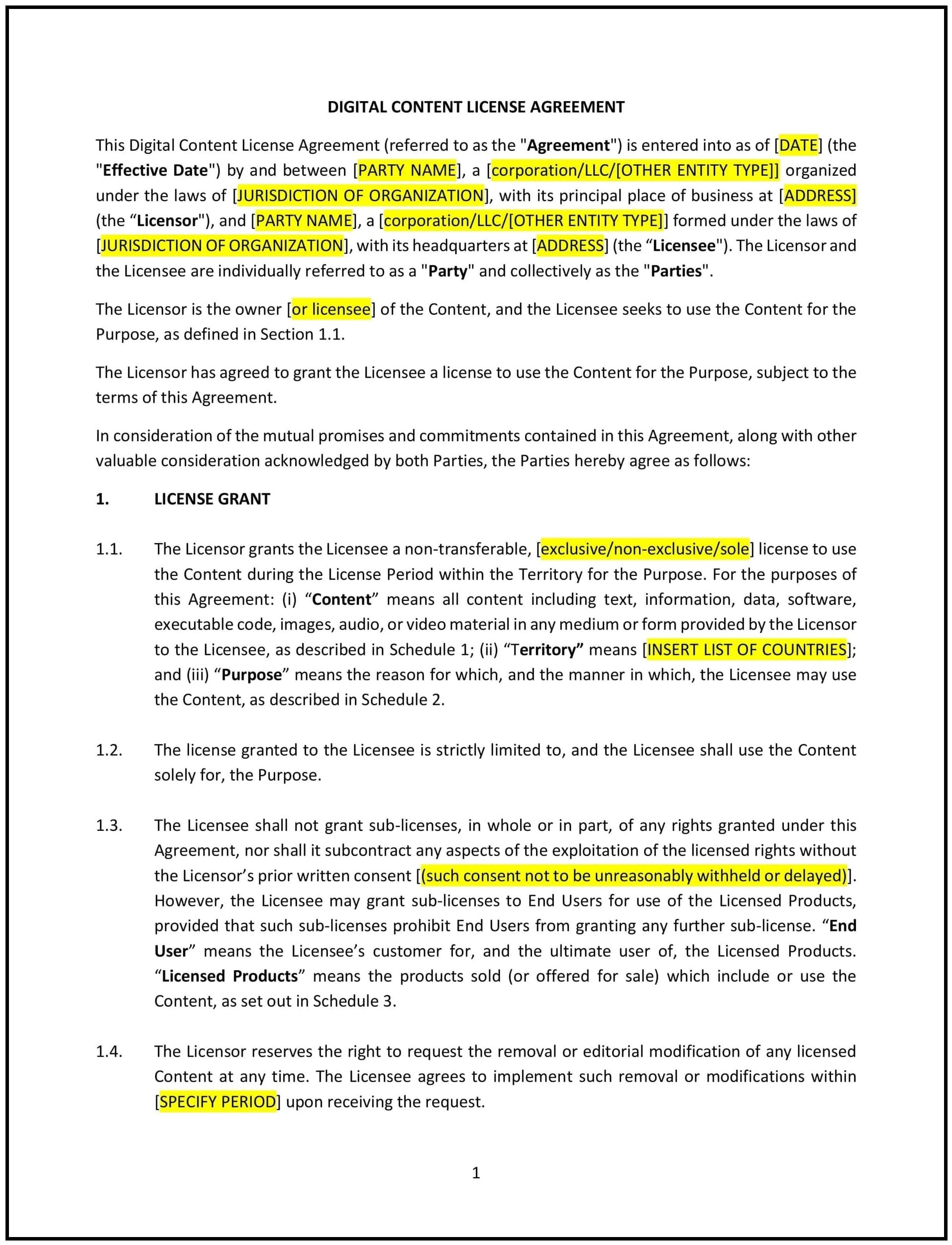
A Digital Content License Agreement is a legal document that grants permission to use digital content, such as images, videos, audio files, written materials, or software, under specific terms and conditions. In Virginia, this agreement must comply with state laws regarding intellectual property, licensing, and contract enforcement. A well-drafted agreement ensures that both the licensor (content owner) and licensee (user) understand their rights and obligations, minimizing the risk of disputes.
For example, a Richmond-based photographer might license their digital photos to a local advertising agency for use in client campaigns. A clear Digital Content License Agreement outlines the scope of usage, payment terms, and other critical details.
Tips for drafting and maintaining a Digital Content License Agreement in Virginia
- Identify the parties: Clearly specify the names and contact information of both the licensor (content owner) and the licensee (user).
- Example: “This Digital Content License Agreement is entered into by [Licensor Name], residing at [Address], and [Licensee Name], located at [Address].”
- Define the licensed content: Provide a detailed description of the digital content being licensed, including file formats, titles, or identifiers.
- Example: “The licensor grants the licensee the right to use the following digital content: [list of files, e.g., photos, videos, or software].”
- Specify the scope of use: Outline how the content can be used, including permitted platforms, purposes, and geographic limitations.
- Example: “The licensee may use the licensed content for promotional purposes on social media platforms and print materials within the United States.”
- Clarify ownership rights: State that the licensor retains ownership of the content and that the license does not transfer ownership.
- Example: “The licensor retains all intellectual property rights to the licensed content. This agreement grants only a limited license to use the content as specified herein.”
- Set usage restrictions: Define any restrictions, such as prohibiting modifications, redistribution, or sublicensing of the content.
- Example: “The licensee may not alter, edit, or modify the licensed content without prior written consent from the licensor.”
- Include payment terms: Specify whether the license is free or paid, and outline payment schedules, methods, and amounts.
- Example: “In consideration for the license granted herein, the licensee agrees to pay the licensor $[Amount] within [Timeframe].”
- Address termination terms: Specify conditions under which the license may be terminated, such as breach of terms or expiration.
- Example: “This license may be terminated by the licensor upon written notice if the licensee breaches any terms of this agreement.”
- Outline governing law and jurisdiction: Ensure the agreement specifies that it is governed by Virginia law and identifies the appropriate courts for dispute resolution.
- Example: “This agreement is governed by the laws of the Commonwealth of Virginia. Any disputes arising under this agreement shall be resolved in the courts of [County], Virginia.”
- Include signatures: Both parties must sign and date the agreement to make it legally binding.
- Example: “IN WITNESS WHEREOF, the parties have executed this Digital Content License Agreement as of the date first written above.”