Employee Confidentiality Agreement (Massachusetts): Free template
Got contracts to review? While you're here for contracts, let Cobrief make contract review effortless—start your free review now.
Customize this template for free
Employee Confidentiality Agreement (Massachusetts)
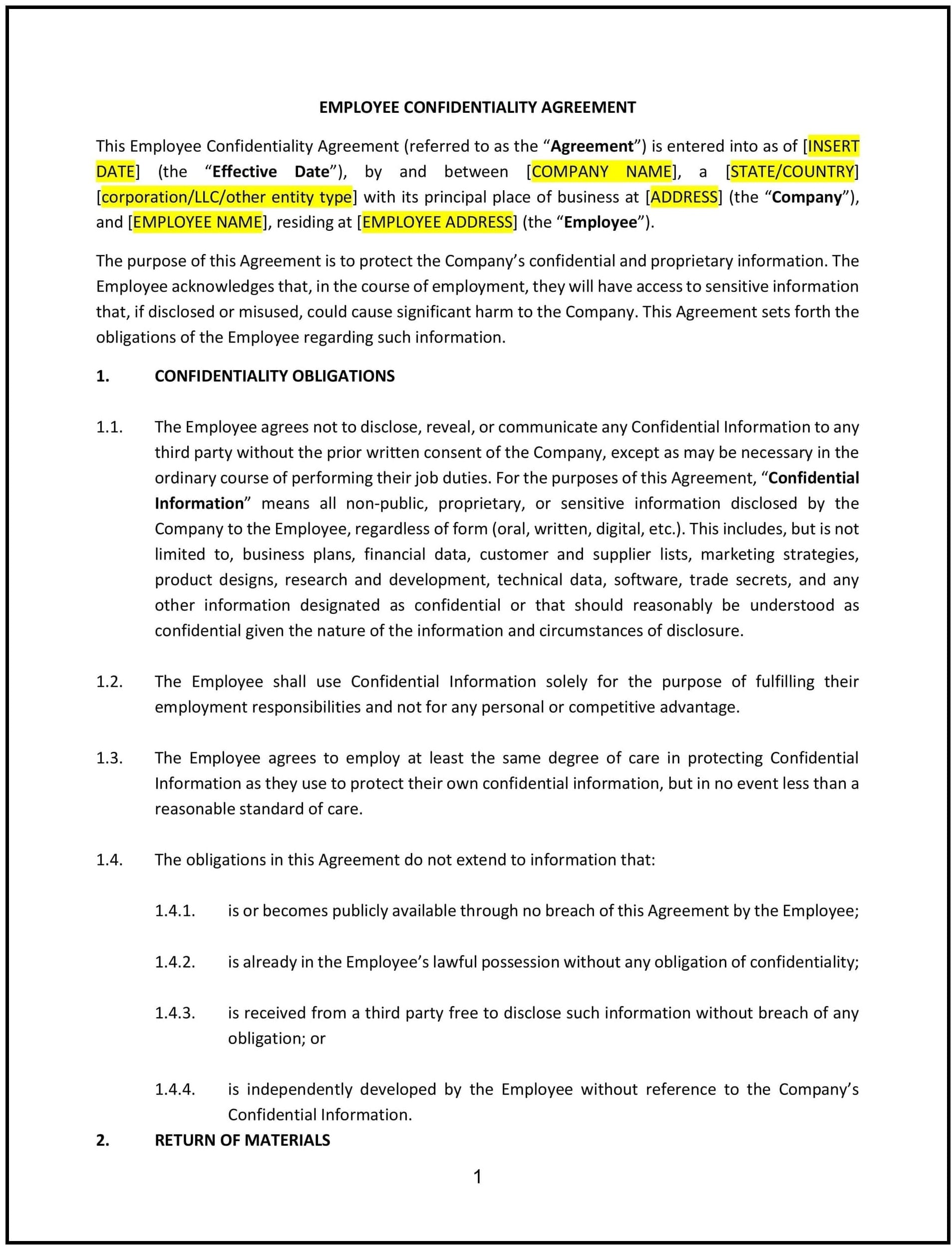
An Employee Confidentiality Agreement, also known as a Non-Disclosure Agreement (NDA), is a legal contract between an employer and an employee that protects sensitive business information from unauthorized disclosure. In Massachusetts, this agreement must comply with state laws regarding contracts, intellectual property, and trade secrets. A well-drafted agreement ensures clarity, minimizes disputes, and safeguards the employer’s proprietary information.
For example, a tech startup in Boston might require its employees to sign a Confidentiality Agreement to protect software code, customer databases, or strategic business plans. A clear agreement specifies the scope of confidentiality, obligations, and consequences for breaches.
Tips for drafting and maintaining an Employee Confidentiality Agreement in Massachusetts
- Identify the parties: Clearly specify the names, contact information, and roles of both the employer and the employee.
- Example: “This Employee Confidentiality Agreement is entered into by [Employer Name], located at [Address], and [Employee Name], located at [Address].”
- Define confidential information: Outline what constitutes confidential information, such as trade secrets, customer lists, financial data, or proprietary processes.
- Example: “Confidential Information includes, but is not limited to, trade secrets, business plans, client lists, marketing strategies, and any other information marked as confidential or disclosed verbally and identified as confidential.”
- Specify exclusions from confidentiality: Clarify what information is not considered confidential, such as publicly available information or knowledge acquired independently.
- Example: “Confidential Information does not include information that is publicly available, already known to the Employee prior to disclosure, or independently developed without reference to the Employer’s information.”
- Address use and protection of confidential information: Detail how the employee must handle and safeguard the confidential information.
- Example: “The Employee agrees to use the Confidential Information solely for the purpose of performing their duties for the Employer and to take all reasonable measures to prevent unauthorized disclosure.”
- Include non-disclosure obligations: Specify that the employee must not disclose confidential information to third parties without written consent.
- Example: “The Employee shall not disclose Confidential Information to any third party without the prior written consent of the Employer.”
- Define intellectual property rights: Clarify ownership of any intellectual property created during employment.
- Example: “All intellectual property developed by the Employee during the course of their employment shall remain the sole property of the Employer.”
- Add liability and indemnification: Clarify the employee’s liability in case of unauthorized disclosure or misuse of confidential information.
- Example: “The Employee shall indemnify the Employer against any losses, damages, or claims arising from the Employee’s unauthorized disclosure or misuse of Confidential Information.”
- Include a termination clause: Specify conditions under which the agreement remains in effect after employment ends.
- Example: “This agreement shall remain in effect indefinitely, even after the termination of the Employee’s employment, unless otherwise specified in writing.”
- Outline governing law and jurisdiction: Ensure the agreement specifies that it is governed by Massachusetts law and identifies the appropriate courts for dispute resolution.
- Example: “This agreement is governed by the laws of the Commonwealth of Massachusetts. Any disputes arising under this agreement shall be resolved in the courts of [County], Massachusetts.”
- Include signatures: Both parties must sign and date the agreement to make it legally binding.
- Example: “IN WITNESS WHEREOF, the parties have executed this Employee Confidentiality Agreement as of the date first written above.”