Got contracts to review? While you're here for contracts, let Cobrief make contract review effortless—start your free review now.
Customize this template for free
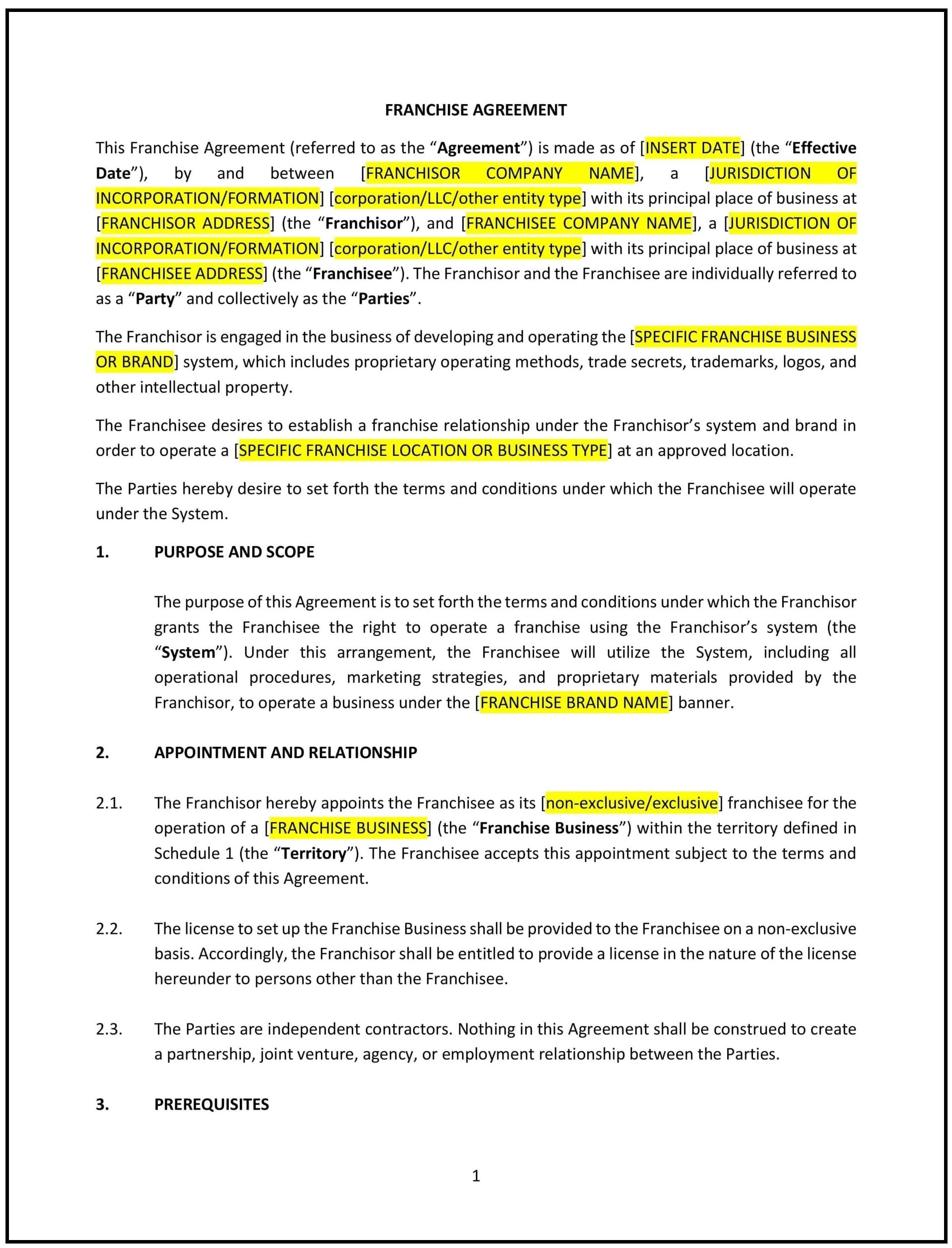
Franchise Agreement (Vermont)
A Franchise Agreement is a legal contract between a franchisor (the "Franchisor") and a franchisee (the "Franchisee"), where the Franchisee is granted the right to operate a business under the Franchisor’s brand, system, and support. In Vermont, this agreement must comply with state laws regarding contracts, intellectual property, and business transactions. A well-drafted agreement ensures clarity, minimizes disputes, and protects both parties' interests.
For example, a restaurant chain based in Burlington might grant a franchisee in Montpelier the rights to operate under its brand name. A clear Franchise Agreement specifies the scope of the license, payment terms, training, marketing obligations, and other critical details.
Tips for drafting and maintaining a Franchise Agreement in Vermont
- Identify the parties: Clearly specify the names, contact information, and roles of both the Franchisor and the Franchisee.
- Example: “This Franchise Agreement is entered into by [Franchisor Name], located at [Address], and [Franchisee Name], located at [Address].”
- Define the franchise grant: Outline the specific rights being granted to the Franchisee, including the territory (if applicable) and exclusivity.
- Example: “The Franchisor grants the Franchisee the non-exclusive right to operate a [Brand Name] franchise at [Location/Address].”
- Specify pricing and payment terms: Outline how the Franchisee will compensate the Franchisor, including initial fees, royalties, and advertising contributions.
- Example: “The Franchisee shall pay an initial franchise fee of $[Amount] and ongoing royalties of [Percentage]% of gross sales, payable monthly.”
- Address performance standards: Detail the expected level of service, including sales targets, quality standards, and operational benchmarks.
- Example: “The Franchisee shall maintain a minimum monthly sales volume of $[Amount] and adhere to all operational standards outlined in the Operations Manual.”
- Include confidentiality and data protection: Protect sensitive business information shared between the parties.
- Example: “Both parties agree to keep all proprietary and confidential information disclosed during the term of this agreement strictly confidential.”
- Define intellectual property rights: Clarify ownership of trademarks, trade secrets, and other intellectual property associated with the franchise.
- Example: “All intellectual property, including trademarks and trade secrets, remains the sole property of the Franchisor.”
- Add liability and indemnification: Clarify each party’s liability in case of errors, damages, or breaches of the agreement.
- Example: “The Franchisee shall indemnify the Franchisor against any claims arising from the Franchisee’s operation of the franchise.”
- Include a termination clause: Specify conditions under which the agreement can be terminated by either party.
- Example: “This agreement may be terminated by either party with [Number] days’ written notice or immediately in the event of a material breach by the other party.”
- Outline governing law and jurisdiction: Ensure the agreement specifies that it is governed by Vermont law and identifies the appropriate courts for dispute resolution.
- Example: “This agreement is governed by the laws of the State of Vermont. Any disputes arising under this agreement shall be resolved in the courts of [County], Vermont.”
- Include signatures: Both parties must sign and date the agreement to make it legally binding.
- Example: “IN WITNESS WHEREOF, the parties have executed this Franchise Agreement as of the date first written above.”