Independent Contractor Agreement (Georgia): Free template
Got contracts to review? While you're here for contracts, let Cobrief make contract review effortless—start your free review now.
Customize this template for free
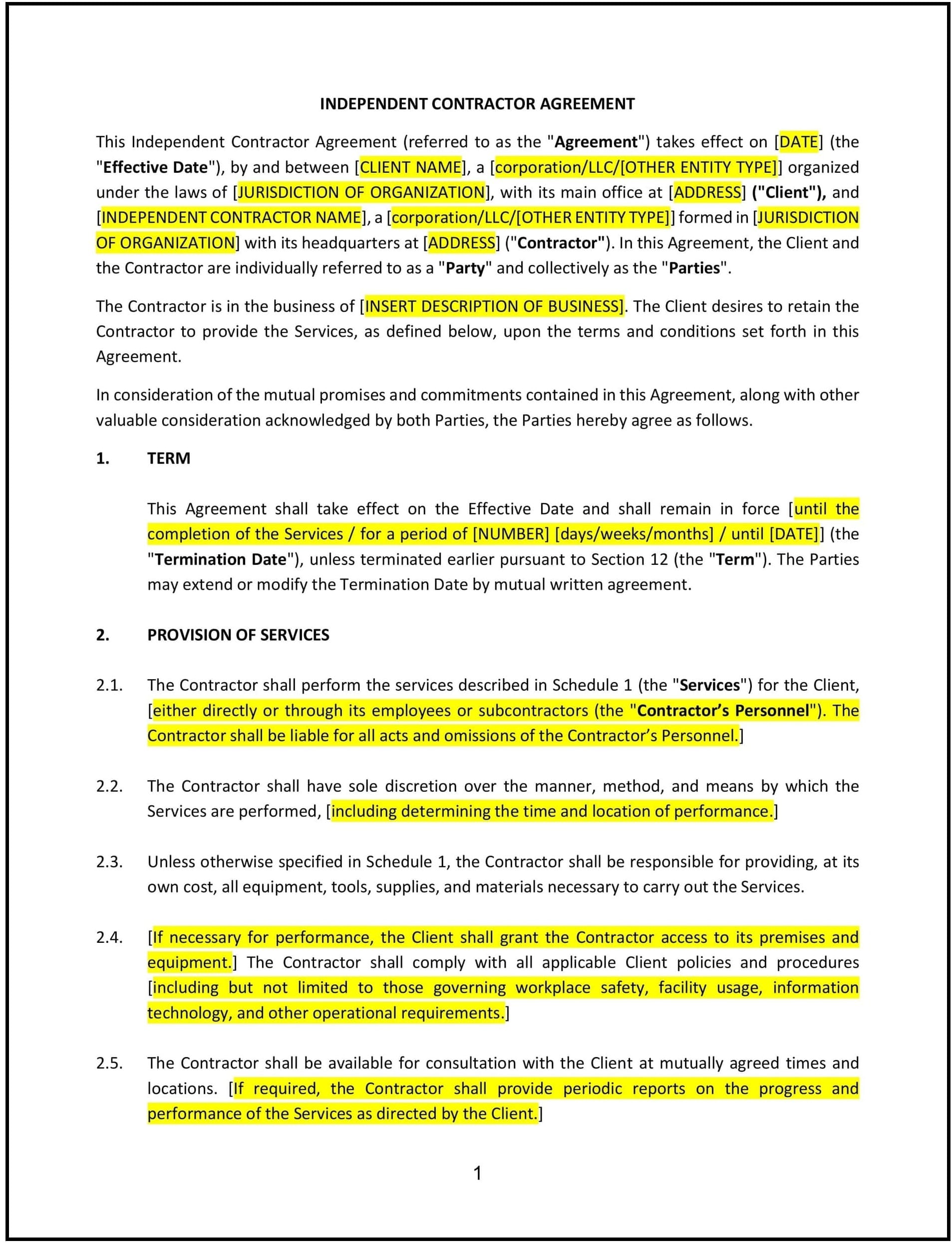
Independent Contractor Agreement (Georgia)
An Independent Contractor Agreement in Georgia is a legally binding contract that outlines the terms of a working relationship between a business and an independent contractor. Unlike employees, independent contractors operate as self-employed professionals responsible for their own taxes, insurance, and work-related expenses. This agreement helps businesses define expectations while supporting compliance with Georgia labor laws regarding worker classification.
Georgia follows IRS guidelines and the Georgia Department of Labor (GDOL) regulations to determine whether a worker qualifies as an independent contractor. The state uses a multi-factor test to assess whether the worker is free from control, performs work outside the hiring entity’s usual business operations, and operates as an independent business. Misclassification can lead to penalties, back taxes, and legal disputes, making a properly structured agreement essential.
Many industries in Georgia, including construction, technology, healthcare, and consulting, frequently use independent contractors for specialized work. This agreement protects both parties by outlining legal rights, responsibilities, and payment terms.
Tips for drafting and maintaining an Independent Contractor Agreement in Georgia
- Clearly define the scope of work, including specific deliverables, deadlines, and performance expectations to ensure clarity.
- Outline payment terms, including invoicing procedures, payment schedules, and any late payment policies. Georgia law allows independent contractors to negotiate flexible payment terms.
- Include a contractor status clause confirming that the worker is an independent contractor and does not qualify as an employee under Georgia labor laws.
- Protect confidential business information by incorporating non-disclosure clauses. Georgia law allows enforceable NDAs as long as they are reasonable in scope and duration.
- Clarify intellectual property ownership, particularly in cases where the contractor is creating proprietary materials or technology. Work-for-hire clauses should be explicitly stated if the hiring entity intends to own the contractor’s work.
- Establish dispute resolution procedures, specifying whether conflicts will be handled through Georgia courts, arbitration, or mediation. Arbitration is commonly used to streamline dispute resolution.