Got contracts to review? While you're here for contracts, let Cobrief make contract review effortless—start your free review now.
Customize this template for free
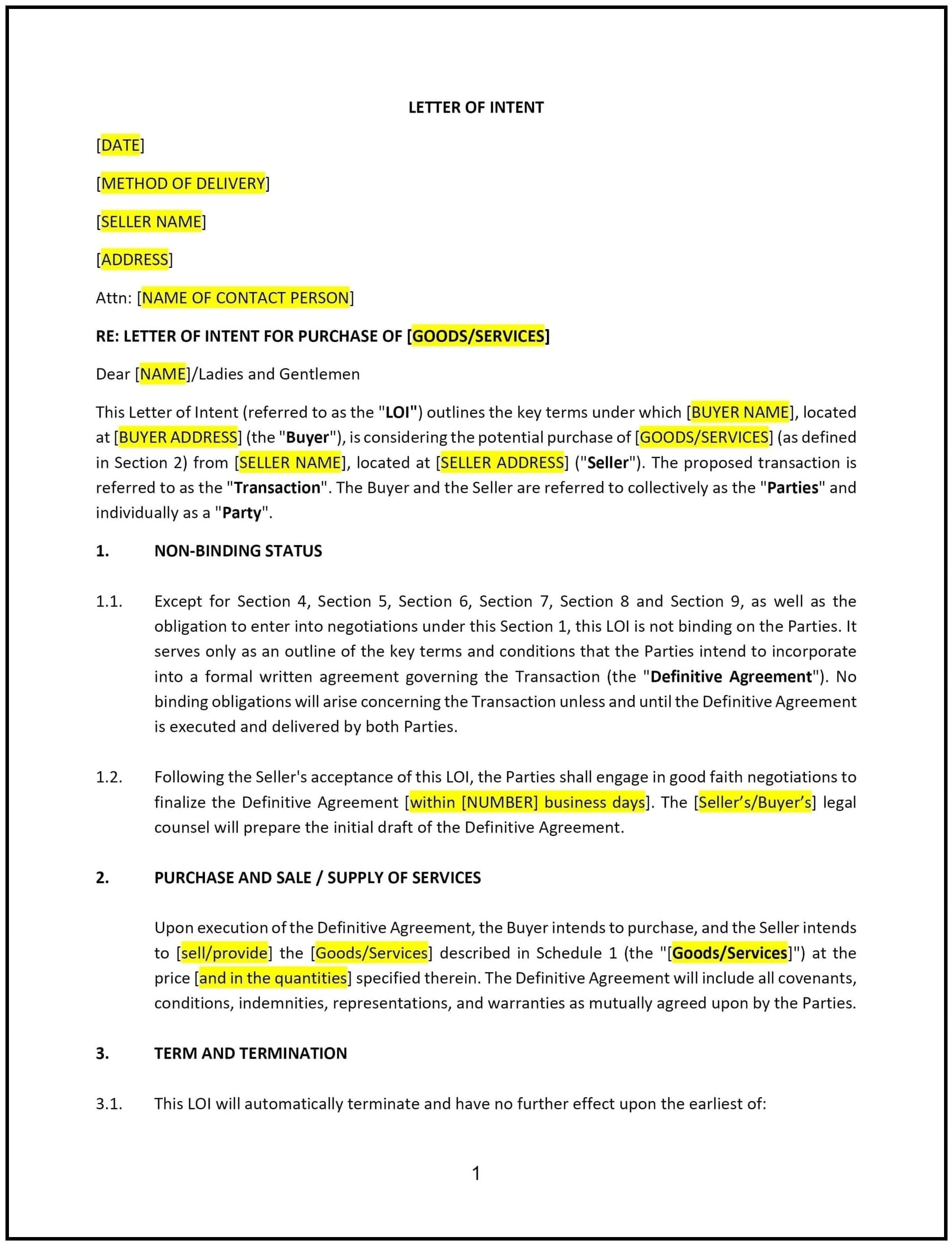
Letter of Intent (LOI) (Alabama)
A Letter of Intent (LOI) is a non-binding document that outlines the preliminary understanding between two or more parties who intend to enter into a formal agreement in the future. In Alabama, an LOI is commonly used in industries such as real estate, mergers and acquisitions, joint ventures, and business partnerships to establish the framework for negotiations and clarify key terms before drafting a legally binding contract.
While an LOI is generally non-binding, certain provisions—such as confidentiality, exclusivity, or governing law clauses—may be enforceable depending on how they are drafted. For example, a Birmingham-based company might use an LOI to express its intent to acquire another business, while a Huntsville-based startup might use it to outline a potential partnership with a technology provider.
Tips for drafting and maintaining a Letter of Intent in Alabama
- Clearly state the purpose: Begin by outlining the intent of the parties and the nature of the proposed transaction or collaboration. For example, specify whether the LOI pertains to a merger, acquisition, lease, or partnership.
- Example: “This Letter of Intent (‘LOI’) expresses the mutual intent of Party A and Party B to explore the possibility of entering into a joint venture for the development of renewable energy projects.”
- Define key terms: Include essential terms such as timelines, financial considerations, and any conditions precedent. For instance, specify whether due diligence will be required or if regulatory approvals are necessary.
- Example: “Party A agrees to conduct due diligence within 30 days of signing this LOI, after which both parties will negotiate definitive agreements.”
- Clarify binding vs. non-binding provisions: Specify which parts of the LOI are binding (e.g., confidentiality, exclusivity) and which are non-binding. This avoids confusion and ensures enforceability of critical clauses.
- Example: “The confidentiality and exclusivity provisions of this LOI shall be legally binding, while all other terms are non-binding and subject to further negotiation.”
- Address confidentiality: Include a confidentiality clause to protect sensitive information shared during negotiations.
- Example: “Both parties agree to maintain the confidentiality of all information disclosed during the negotiation process and not to disclose such information to third parties without prior written consent.”
- Include an exclusivity period: If applicable, specify a timeframe during which the parties agree not to negotiate with other potential partners.
- Example: “Party B agrees not to engage in discussions with any third party regarding the proposed transaction for a period of 60 days from the date of this LOI.”
- Comply with Alabama laws: Ensure the LOI adheres to Alabama’s contract laws and any industry-specific regulations. For example, if the LOI involves real estate, ensure compliance with Alabama’s property and zoning laws.
- Set deadlines for next steps: Outline the timeline for completing due diligence, negotiating definitive agreements, and finalizing the transaction.
- Example: “The parties agree to execute a definitive agreement no later than 90 days from the date of this LOI.”