Marketing Services Agreement (Indiana): Free template
Got contracts to review? While you're here for contracts, let Cobrief make contract review effortless—start your free review now.
Customize this template for free
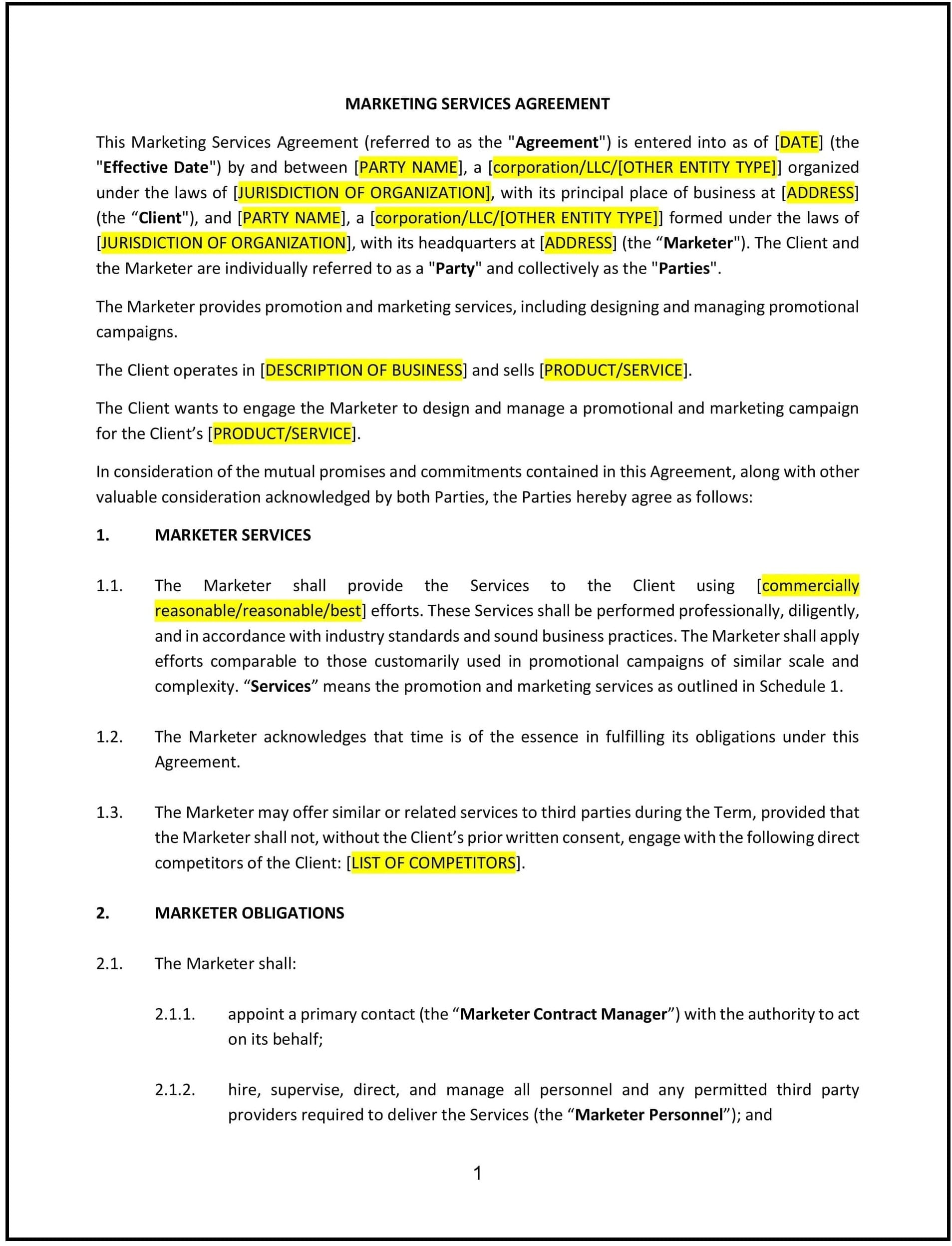
Marketing Services Agreement (Indiana)
A Marketing Services Agreement is a legally binding contract between a business (the "Client") and a marketing agency or professional (the "Provider") that outlines the terms and conditions for the provision of marketing services. This agreement ensures clarity on deliverables, timelines, payment terms, and other critical aspects of the engagement.
Tips for drafting and maintaining a Marketing Services Agreement in Indiana
- Define the scope of services: Clearly outline the marketing services to be provided, such as social media management, SEO, content creation, or advertising campaigns. Include specific deliverables and timelines.
- Example: “The Provider agrees to manage the Client’s social media accounts, including creating and posting content three times per week, and running two ad campaigns per month.”
- Establish payment terms: Detail the payment structure, whether fixed-price, hourly, or performance-based. Include invoicing procedures, due dates, and penalties for late payments.
- Example: “The Client agrees to pay the Provider $3,000 per month, with payment due within 15 days of receiving an invoice.”
- Include performance metrics: Define how the success of the marketing services will be measured, such as through key performance indicators (KPIs) like website traffic, lead generation, or sales conversions.
- Example: “The Provider will deliver a monthly report detailing website traffic, social media engagement, and lead generation metrics.”
- Address intellectual property rights: Specify who will own the intellectual property (IP) for any content, designs, or campaigns created during the engagement. Typically, the Client retains ownership, while the Provider may retain rights to pre-existing materials.
- Example: “Upon full payment, the Client will own all intellectual property rights to the content and campaigns created. The Provider retains ownership of any pre-existing materials used.”
- Set confidentiality obligations: Include a confidentiality clause to protect sensitive information shared during the engagement, such as business strategies or customer data.
- Example: “Both parties agree to keep all confidential information disclosed during the engagement confidential for a period of two years after the agreement’s termination.”
- Outline termination provisions: Define the circumstances under which the agreement can be terminated, such as breach of terms, failure to meet performance metrics, or mutual consent. Include steps for winding down the engagement.
- Example: “Either party may terminate this agreement with 30 days’ written notice if the other party fails to comply with the terms outlined herein.”
- Align with Indiana-specific laws: Ensure the agreement complies with Indiana’s contract laws and consumer protection regulations, including the Indiana Deceptive Consumer Sales Act.
- Example: “This agreement shall be governed by and construed in accordance with the laws of the State of Indiana. Both parties agree to comply with all applicable state and federal laws.”