Got contracts to review? While you're here for contracts, let Cobrief make contract review effortless—start your free review now.
Customize this template for free
Media Rights Agreement (Arkansas)
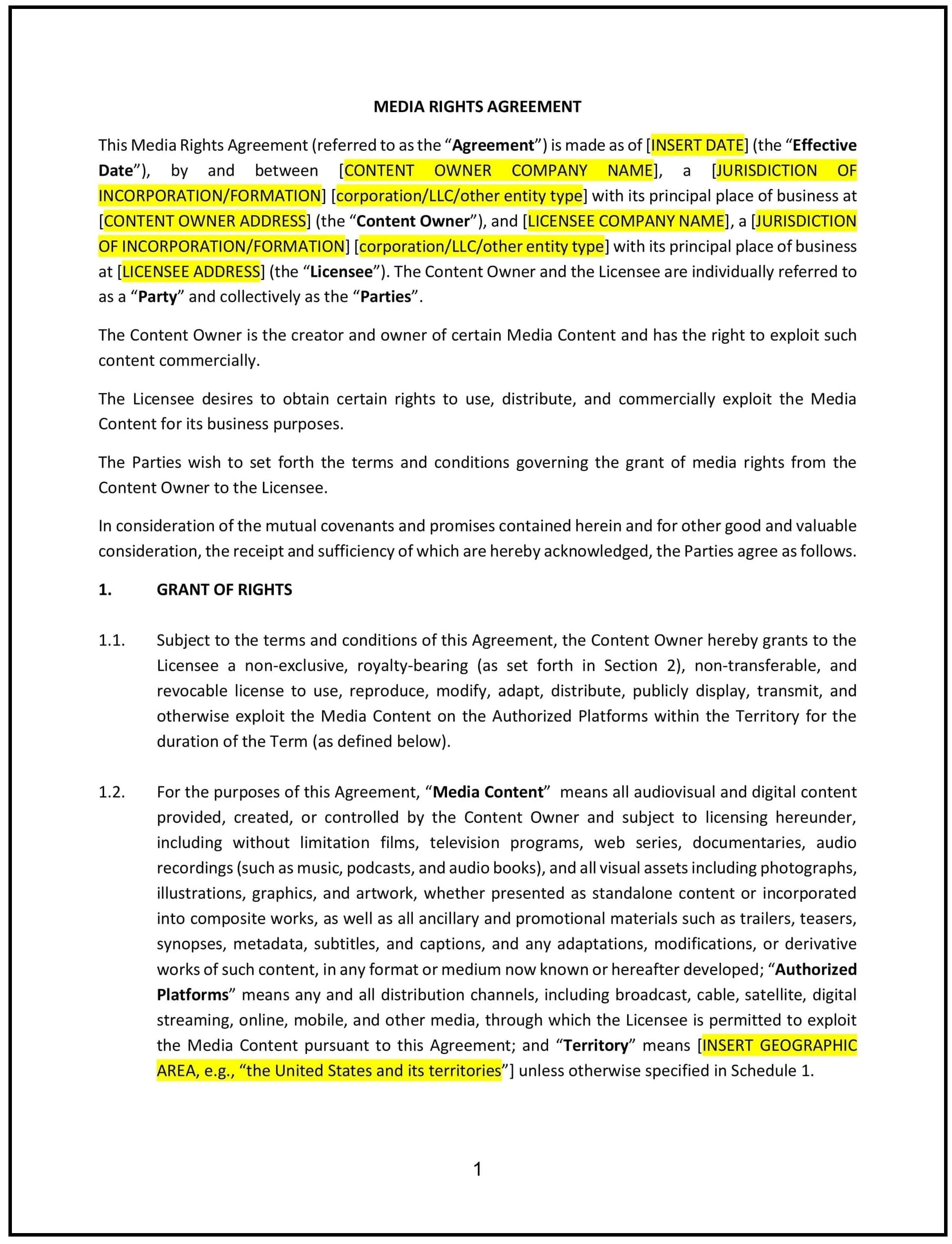
A Media Rights Agreement is a legally binding contract between two or more parties that outlines the terms and conditions under which media content (such as videos, images, audio, or written materials) can be used, distributed, or monetized. In Arkansas, Media Rights Agreements are commonly used in industries such as entertainment, sports, broadcasting, publishing, and digital media. These agreements provide clarity on ownership, licensing, revenue-sharing, and strengthen alignment with Arkansas’s legal framework.
For example, a Little Rock-based production company might use a Media Rights Agreement to formalize its partnership with a Fayetteville-based broadcaster to distribute a documentary series. A well-drafted Media Rights Agreement fosters transparency, minimizes disputes, and aligns with Arkansas’s contract laws and intellectual property statutes.
Tips for drafting and maintaining a Media Rights Agreement in Arkansas
- Define the scope of the agreement: Clearly specify the media content being licensed or distributed, including any limitations or exclusions. Ensure the agreement outlines each party’s roles, responsibilities, and contributions.
- Example: “The Parties agree to collaborate on the distribution of a documentary series titled ‘Southern Roots’ (the ‘Content’), with Party A retaining ownership and Party B granted exclusive distribution rights within the United States.”
- Specify ownership and licensing rights: Clearly define who owns the media content and what rights are being granted to the licensee. Include details about whether the license is exclusive, non-exclusive, transferable, or time-bound.
- Example: “Party A retains full ownership of the Content. Party B is granted an exclusive, non-transferable license to distribute the Content in the United States for a period of three years.”
- Outline usage restrictions: Specify how the media content can and cannot be used. Include restrictions on modifications, sublicensing, geographic regions, and platforms.
- Example: “Party B may not modify, edit, or alter the Content without prior written consent from Party A. The Content may only be distributed on television and streaming platforms within the United States.”
- Establish payment terms: Detail how the licensor will be compensated, whether through a flat fee, royalty payments, revenue-sharing, or other arrangements. Include payment schedules, invoicing procedures, late payment penalties, and any additional costs.
- Example: “Party B agrees to pay Party A a royalty of 15% of gross revenue generated from the distribution of the Content. Payments will be made quarterly within 30 days of the end of each calendar quarter.”
- Address reporting and auditing requirements: Specify the frequency and format of financial reports, as well as the right of the licensor to audit the licensee’s records to confirm accuracy.
- Example: “Party B will provide Party A with a quarterly revenue report detailing all transactions related to the Content. Party A reserves the right to conduct an annual audit of Party B’s financial records related to the Content.”
- Clarify intellectual property rights: Define ownership of any intellectual property created or used during the collaboration. Specify whether intellectual property rights are shared, retained by one party, or licensed.
- Example: “All intellectual property related to the Content remains the exclusive property of Party A. Party B is granted a limited license to use the Content as outlined herein.”
- Protect confidentiality and data security: Protect sensitive information shared between the parties by including confidentiality clauses that align with Arkansas’s trade secret and privacy laws. Address data security measures to safeguard financial and operational data.
- Example: “Both parties agree to maintain the confidentiality of all proprietary information disclosed during the term of this agreement and for a period of 3 years thereafter. Each party will implement industry-standard encryption and access controls to protect shared data.”
- Set termination provisions: Define the circumstances under which the agreement can be terminated, such as breach of terms, mutual consent, or expiration of the agreement. Include steps for transitioning responsibilities if the agreement ends.
- Example: “Either party may terminate this agreement with 30 days’ written notice if the other party fails to comply with the terms outlined herein. Upon termination, all outstanding payments will be settled within 30 days.”
- Include dispute resolution mechanisms: Specify how disputes will be resolved, whether through negotiation, mediation, arbitration, or litigation. Include jurisdiction and governing law clauses to streamline the process.
- Example: “Any disputes arising under this agreement shall be resolved through binding arbitration in accordance with the rules of the American Arbitration Association. The arbitration will take place in Pulaski County, Arkansas, and the decision will be final and binding.”
- Align with Arkansas-specific laws: Ensure the agreement adheres to Arkansas’s contract laws, including the Arkansas Uniform Commercial Code (UCC) for transactions involving goods. Additionally, address alignment with consumer protection statutes and intellectual property regulations.
- Example: “This agreement shall be governed by and construed in accordance with the laws of the State of Arkansas. Both parties agree to adhere to all applicable state and federal laws, including intellectual property and consumer protection regulations.”