Non-Disclosure Agreement (Unilateral) (Alabama): Free template
Got contracts to review? While you're here for contracts, let Cobrief make contract review effortless—start your free review now.
Customize this template for free
Non-Disclosure Agreement (Unilateral) (Alabama)
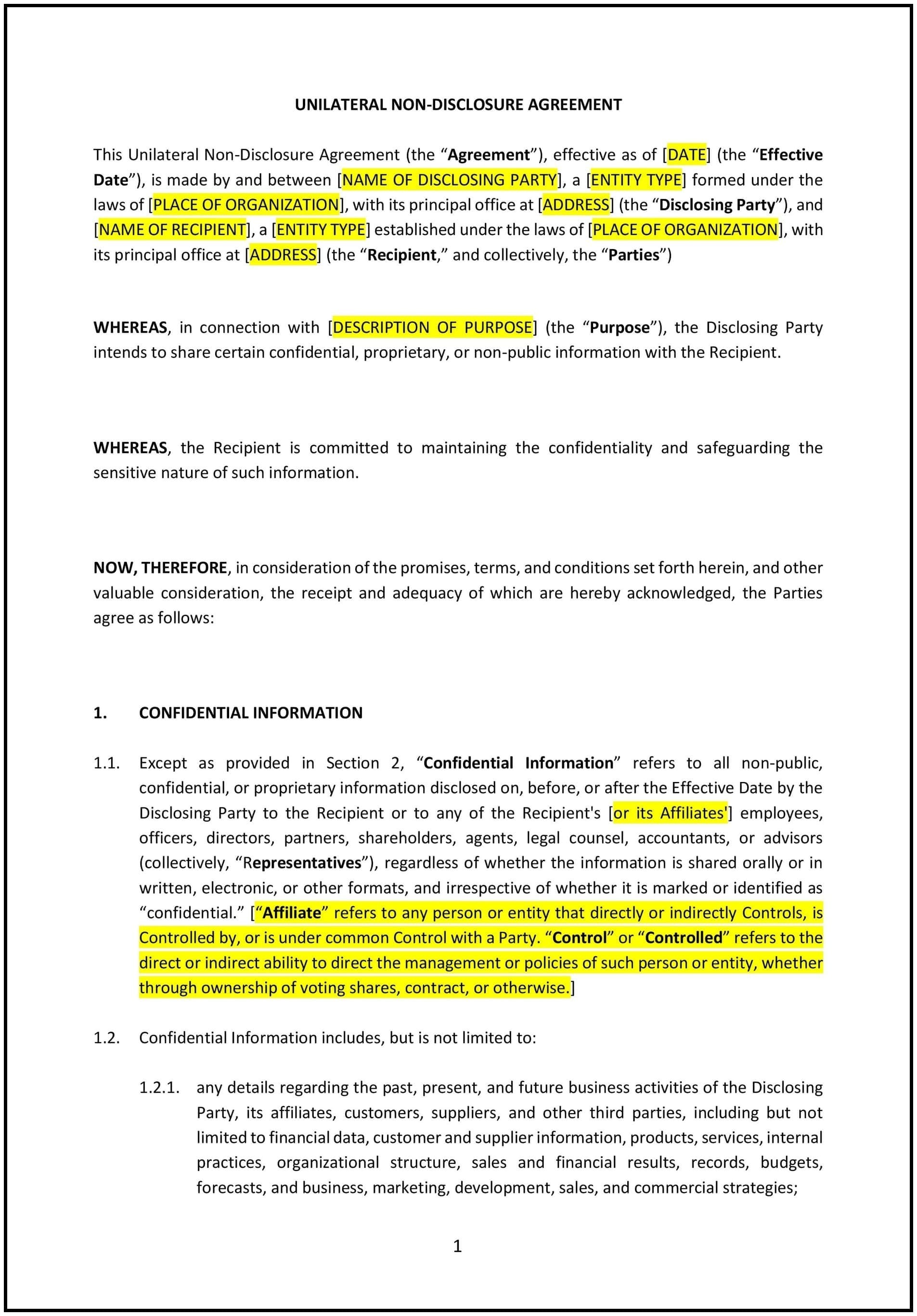
A Non-Disclosure Agreement (Unilateral) in Alabama is a contract that protects confidential information shared by one party with another. Unlike a mutual NDA, this agreement binds only the receiving party to confidentiality obligations, making it commonly used when businesses disclose sensitive information to employees, contractors, or potential investors.
Businesses in Alabama use this agreement to safeguard trade secrets, intellectual property, and proprietary business details. It helps prevent unauthorized disclosures and ensures legal recourse if confidential information is misused.
Tips for drafting and maintaining a Non-Disclosure Agreement (Unilateral) in Alabama
- Define the scope of confidential information clearly: Specify what constitutes confidential information, including examples such as trade secrets, business plans, customer lists, or technical data. For example, state that "Confidential Information includes any non-public information disclosed in writing, orally, or electronically, marked as 'Confidential' or reasonably understood to be confidential." Ensure the definition is broad enough to cover all sensitive information but specific enough to avoid ambiguity.
- Include measurable confidentiality obligations: Outline how the Receiving Party must handle the confidential information, such as requiring encryption for digital files or secure storage for physical documents. For instance, specify that "The Receiving Party must store Confidential Information in a locked file cabinet or password-protected system and limit access to authorized personnel only."
- Outline exclusions for confidentiality: Clearly state what information is not covered by the NDA, such as information already publicly available, independently developed, or disclosed under legal obligation. For example, include a clause stating, "This Agreement does not apply to information that is publicly available at the time of disclosure or becomes public through no fault of the Receiving Party."
- Address remedies for breaches: Specify the consequences if the Receiving Party violates the NDA, such as injunctive relief, monetary damages, or termination of the agreement. For instance, state that "In the event of a breach, the Disclosing Party may seek injunctive relief and recover damages incurred due to unauthorized disclosure."
- Comply with Alabama laws: Ensure the NDA adheres to Alabama’s contract laws and any applicable regulations. For example, if the confidential information pertains to healthcare, ensure compliance with HIPAA. Similarly, if the NDA involves trade secrets, align it with federal laws like the Defend Trade Secrets Act (DTSA).
- Regularly review and update: Periodically review the NDA to ensure it remains relevant and enforceable. For instance, if the nature of the collaboration changes or new types of sensitive information are shared, update the NDA to reflect these changes. Include a clause allowing amendments by mutual written consent.