Service Level Agreement (SLA) (Alaska): Free template
Got contracts to review? While you're here for contracts, let Cobrief make contract review effortless—start your free review now.
Customize this template for free
Service Level Agreement (SLA) (Alaska)
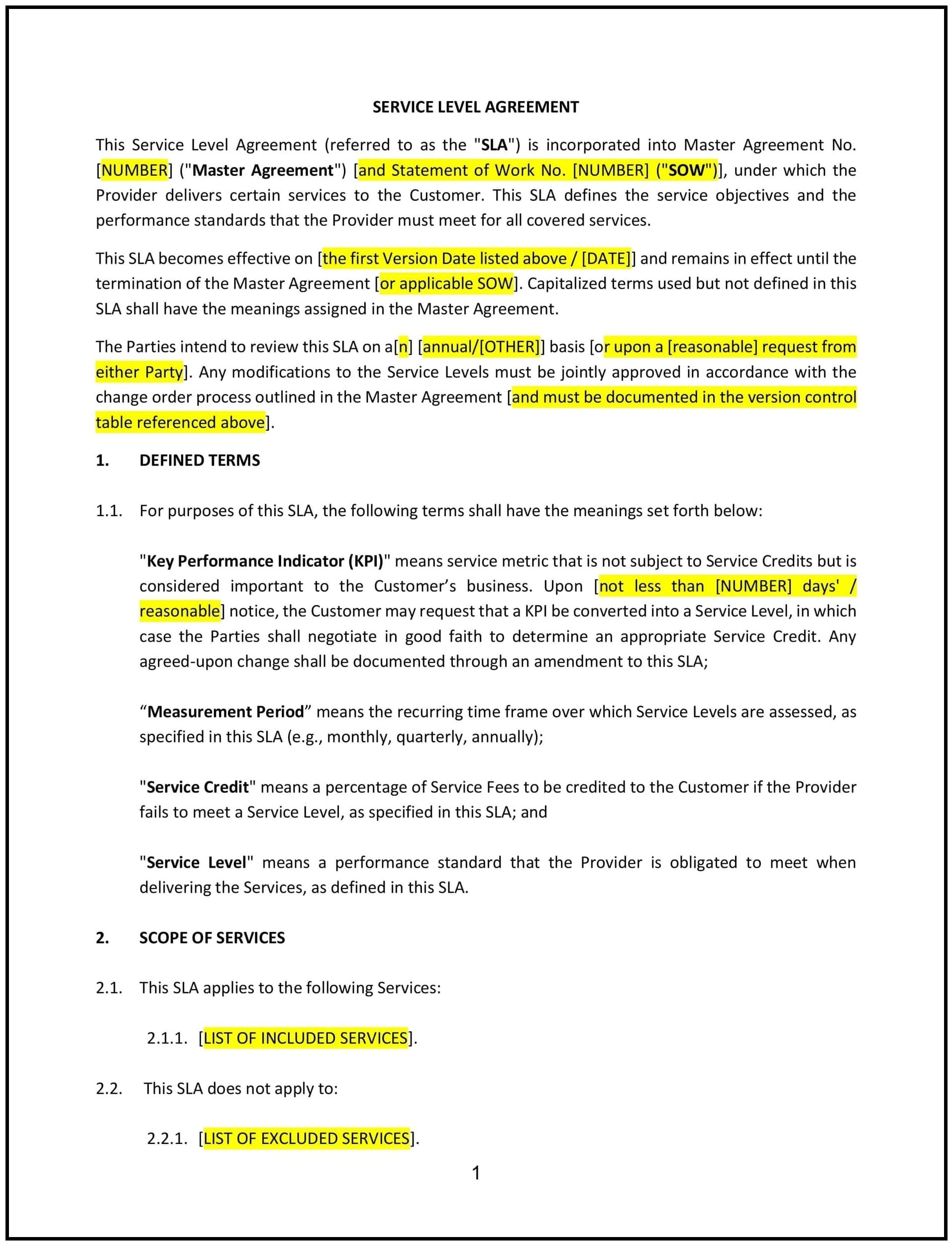
A Service Level Agreement (SLA) is a legally binding contract between a service provider and a client that outlines the expectations, deliverables, and performance standards for the services provided. In Alaska, SLAs are commonly used in industries such as telecommunications, logistics, healthcare, and IT services to ensure clear communication and accountability. This agreement establishes measurable performance metrics, outlines remedies for service disruptions, and provides mechanisms for resolving disputes.
For example, an Alaska-based telecommunications provider might use an SLA to guarantee network uptime and response times for technical support, while a logistics company might define delivery schedules and performance benchmarks for remote or rural areas. A well-drafted SLA helps businesses build trust with clients while minimizing risks associated with service interruptions or unmet expectations.
Tips for drafting and maintaining a Service Level Agreement (SLA) in Alaska
- Define service expectations clearly: Specify the services to be provided, including measurable performance standards. For instance, if offering IT support, detail response times, resolution targets, and system availability guarantees.
- Include performance metrics: Establish key performance indicators (KPIs) to evaluate service quality. For example, specify a 99.5% uptime guarantee for cloud services or a maximum 6-hour response time for critical issues in remote locations.
- Address service credits or penalties: Outline remedies for service failures, such as refunds, credits, or discounts. For example, include provisions for issuing credits if performance falls below agreed-upon thresholds.
- Strengthen alignment with Alaska regulations: Ensure the SLA complies with state-specific laws, such as consumer protection statutes or industry-specific requirements. This reinforces enforceability and protects both parties.
- Include dispute resolution mechanisms: Define how disputes will be handled, whether through mediation, arbitration, or litigation. Specify Alaska as the governing law to avoid jurisdictional conflicts.
- Regularly review and update: Periodically assess the SLA to ensure it reflects changes in service offerings or client needs. For example, if new technologies or processes are introduced, update the agreement to incorporate these changes.