Service Level Agreement (SLA) (Arkansas): Free template
Got contracts to review? While you're here for contracts, let Cobrief make contract review effortless—start your free review now.
Customize this template for free
Service Level Agreement (SLA) (Arkansas)
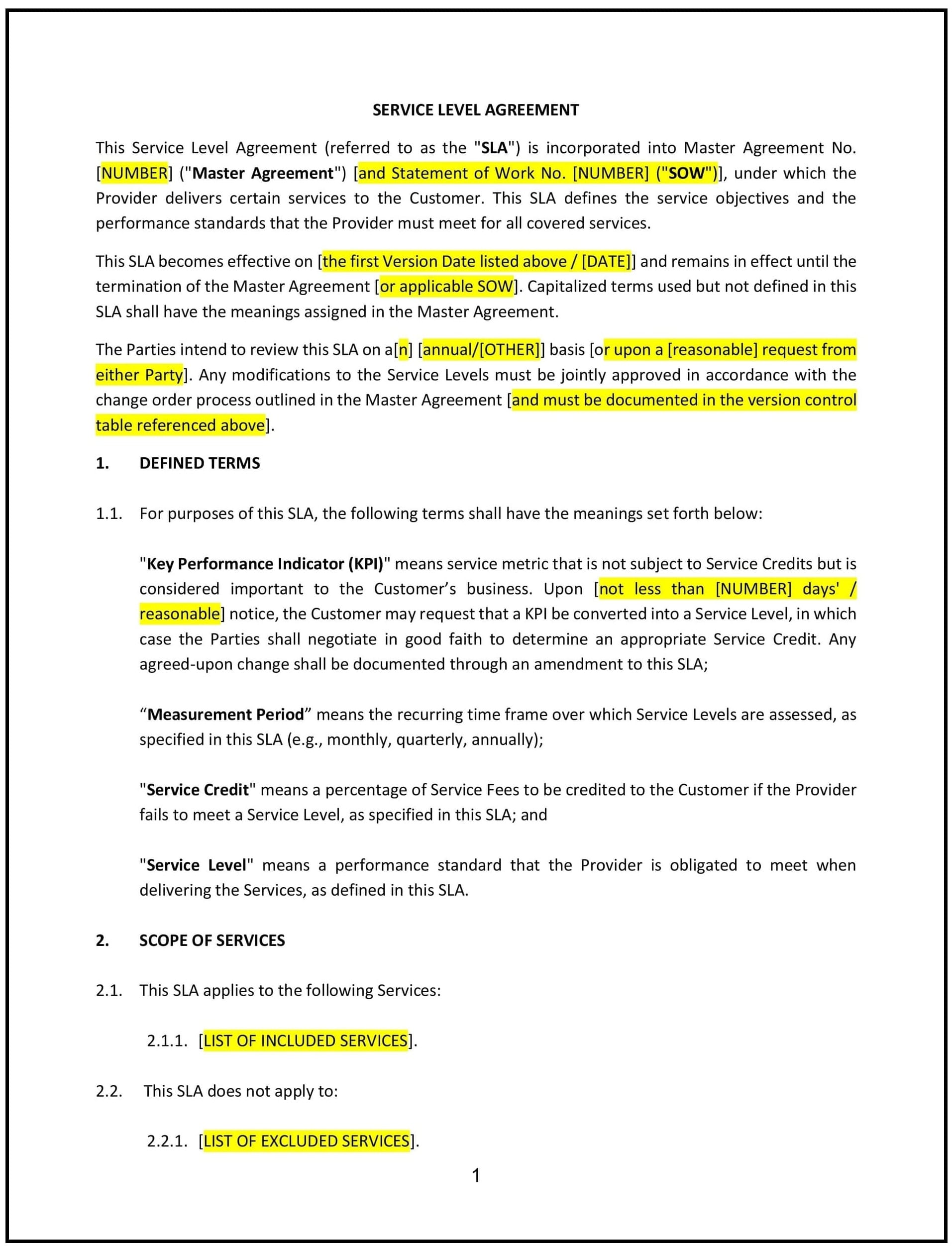
A Service Level Agreement (SLA) serves as a formal contract between a service provider and a client, detailing the scope, quality, and expectations of the services to be delivered. In Arkansas, SLAs are particularly valuable for businesses operating in sectors like healthcare, agriculture, manufacturing, and IT services, where clear performance standards and accountability are essential. This agreement not only sets measurable benchmarks for service delivery but also establishes protocols for addressing issues when those benchmarks aren’t met.
For instance, an Arkansas-based agricultural technology company might use an SLA to outline equipment maintenance schedules and response times, while a healthcare provider could define patient portal uptime guarantees and support availability. A well-crafted SLA ensures that both parties have a shared understanding of responsibilities, reducing the risk of misunderstandings or disputes.
Tips for drafting and maintaining a Service Level Agreement (SLA) in Arkansas
- Clearly outline service deliverables: Specify the exact services being provided, along with any associated performance standards. For example, if offering software support, include details like response times, resolution deadlines, and system availability targets.
- Establish measurable performance metrics: Define key performance indicators (KPIs) that will be used to evaluate service quality. For instance, specify a 99% uptime guarantee for hosted services or a 2-hour response time for urgent technical issues.
- Include remedies for service failures: Provide clear provisions for addressing service disruptions, such as credits, refunds, or discounts. For example, outline how clients will be compensated if performance falls below agreed-upon thresholds.
- Align with Arkansas legal requirements: Ensure the SLA complies with state-specific regulations, including consumer protection laws and industry-specific guidelines. This helps reinforce enforceability and protects both parties.
- Address dispute resolution: Specify how disputes will be resolved, whether through negotiation, mediation, arbitration, or litigation. Designate Arkansas as the governing jurisdiction to streamline legal processes.
- Regularly update the agreement: Periodically review the SLA to ensure it remains relevant and aligned with evolving business needs or regulatory changes. For example, if new technologies or services are introduced, update the agreement accordingly.