Got contracts to review? While you're here for contracts, let Cobrief make contract review effortless—start your free review now.
Customize this template for free
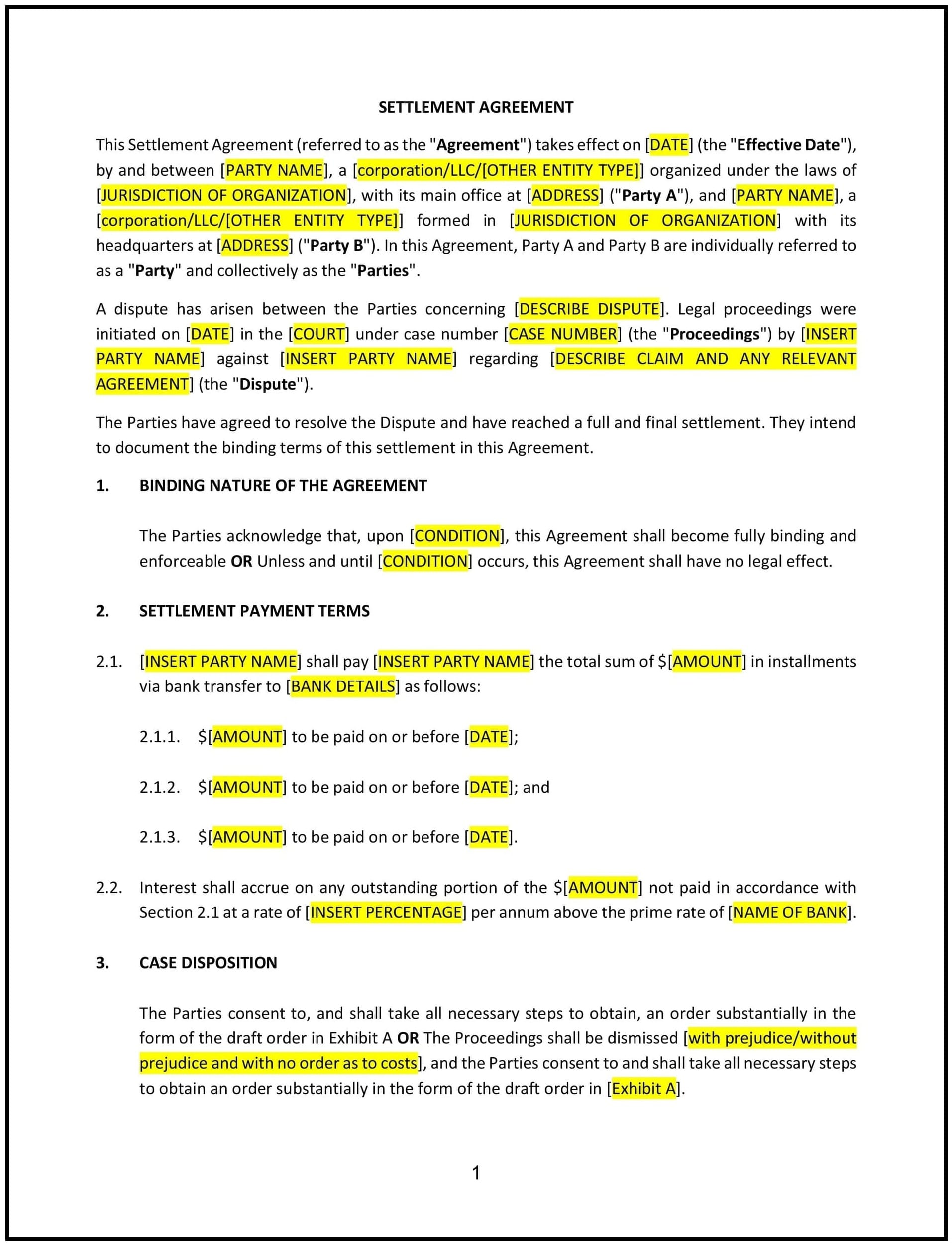
Settlement Agreement (New York)
A Settlement Agreement is a legally binding contract used to resolve disputes between two or more parties without going to trial. In New York, this type of agreement is commonly used in industries such as employment, real estate, construction, and business litigation to settle claims related to contracts, injuries, or other legal disputes.
Whether resolving a workplace dispute, ending a lawsuit, or settling a breach of contract claim, a well-drafted Settlement Agreement helps minimize risks, clarify final obligations, and provide closure for all parties involved. For example, a Manhattan-based employer might use a Settlement Agreement to resolve an employment discrimination claim, while a Queens-based contractor might settle a payment dispute with a client.
Tips for drafting and maintaining a Settlement Agreement in New York
- Clearly articulate the purpose of the settlement: Specify the nature of the dispute being resolved and the intent of the parties to settle the matter amicably.
- Example: “This Settlement Agreement resolves all claims arising from the employment dispute between Party A and Party B, including but not limited to allegations of wrongful termination.”
- Outline the terms of the settlement: Detail the financial settlements, payments, or other remedies agreed upon by the parties. Ensure these terms are clear and realistic.
- Example: “Party A agrees to pay Party B $50,000 as a full and final settlement of all claims, payable in two installments of $25,000 each.”
- Include release and waiver clauses: Specify that the parties agree to release each other from all claims related to the dispute, except as otherwise stated in the agreement.
- Example: “In consideration of the settlement payment, Party B releases Party A from any and all claims, known or unknown, arising out of the dispute.”
- Address confidentiality: Protect sensitive information by requiring parties to maintain confidentiality about the terms of the settlement.
- Example: “The terms of this Settlement Agreement shall remain confidential, and neither party shall disclose the details to any third party without prior written consent.”
- Specify governing law: Indicate that New York law will govern the agreement and specify the jurisdiction for resolving disputes. Under New York law, settlement agreements must comply with the New York Civil Practice Law and Rules (CPLR).
- Include dispute resolution mechanisms: Specify how disputes related to the settlement will be resolved, whether through negotiation, mediation, or arbitration.
- Example: “Any disputes arising under this agreement shall be resolved through arbitration in New York City, New York.”
- Keep records of the settlement: Maintain copies of the signed Settlement Agreement and any related documentation for future reference. This is especially important in case of future disputes or audits.