Software Development Agreement (California): Free template
Got contracts to review? While you're here for contracts, let Cobrief make contract review effortless—start your free review now.
Customize this template for free
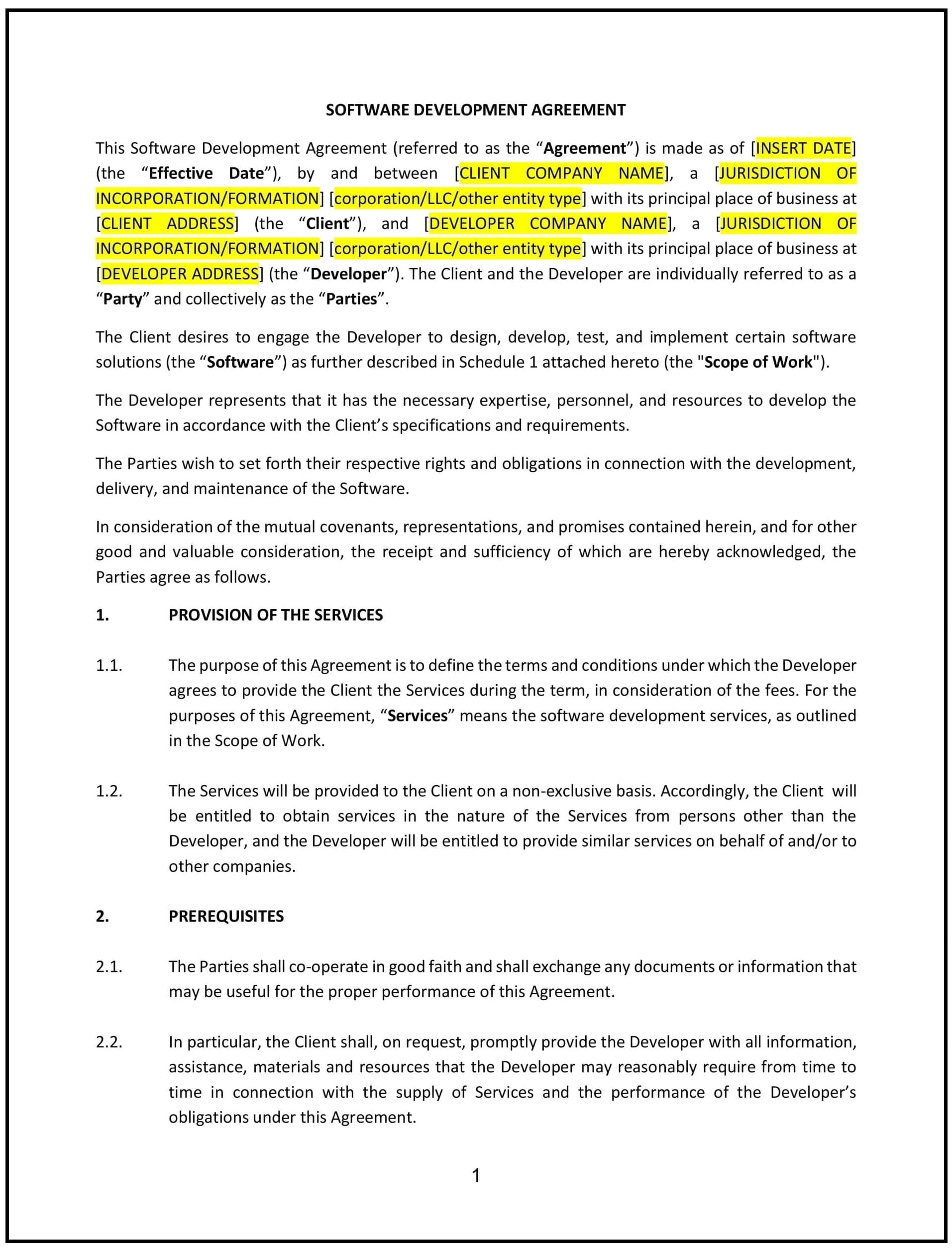
Software Development Agreement (California)
A Software Development Agreement is a legally binding contract between a client (the "Client") and a software developer or development company (the "Developer") that outlines the terms and conditions for the creation, delivery, and maintenance of custom software. In California, such agreements are guided by state contract laws, including the California Uniform Commercial Code (UCC) for transactions involving goods, and common law principles for services. It is essential for parties to establish clear agreements that address intellectual property rights, payment terms, and project milestones.
For example, a San Francisco-based startup might hire a Los Angeles software development firm to create a mobile application. A well-drafted Software Development Agreement helps clarify deliverables, timelines, and aligns with California’s legal framework.
Tips for drafting and maintaining a Software Development Agreement in California
- Define the scope of work: Clearly outline the software to be developed, including features, functionalities, and technical specifications. Include milestones and deadlines to track progress.
- Example: “The Developer agrees to design and develop a mobile application with features including user authentication, payment processing, and push notifications, to be delivered in three phases over six months.”
- Address intellectual property rights: Specify who will own the intellectual property (IP) for the software. Typically, the Client retains ownership, while the Developer may retain rights to pre-existing code or tools used in the project.
- Example: “Upon full payment, the Client will own all intellectual property rights to the custom software. The Developer retains ownership of any pre-existing code or tools incorporated into the project.”
- Establish payment terms: Detail the payment structure, whether fixed-price, hourly, or milestone-based. Include invoicing procedures, due dates, and penalties for late payments.
- Example: “The Client agrees to pay the Developer 50,000,with50,000,with10,000 due upon signing, 20,000uponcompletionofPhase1,andtheremaining20,000uponcompletionofPhase1,andtheremaining20,000 upon final delivery.”
- Include acceptance testing provisions: Define how the Client will test and accept the software. Specify criteria for acceptance and procedures for addressing defects or issues.
- Example: “The Client will have 14 days to test the software after delivery. If defects are found, the Developer will have 30 days to resolve them at no additional cost.”
- Set confidentiality obligations: Include a confidentiality clause to protect sensitive information shared during the project, such as trade secrets or proprietary data.
- Example: “Both parties agree to keep all confidential information disclosed during the project confidential for a period of three years after the agreement’s termination.”
- Outline maintenance and support: Specify whether the Developer will provide ongoing maintenance, updates, or technical support after delivery, and include associated costs.
- Example: “The Developer will provide bug fixes and updates for six months post-delivery at no additional cost. Additional support will be billed at $100 per hour.”
- Align with California-specific laws: Ensure the agreement reflects California’s contract laws, including the California UCC for transactions involving goods, and consider any state-specific consumer protection or data privacy regulations, such as the California Consumer Privacy Act (CCPA).
- Example: “This agreement shall be governed by and construed in accordance with the laws of the State of California. Both parties agree to comply with all applicable state and federal laws, including the California Consumer Privacy Act.”