Got contracts to review? While you're here for policies, let Cobrief make contract review effortless—start your free review now.
Customize this template for free
Contract review policy (Missouri)
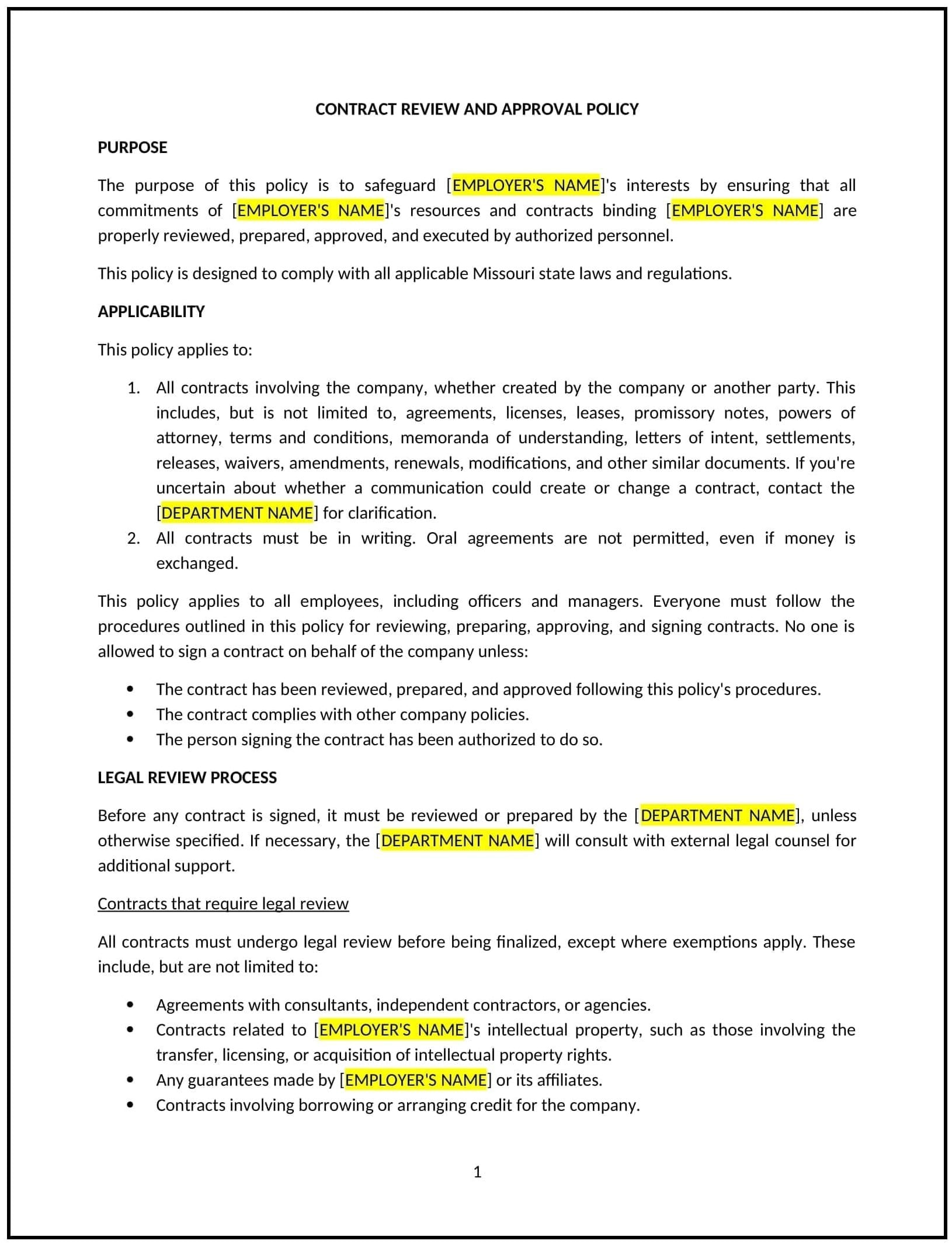
A contract review policy helps businesses in Missouri establish a consistent and thorough process for reviewing contracts before signing or executing them. This policy outlines the steps for evaluating the terms, conditions, and potential risks associated with contracts. It is designed to minimize legal risks, protect business interests, and ensure all contracts align with company goals and regulatory requirements.
By adopting this policy, businesses in Missouri can improve contract management, reduce disputes, and ensure clarity in all agreements.
How to use this contract review policy (Missouri)
- Define the review process: Specify the steps involved in reviewing contracts, such as initial drafts, internal review, legal review, and final approval.
- Set roles and responsibilities: Outline who is responsible for reviewing contracts at different stages, including legal teams, managers, or other relevant stakeholders.
- Identify contract types: Define the types of contracts that require formal review, such as vendor agreements, employment contracts, non-disclosure agreements, and client contracts.
- Clarify timelines: Establish timelines for completing contract reviews, ensuring timely responses and minimizing delays in contract execution.
- Address key terms: Ensure the review process focuses on key contract terms such as payment terms, liabilities, dispute resolution, termination clauses, and intellectual property rights.
- Include risk assessment: Incorporate a process for identifying and evaluating potential risks associated with the contract, including financial, legal, and operational risks.
- Review and update the policy: Periodically assess the policy to ensure it reflects any changes in Missouri law, business practices, or the company’s needs.
Benefits of using this contract review policy (Missouri)
This policy provides several benefits for businesses in Missouri:
- Minimizes legal risks: By ensuring that all contracts are thoroughly reviewed, businesses can identify potential legal issues before they arise, reducing the risk of disputes or litigation.
- Improves contract clarity: A structured review process ensures that all parties clearly understand the terms of the agreement, which can help prevent misunderstandings and disagreements.
- Enhances efficiency: A clear contract review process helps businesses move contracts through the approval process more quickly and efficiently, reducing delays in operations.
- Protects business interests: The policy helps safeguard the company’s interests by ensuring that all contracts are aligned with business goals and do not expose the company to undue risks.
- Promotes consistency: Establishing a consistent review process ensures that all contracts are evaluated using the same criteria, promoting fairness and consistency across the business.
- Aligns with Missouri business practices: This policy reflects Missouri’s emphasis on business transparency, fairness, and legal integrity.
Tips for using this contract review policy (Missouri)
- Communicate the policy clearly: Ensure that all employees involved in contract management are aware of the policy and understand their role in the review process.
- Use standard templates: Consider using standard contract templates to streamline the review process and reduce the time needed for negotiations.
- Set up a checklist: Develop a checklist to help the review team assess key terms and potential risks in contracts.
- Ensure timely reviews: Set clear expectations for review timelines to avoid delays in contract execution and maintain business efficiency.
- Involve relevant stakeholders: Ensure that key departments (e.g., legal, finance, operations) are involved in the review process to provide diverse perspectives and minimize oversight.
- Regularly review the policy: Periodically update the policy to reflect changes in Missouri law, business practices, or the company’s evolving needs.