Disability accommodations policy (Indiana): Free template
Got contracts to review? While you're here for policies, let Cobrief make contract review effortless—start your free review now.
Customize this template for free
Disability accommodations policy (Indiana): Free template
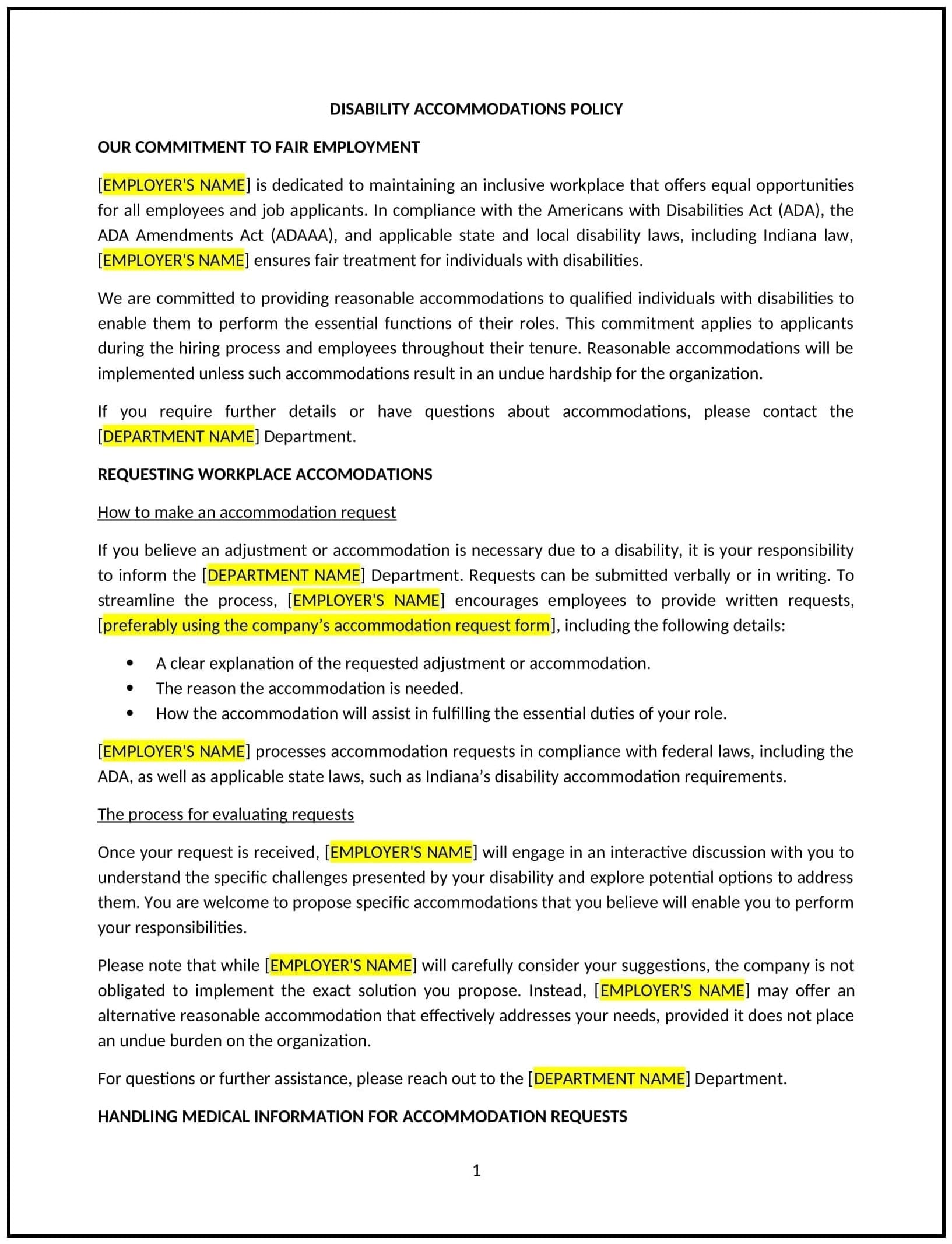
The disability accommodations policy helps Indiana businesses comply with the Americans with Disabilities Act (ADA) and other relevant state laws by providing clear guidelines for offering accommodations to employees with disabilities. This policy outlines how employees can request accommodations, the process for evaluating those requests, and the steps the business will take to ensure a supportive and accessible work environment. By using this template, businesses can foster an inclusive workplace, enhance employee satisfaction, and minimize the risk of legal challenges related to disability discrimination.
By implementing this policy, Indiana businesses can ensure that employees with disabilities have the necessary support to perform their jobs, promoting equal opportunities and a more diverse workforce.
How to use this disability accommodations policy (Indiana)
- Define disability and accommodation: Clearly define what constitutes a disability under the ADA and applicable state laws. Provide examples of reasonable accommodations, such as modifications to the work environment, adjustments to work schedules, or assistive technology.
- Outline the accommodation request process: Specify how employees can request accommodations, including who they should contact (e.g., HR, direct supervisor) and the format of the request (e.g., written, verbal). The policy should ensure that the process is straightforward and non-discriminatory.
- Evaluate requests for accommodations: Describe how accommodation requests will be reviewed and evaluated. This may include gathering medical documentation, assessing the impact of the accommodation on the business, and determining if the requested accommodation is reasonable and effective.
- Address the interactive process: Emphasize the importance of the interactive process, where employers and employees engage in a dialogue to identify and implement appropriate accommodations. The policy should highlight the need for collaboration and flexibility in finding solutions.
- Set timelines for decision-making: Specify how long the process of evaluating accommodation requests will take, and set expectations for timely responses. This ensures that accommodations are provided promptly without unnecessary delays.
- Maintain confidentiality: Clearly state that all medical information provided during the accommodation process will be kept confidential and used only to assess the employee’s needs. The policy should outline how medical records will be handled and protected.
- Address potential accommodation denials: Provide guidance on how to handle situations where a requested accommodation cannot be granted. This may include offering alternative accommodations or explaining the reasons for the denial, such as undue hardship on the business.
- Comply with legal requirements: Ensure the policy aligns with the ADA, the Rehabilitation Act of 1973, and other relevant state laws. This may include specific provisions for certain types of disabilities or accommodations.
Benefits of using this disability accommodations policy (Indiana)
Implementing this policy provides several key benefits for Indiana businesses:
- Promotes an inclusive workplace: Offering accommodations to employees with disabilities helps create a diverse and inclusive work environment, where all employees have equal opportunities to succeed.
- Reduces legal risks: By adhering to the ADA and other applicable laws, businesses reduce the risk of discrimination claims and legal penalties related to failure to provide reasonable accommodations.
- Increases employee retention: Providing the necessary support for employees with disabilities helps improve job satisfaction and retention, reducing turnover and fostering a more loyal workforce.
- Enhances productivity: Accommodations that enable employees with disabilities to perform their job functions more effectively can lead to higher productivity and better overall performance.
- Improves company reputation: Businesses that prioritize accessibility and inclusion often enjoy a positive reputation both within the community and in the marketplace, attracting top talent and customers who value diversity and fairness.
- Promotes equal opportunities: The policy ensures that employees with disabilities have the same opportunities for career advancement and job performance as their non-disabled peers.
Tips for using this disability accommodations policy (Indiana)
- Communicate the policy effectively: Ensure that all employees are aware of the disability accommodations policy and understand how to request accommodations. Include the policy in the employee handbook, during onboarding, and on the company intranet.
- Provide training to managers and HR: Train managers and HR staff on how to handle accommodation requests and the interactive process. Ensure that they understand the importance of compliance with disability laws and how to engage employees in finding effective accommodations.
- Create a clear and accessible request process: Make sure that the accommodation request process is straightforward, accessible, and free from barriers. Ensure that employees feel comfortable requesting accommodations and that the process is transparent.
- Monitor and track accommodation requests: Keep track of accommodation requests and resolutions to identify any recurring issues or gaps in support. Regularly review the accommodations provided to ensure they remain effective.
- Review and update the policy regularly: Periodically review the disability accommodations policy to ensure it is up-to-date with any changes in federal, state, or local laws, as well as the company’s operations or workforce needs.