Got contracts to review? While you're here for policies, let Cobrief make contract review effortless—start your free review now.
Customize this template for free
Document retention policy (Florida)
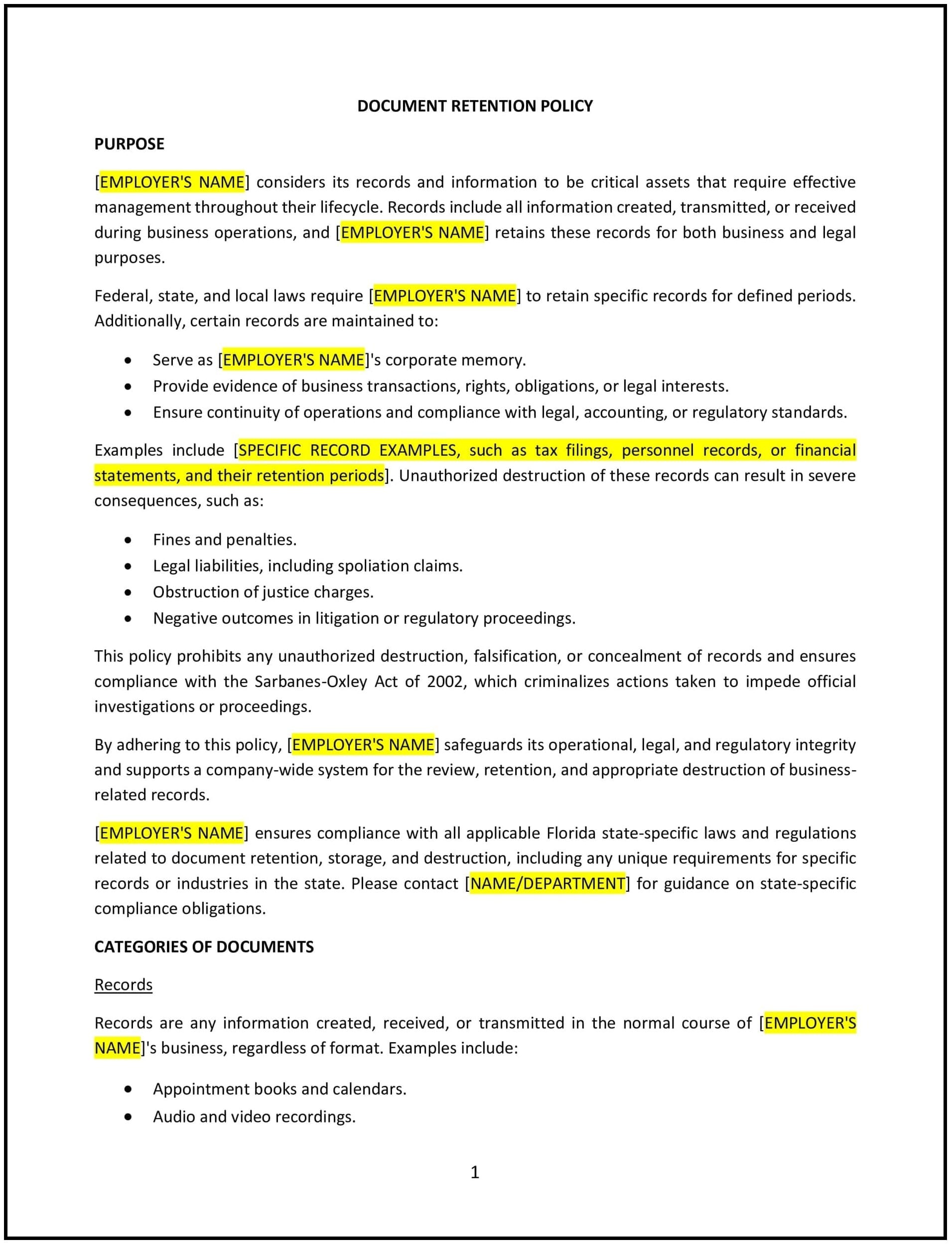
A document retention policy helps Florida businesses manage the storage, retention, and disposal of documents in compliance with applicable laws and regulations. This policy outlines how long various types of documents should be kept, the methods for storing them, and the procedures for securely disposing of them when they are no longer needed. The policy also addresses electronic documents, ensuring that both physical and digital records are handled appropriately.
By implementing this policy, businesses can protect sensitive information, ensure compliance with legal and regulatory requirements, and reduce the risk of retaining unnecessary or outdated documents that could pose a security risk or violate privacy laws.
How to use this document retention policy (Florida)
- Define document categories: Clearly define the types of documents that the policy covers, such as financial records, employee files, contracts, emails, intellectual property, and legal documents. The policy should specify which documents are subject to retention and which can be discarded after use.
- Establish retention periods: Specify how long each category of document should be retained, based on legal or regulatory requirements and business needs. For example, tax records might need to be kept for seven years, while employee performance reviews might only need to be kept for five years.
- Outline storage methods: Specify how documents should be stored, including whether they should be kept in physical or digital form, and if digital records are used, what security measures should be in place, such as encryption, password protection, and backup procedures.
- Set procedures for document disposal: Establish secure methods for disposing of documents once their retention period has expired. This may include shredding paper documents or securely deleting digital files to prevent unauthorized access.
- Provide guidelines for special documents: Identify documents that require special handling, such as confidential, sensitive, or privileged information. These documents should be stored and disposed of following more stringent security measures.
- Ensure legal compliance: Ensure the policy is compliant with relevant Florida state laws, federal regulations (e.g., the Sarbanes-Oxley Act, HIPAA), and industry-specific standards regarding data retention and disposal. This may include specifying how long certain records must be retained to comply with legal, financial, or tax reporting requirements.
- Designate responsibility: Assign responsibility for managing and enforcing the policy to specific personnel or departments, such as the legal team, HR, or IT department. Ensure these teams are trained on the policy and its implementation.
Benefits of using this document retention policy (Florida)
This policy offers several benefits for Florida businesses:
- Ensures legal compliance: By following the retention requirements set forth by applicable laws and regulations, businesses can avoid legal penalties, audits, or disputes related to improper document management.
- Reduces risk of data breaches: Securely disposing of outdated or unnecessary documents minimizes the risk of data breaches or unauthorized access to sensitive information.
- Enhances organizational efficiency: The policy helps businesses keep their document management systems organized, reducing clutter and ensuring that important documents are easily accessible when needed.
- Protects sensitive information: Proper retention and disposal procedures ensure that confidential or sensitive information is handled securely, minimizing the risk of unauthorized access.
- Improves business continuity: By maintaining proper records and ensuring they are safely stored, businesses can improve their continuity planning and be better prepared for audits, legal challenges, or regulatory inquiries.
Tips for using this document retention policy (Florida)
- Communicate the policy clearly: Ensure that all employees understand the document retention policy, including the types of documents covered, the retention periods, and the procedures for storage and disposal.
- Provide training: Offer training to relevant employees, such as those in HR, legal, and IT, on the policy and how to properly handle documents in accordance with the guidelines.
- Monitor compliance: Regularly monitor document management practices to ensure that employees are adhering to the policy, and review documents periodically to ensure they are being retained or disposed of according to the policy.
- Implement technology: Consider implementing a document management system to automate retention schedules, improve document access, and ensure secure storage and disposal of documents.
- Review periodically: Review and update the policy regularly to ensure it remains aligned with Florida laws, federal regulations, and any changes in business practices.