External communications policy (Mississippi): Free template
Got contracts to review? While you're here for policies, let Cobrief make contract review effortless—start your free review now.
Customize this template for free
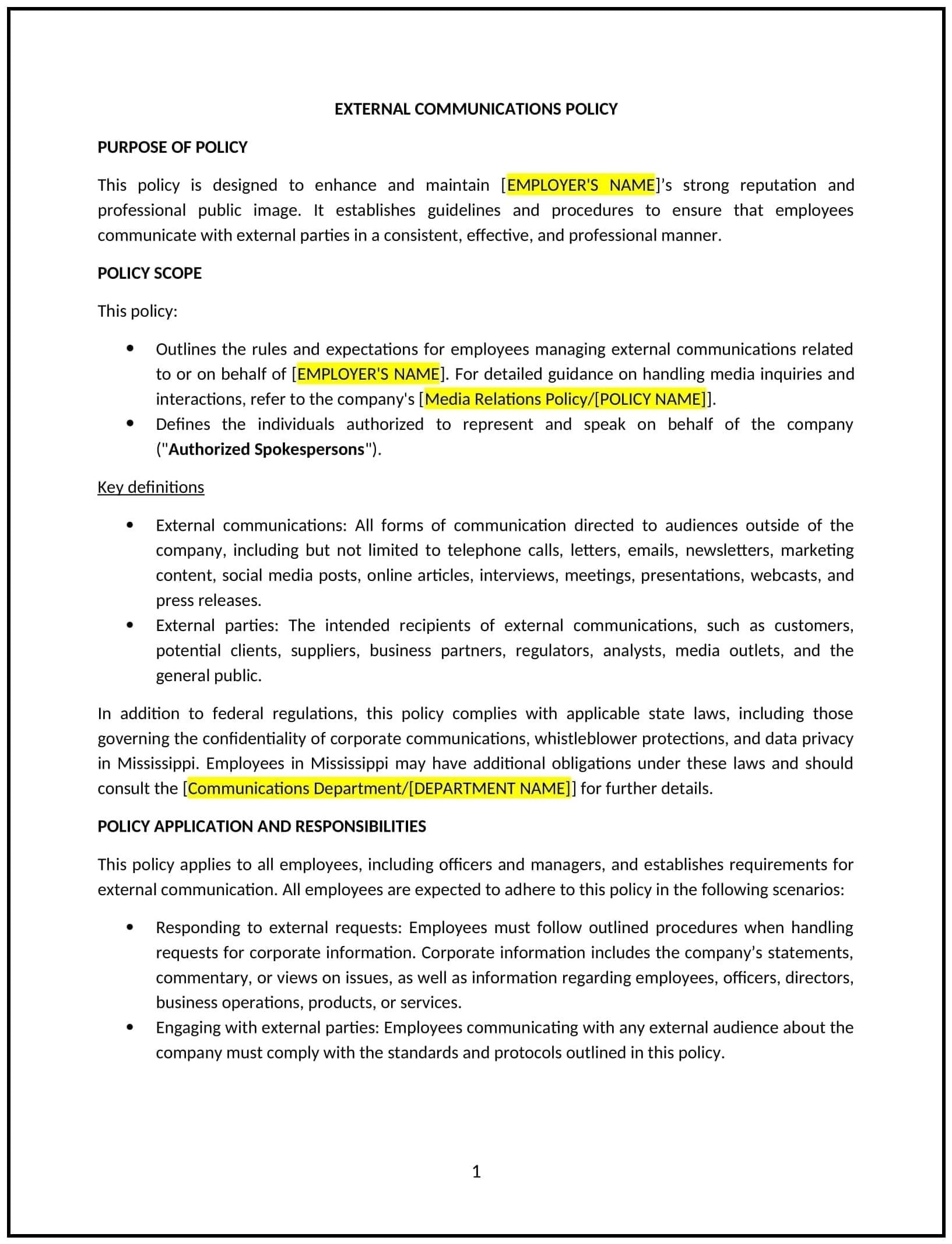
External communications policy (Mississippi)
An external communications policy helps Mississippi businesses manage and control communications with the public, media, and external stakeholders. This policy establishes guidelines for how employees and representatives should handle public-facing communications to ensure consistency, protect the company’s reputation, and maintain legal and ethical standards. It also outlines how to respond to media inquiries and social media interactions.
By adopting this policy, businesses can present a unified voice, reduce the risk of misinformation, and ensure that external communications align with the organization’s values and objectives.
How to use this external communications policy (Mississippi)
- Define the scope of external communications: Clearly outline what types of communications are covered by the policy, such as media relations, public statements, social media posts, and client or customer communications.
- Designate spokespersons: Identify specific individuals or departments responsible for managing external communications, including media relations, public relations, and crisis communications.
- Establish approval processes: Specify that all public-facing communications must be reviewed and approved by designated individuals or teams before being released. This ensures that messages align with company goals and messaging standards.
- Set guidelines for media inquiries: Outline the procedure for responding to media inquiries, including who is authorized to speak on behalf of the company and what information can be shared.
- Provide social media guidelines: Set clear rules for employees about using social media in a professional capacity, ensuring that personal posts do not reflect negatively on the company. Provide examples of appropriate and inappropriate social media behavior.
- Protect confidential information: Emphasize that employees must not disclose confidential or proprietary information when communicating with external parties, including clients, vendors, or the media.
- Define crisis communication protocols: Establish procedures for handling communications during a crisis, including who should be involved in crafting messages, how to inform employees and external parties, and how to monitor and respond to public reactions.
- Ensure consistent messaging: Encourage all external communications to reflect the company’s values, mission, and vision to maintain a consistent brand voice and messaging.
- Review and update the policy: Regularly review and update the policy to account for changes in company structure, technology, or communication channels.
Benefits of using this external communications policy (Mississippi)
This policy provides several benefits for Mississippi businesses:
- Protects company reputation: Clear guidelines for external communications help prevent misinformation, rumors, or inconsistent messaging that could harm the company’s public image.
- Ensures consistency: By aligning all public communications with company goals, businesses can present a unified, professional voice across all platforms.
- Reduces legal risks: Establishing boundaries on what can be communicated externally helps minimize the risk of disclosing confidential or proprietary information that could result in legal consequences.
- Improves crisis management: A structured communication protocol helps businesses manage public relations during a crisis, ensuring that information is communicated swiftly and clearly.
- Enhances brand trust: Consistent and transparent external communications foster trust with customers, clients, and stakeholders, ultimately strengthening the company’s brand reputation.
Tips for using this external communications policy (Mississippi)
- Communicate the policy to all employees: Ensure that all employees, especially those in customer-facing or public relations roles, are familiar with the policy and understand its importance.
- Train employees on media relations: Provide training on how to handle media inquiries, including how to respond to journalists, what information to share, and when to refer inquiries to the designated spokesperson.
- Set clear social media boundaries: Employees should be aware of the company’s expectations regarding social media use, both professionally and personally, to avoid unintentional public statements that may conflict with the company’s values.
- Implement a review and approval process: Ensure that all significant external communications are reviewed and approved by the appropriate team members before being sent out, ensuring the consistency and accuracy of the message.
- Monitor media coverage: Regularly track media coverage and social media discussions to address any miscommunications, correct inaccuracies, or respond to public inquiries.