Got contracts to review? While you're here for policies, let Cobrief make contract review effortless—start your free review now.
Customize this template for free
Moonlighting policy (Alaska)
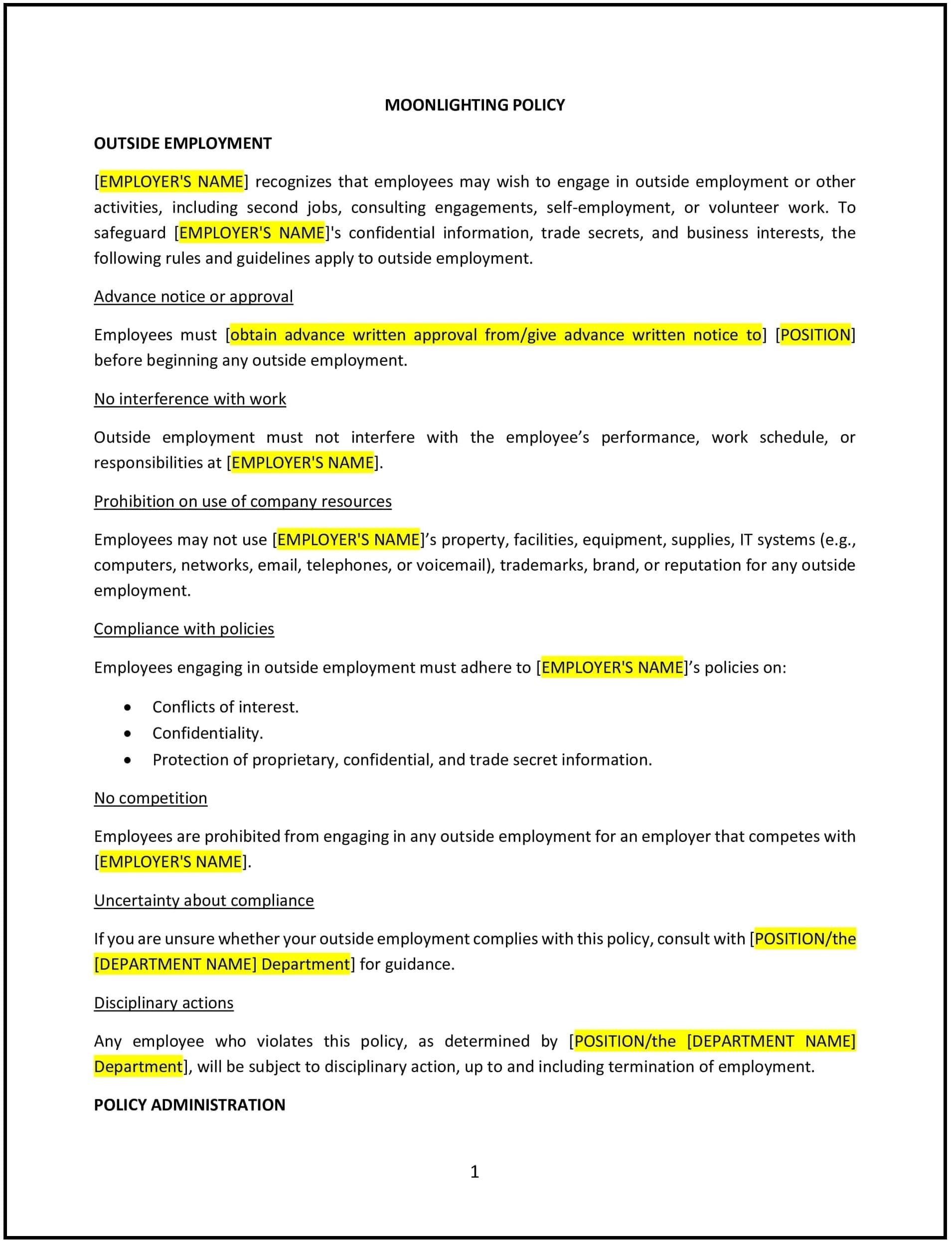
In Alaska, a moonlighting policy provides guidelines for employees who engage in secondary employment or personal business activities outside their primary job. This policy ensures that external work does not conflict with an employee’s duties, compromise company interests, or violate confidentiality agreements. By implementing a moonlighting policy, businesses can address potential conflicts of interest and maintain productivity while supporting employees’ ability to pursue additional work.
Given Alaska’s unique workforce dynamics, such as seasonal employment and remote work opportunities, businesses may tailor the policy to address local considerations.
How to use this moonlighting policy (Alaska)
- Define acceptable external work: Clearly outline the types of secondary employment or activities that are permissible, such as freelance work, consulting, or part-time roles, provided they do not interfere with the employee’s primary job.
- Address conflicts of interest: Include specific examples of conflicts, such as working for competitors or using company resources for personal business activities.
- Establish disclosure requirements: Require employees to disclose secondary employment to HR or management for review and approval.
- Protect confidentiality: Emphasize the importance of safeguarding company information and prohibiting its use for external work.
- Outline consequences: Specify the actions that may be taken if an employee violates the policy, such as disciplinary measures or termination.
Benefits of using a moonlighting policy (Alaska)
A moonlighting policy provides several advantages for businesses in Alaska. Here’s how it helps:
- Prevents conflicts of interest: Reduces the risk of employees engaging in activities that compete with or harm the company’s interests.
- Protects productivity: Ensures that external work does not interfere with employees’ performance in their primary roles.
- Safeguards company resources: Prohibits the misuse of company time, tools, or information for personal business activities.
- Supports transparency: Encourages open communication about external work, fostering trust between employees and management.
- Provides clarity: Establishes clear expectations for employees, minimizing misunderstandings or disputes related to secondary employment.
Tips for using a moonlighting policy (Alaska)
- Tailor to local industries: Address specific challenges in Alaska, such as seasonal or industry-specific secondary work, to ensure the policy is practical and relevant.
- Promote transparency: Create a culture where employees feel comfortable disclosing secondary employment without fear of retaliation.
- Monitor compliance: Regularly review disclosures and investigate potential conflicts of interest to ensure adherence to the policy.
- Address remote work concerns: Include provisions for employees working remotely to prevent the misuse of company resources or time.
- Update regularly: Revise the policy to reflect changes in company priorities, workforce dynamics, or legal requirements.