Got contracts to review? While you're here for policies, let Cobrief make contract review effortless—start your free review now.
Customize this template for free
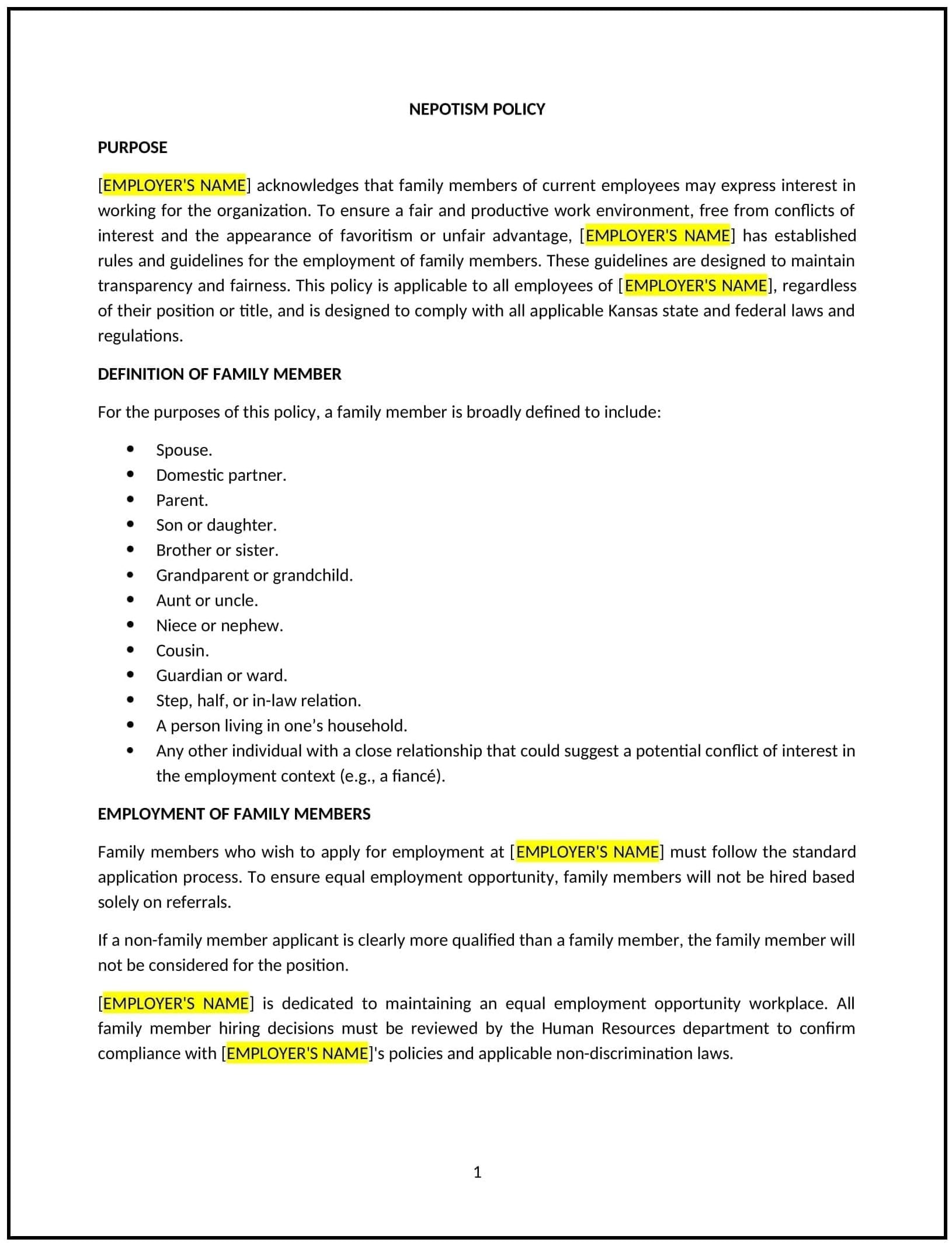
Nepotism policy (Kansas)
A nepotism policy helps Kansas businesses establish clear guidelines for hiring, promoting, and managing employees who are related to other employees within the organization. This policy aims to prevent conflicts of interest, favoritism, and any potential negative impact on the workplace culture or business operations when family members or relatives are involved in the hiring process.
By implementing this policy, businesses can maintain fairness and transparency in their hiring practices, protect against potential bias, and create a more professional work environment.
How to use this nepotism policy (Kansas)
- Define family relationships: Businesses should clearly define what constitutes a family member or relative under the policy, including spouses, siblings, parents, children, and other close relationships.
- Outline hiring restrictions: Businesses should specify whether family members are allowed to be hired for positions within the same department, or if they can hold positions where one relative directly supervises the other.
- Set promotion guidelines: Businesses should establish clear guidelines for promotions and ensure that relatives are not unfairly advantaged or disadvantaged during the promotion process.
- Address conflict of interest: Businesses should identify potential conflicts of interest and take steps to mitigate them, such as requiring employees to disclose familial relationships if they are involved in hiring or supervisory decisions.
- Provide exceptions for certain roles: In some cases, businesses may choose to make exceptions for certain roles, such as non-supervisory positions or specific circumstances where a relative’s experience or skills are particularly valuable.
- Maintain transparency: Businesses should establish a process for disclosing familial relationships during the hiring or promotion process to ensure transparency and fairness.
- Review and update regularly: Businesses should review the policy periodically to ensure it reflects current best practices, legal requirements, and the company’s evolving needs.
Benefits of using a nepotism policy (Kansas)
- Promotes fairness and equality: A clear nepotism policy helps ensure that hiring and promotion decisions are based on qualifications and merit, rather than familial connections.
- Reduces conflicts of interest: By addressing potential conflicts early, businesses can reduce the risk of favoritism and bias in decision-making.
- Protects company culture: A well-defined nepotism policy helps maintain a professional workplace environment and minimizes the impact of personal relationships on business operations.
- Increases employee trust: Transparency in hiring and promotion processes leads to higher levels of trust among employees, as they can see that decisions are made fairly and equitably.
- Strengthens legal protection: A written nepotism policy helps businesses avoid potential legal issues related to discrimination, bias, or unfair treatment of employees.
- Enhances workplace morale: Employees are more likely to feel valued and engaged in a workplace where nepotism is managed fairly and where all employees have equal opportunities for advancement.
Tips for using this nepotism policy (Kansas)
- Communicate the policy clearly: Businesses should ensure that all employees understand the nepotism policy and the guidelines for hiring, promotions, and workplace relationships.
- Disclose familial relationships: Employees should be required to disclose any familial relationships to HR or management during the hiring or promotion process to ensure transparency.
- Implement a fair review process: Businesses should implement a structured, unbiased review process for all hiring and promotion decisions, ensuring that relatives do not influence the outcome.
- Encourage open communication: Employees should feel comfortable discussing concerns about potential nepotism or conflicts of interest with HR or management without fear of retaliation.
- Review the policy regularly: Businesses should periodically review the policy to ensure it is up-to-date and relevant to the current organizational structure and business needs.
- Offer training: Managers and HR personnel should receive training on how to recognize and avoid nepotism, ensuring fair treatment for all employees.