Got contracts to review? While you're here for policies, let Cobrief make contract review effortless—start your free review now.
Customize this template for free
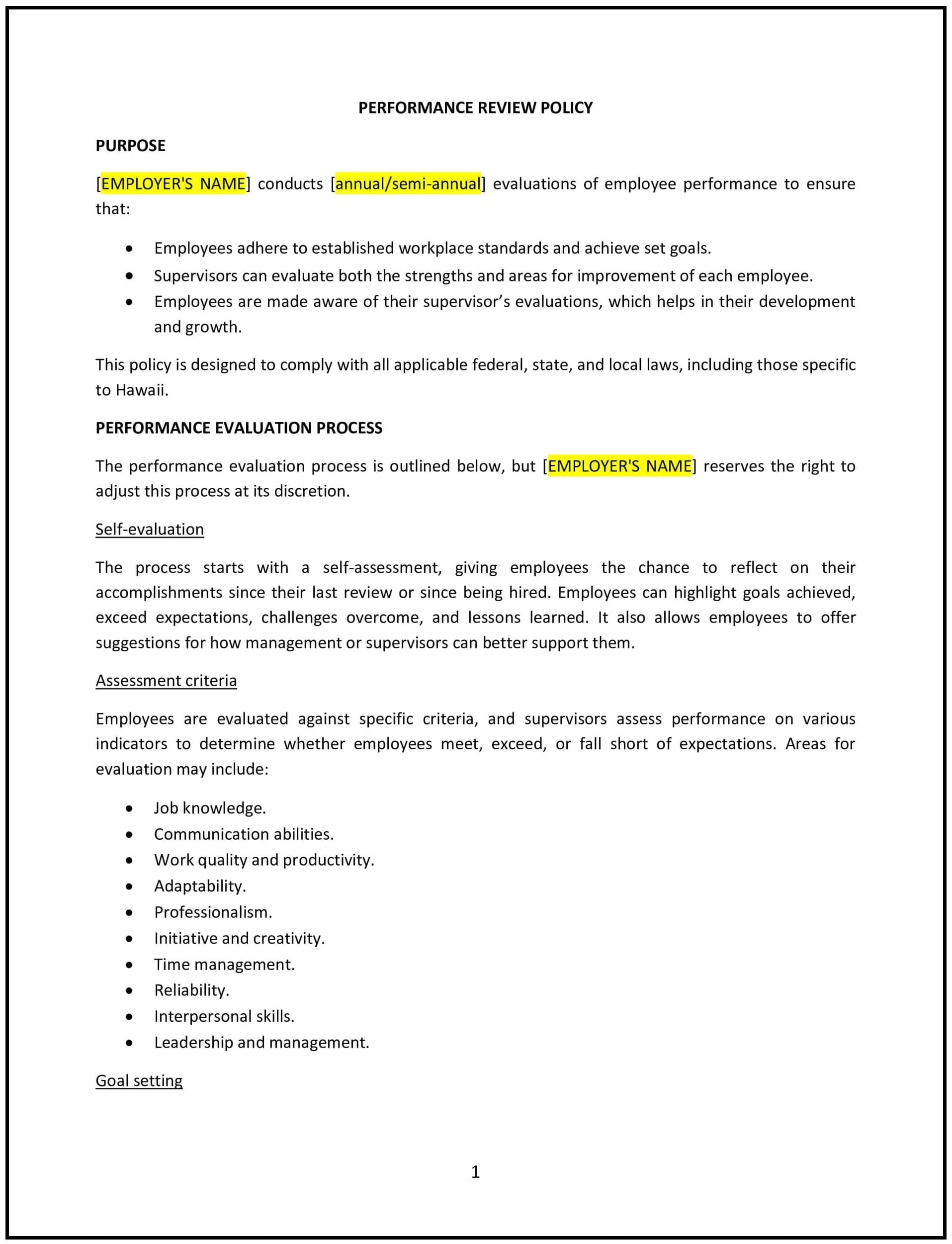
Performance review policy (Hawaiʻi)
A performance review policy helps Hawaiʻi businesses establish guidelines for evaluating employee performance, providing feedback, and setting goals for improvement. This policy outlines procedures for conducting regular performance reviews, addressing Hawaiʻi’s unique cultural and workplace dynamics. It is designed to promote employee growth, enhance productivity, and foster a culture of continuous improvement.
By implementing this policy, businesses in Hawaiʻi can improve employee engagement, identify training needs, and align individual performance with organizational goals.
How to use this performance review policy (Hawaiʻi)
- Define review frequency: Specify how often performance reviews will be conducted, such as annually, semi-annually, or quarterly.
- Establish evaluation criteria: Provide clear performance metrics and goals, such as job responsibilities, key performance indicators (KPIs), or behavioral competencies.
- Create review procedures: Outline steps for conducting performance reviews, including self-assessments, manager evaluations, and one-on-one feedback sessions.
- Address feedback delivery: Provide guidelines for delivering constructive feedback, focusing on strengths, areas for improvement, and actionable goals.
- Set development plans: Encourage managers and employees to collaborate on creating individual development plans (IDPs) to support growth and career progression.
- Communicate the policy: Share the policy with employees during onboarding and through internal communications to ensure awareness and understanding.
- Train managers: Educate supervisors on how to conduct effective performance reviews, deliver feedback, and create development plans.
- Monitor compliance: Regularly review the performance review process to ensure adherence to the policy and address any issues promptly.
- Review and update the policy: Regularly assess the policy’s effectiveness and make adjustments as needed to reflect changes in business needs or workplace dynamics.
Benefits of using this performance review policy (Hawaiʻi)
This policy offers several advantages for Hawaiʻi businesses:
- Improves employee performance: Regular feedback and goal-setting help employees understand expectations and improve their performance.
- Enhances engagement: A structured review process fosters open communication and demonstrates the business’s commitment to employee development.
- Identifies training needs: Performance reviews highlight areas where employees may benefit from additional training or resources.
- Aligns individual and organizational goals: Clear performance metrics ensure employees’ efforts contribute to the business’s overall objectives.
- Supports career growth: Development plans provide employees with opportunities for skill-building and career advancement.
- Encourages accountability: Employees understand their responsibilities for meeting performance standards and achieving goals.
- Builds trust: A fair and transparent review process fosters trust and mutual respect between employees and management.
Tips for using this performance review policy (Hawaiʻi)
- Communicate the policy effectively: Share the policy with employees during onboarding and through regular reminders, such as emails or training sessions.
- Provide training: Educate managers on how to conduct effective performance reviews, deliver feedback, and create development plans.
- Be consistent: Apply the policy uniformly to all employees to avoid perceptions of bias or favoritism.
- Encourage two-way communication: Foster open dialogue during reviews, allowing employees to share their perspectives and concerns.
- Monitor compliance: Regularly review the performance review process to ensure adherence to the policy and address any issues promptly.
- Be transparent: Clearly explain the policy’s purpose, benefits, and expectations to employees to build trust and cooperation.
- Review the policy periodically: Update the policy as needed to reflect changes in business needs or workplace dynamics.