Got contracts to review? While you're here for policies, let Cobrief make contract review effortless—start your free review now.
Customize this template for free
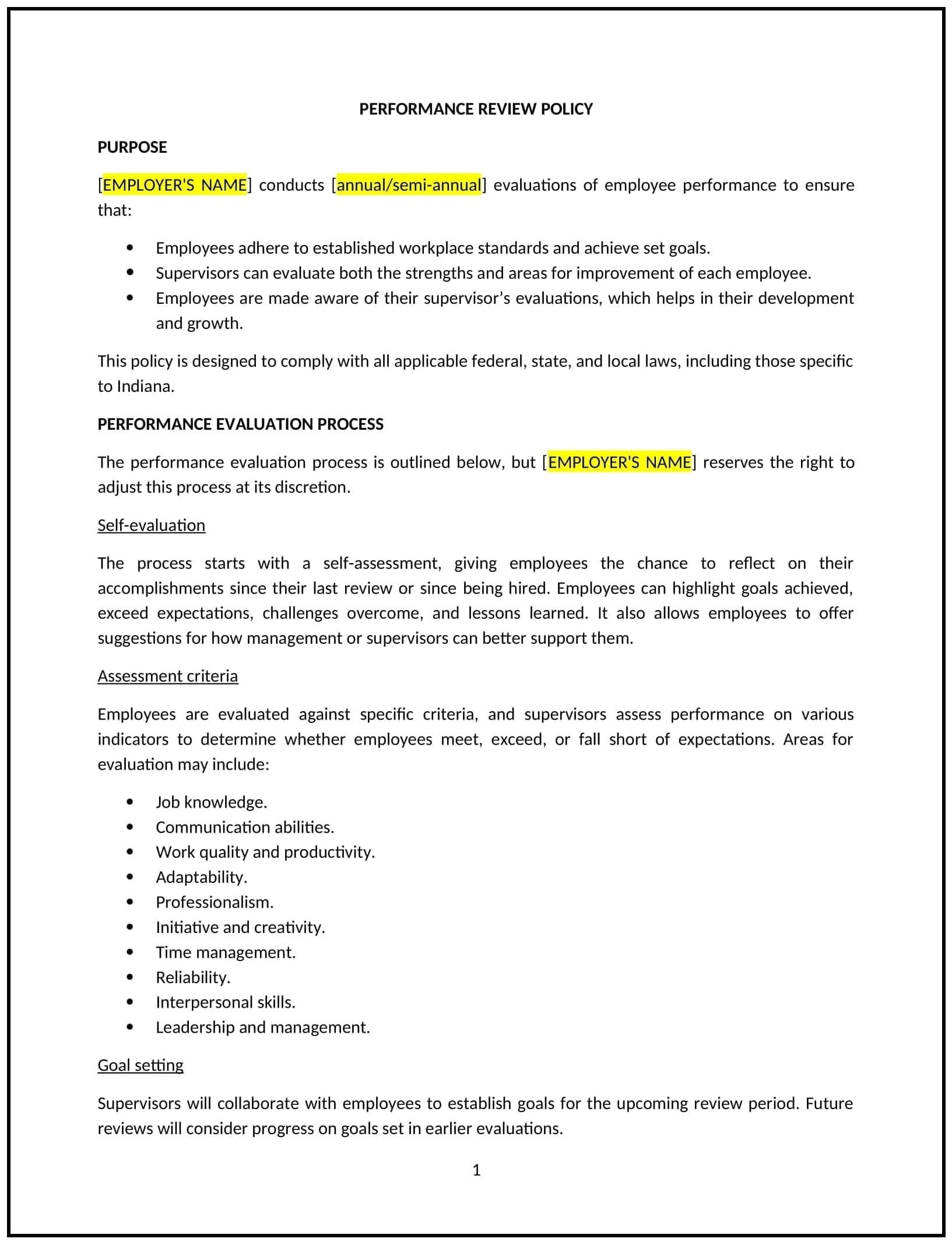
Performance review policy (Indiana): Free template
This performance review policy helps Indiana businesses establish a clear, consistent process for evaluating employee performance. It outlines the purpose and frequency of performance reviews, the criteria for assessing employee contributions, and the process for setting goals and providing feedback. The policy ensures that performance reviews are conducted fairly, aligned with business objectives, and contribute to both individual and organizational development. By using this template, businesses can promote a culture of continuous improvement, enhance employee engagement, and identify areas for professional growth.
By implementing this policy, Indiana businesses can foster a transparent and supportive performance evaluation process that improves productivity, boosts employee morale, and aligns individual goals with organizational success.
How to use this performance review policy (Indiana)
- Define the purpose of performance reviews: Clearly state the purpose of performance reviews, including how they help employees grow, how feedback contributes to improved performance, and how reviews align with the company’s overall objectives. The policy should emphasize that the reviews are designed to provide constructive feedback and guide development.
- Establish review frequency: Specify how often performance reviews will be conducted, such as annually, semi-annually, or quarterly. The policy should outline the timeline for performance evaluations, whether they are linked to annual goal-setting or separate from other business milestones.
- Outline performance criteria: Define the specific criteria that will be used to assess employee performance. This could include job-specific skills, contributions to team goals, leadership abilities, problem-solving, communication, and overall work quality. The policy should encourage the use of clear, measurable performance metrics.
- Set expectations for feedback: Emphasize that feedback should be specific, actionable, and focused on both strengths and areas for improvement. The policy should include guidelines for how managers should give feedback, ensuring it is balanced, respectful, and conducive to growth.
- Include goal-setting guidelines: Outline the process for setting performance goals, whether these are individual goals or team objectives. The policy should specify how goals are set, tracked, and evaluated during performance reviews. This should also include how employees can work with their managers to set goals that align with the business’s priorities.
- Provide for employee self-assessments: Include the option for employees to conduct self-assessments as part of the review process. The policy should encourage employees to reflect on their performance, achievements, and areas for improvement, fostering a sense of ownership in the evaluation process.
- Incorporate 360-degree feedback (if applicable): If the company uses 360-degree feedback, where feedback is gathered from peers, subordinates, and managers, the policy should outline how this feedback will be collected, incorporated into the review, and communicated to employees.
- Ensure follow-up and action plans: The policy should outline how performance reviews are followed up, with managers creating action plans to help employees improve or develop further. It should specify that the follow-up process includes setting clear objectives, providing necessary resources or training, and tracking progress.
- Clarify performance improvement plans (PIPs): If an employee’s performance is not meeting expectations, the policy should outline how a performance improvement plan (PIP) will be implemented. The policy should specify the criteria for initiating a PIP, the steps involved, and the timeline for improvement.
- Review and update regularly: Periodically review and update the performance review process to ensure it remains relevant, fair, and effective. The policy should specify that regular feedback from employees and managers will be used to refine and improve the review process.
Benefits of using this performance review policy (Indiana)
Implementing this policy provides several key benefits for Indiana businesses:
- Promotes consistent evaluations: The policy ensures that performance reviews are conducted consistently across the organization, providing a fair evaluation process for all employees.
- Enhances employee development: By providing regular feedback, goal-setting, and support, businesses can help employees improve their skills, reach their potential, and contribute more effectively to organizational success.
- Increases employee engagement: Employees are more likely to feel valued and motivated when they receive regular feedback and see that their efforts are recognized. This helps build a stronger relationship between employees and management.
- Supports organizational goals: Performance reviews help align individual goals with broader business objectives, ensuring that all employees are contributing to the company’s success.
- Identifies opportunities for improvement: The review process allows businesses to identify areas where employees may need additional training or support, enabling the company to address skill gaps and improve overall performance.
- Reduces turnover: Employees who receive regular feedback, recognition, and development opportunities are more likely to stay with the organization, reducing turnover and associated costs.
Tips for using this performance review policy (Indiana)
- Communicate the policy effectively: Ensure that all employees are aware of the performance review policy by including it in the employee handbook, during onboarding, and through ongoing communication. Employees should understand the review process, the criteria for evaluation, and how feedback will be provided.
- Set clear, measurable goals: When setting performance goals, ensure they are specific, measurable, achievable, relevant, and time-bound (SMART). This helps employees understand what is expected and provides a clear framework for evaluation.
- Provide regular, ongoing feedback: While performance reviews are typically conducted on a set schedule, businesses should encourage managers to provide ongoing feedback throughout the year, not just at review time. This helps employees stay on track and make improvements as needed.
- Involve employees in goal-setting: Engage employees in the goal-setting process, allowing them to contribute to the development of their performance goals. This fosters a sense of ownership and accountability for their own growth.
- Track progress toward goals: Regularly track and document progress toward goals so that employees and managers can discuss any challenges or successes during the review process. This also helps ensure that employees are aware of their progress and the steps needed to improve.