Got contracts to review? While you're here for policies, let Cobrief make contract review effortless—start your free review now.
Customize this template for free
Performance review policy (Iowa)
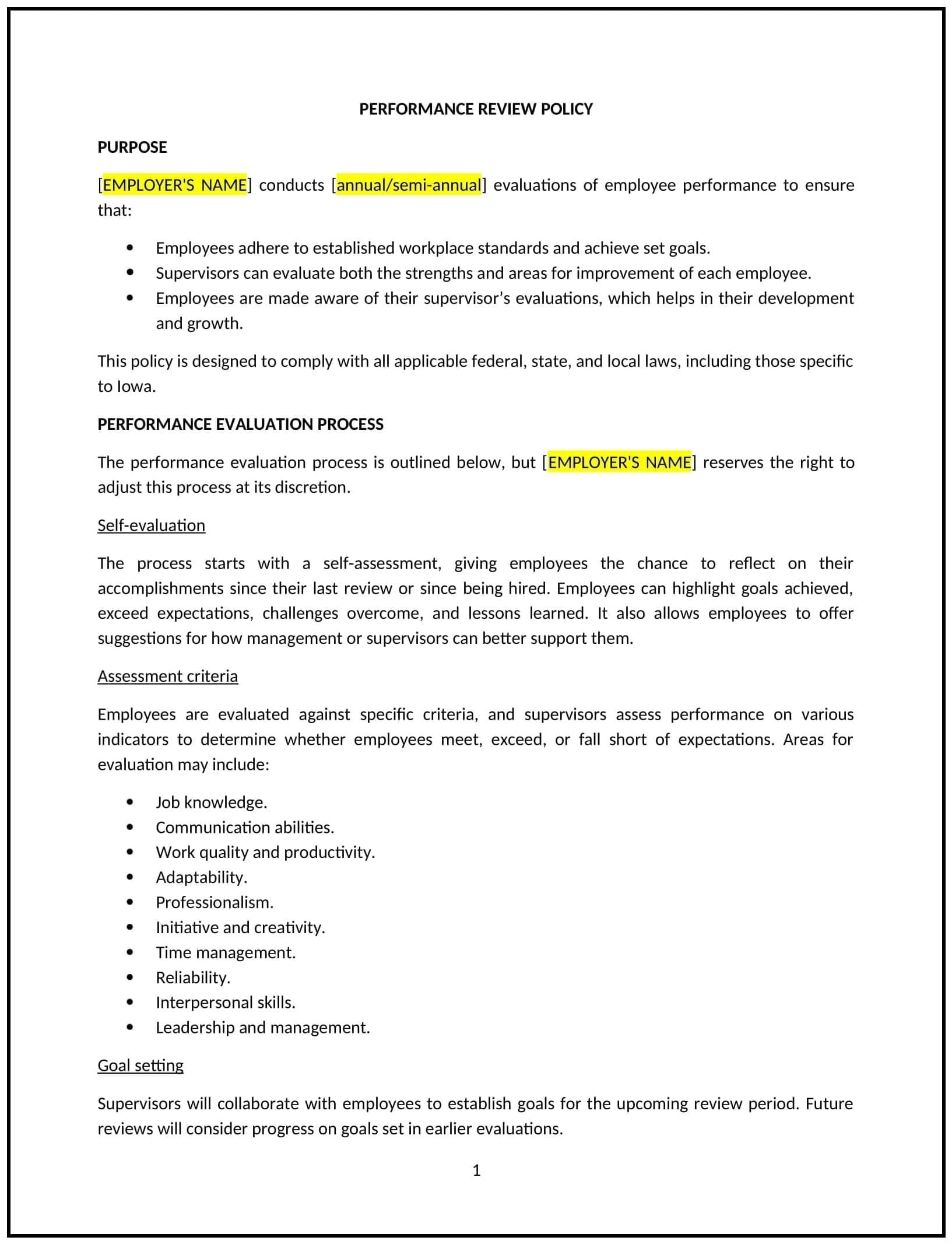
A performance review policy helps Iowa businesses systematically evaluate and improve employee performance, providing a structured framework for feedback, goal-setting, and professional development. This policy outlines the process for conducting performance reviews, including the frequency of reviews, the criteria for assessment, and how feedback is delivered. It aims to create a culture of continuous improvement and ensure that employees are aligned with organizational goals.
By implementing this policy, businesses can identify areas for employee growth, improve communication between managers and employees, and foster a work environment focused on development and success.
How to use this performance review policy (Iowa)
- Define the purpose of performance reviews: Explain the objectives of performance reviews, such as evaluating job performance, identifying strengths and areas for improvement, setting goals, and fostering professional development.
- Set the review frequency: Establish how often performance reviews will be conducted, such as annually, semi-annually, or quarterly, depending on the organization’s needs and the nature of the job.
- Determine the evaluation criteria: Specify the key performance indicators (KPIs) or criteria used to assess employee performance, such as job-specific tasks, teamwork, communication skills, and adherence to company values.
- Establish the review process: Outline the steps in the performance review process, including self-assessments, manager evaluations, goal-setting discussions, and feedback sessions.
- Provide feedback: Ensure that reviews include constructive, actionable feedback that highlights both strengths and areas for improvement. This feedback should be specific, measurable, and focused on behavior and outcomes.
- Set clear performance goals: After each review, collaborate with employees to set SMART (Specific, Measurable, Achievable, Relevant, Time-bound) goals for the upcoming period, aligning them with business objectives.
- Track progress and follow up: Regularly track employee progress toward their goals and provide ongoing support and feedback between formal reviews.
- Handle performance issues: If performance issues are identified, develop a performance improvement plan (PIP) with clear expectations and timelines for improvement, offering the necessary resources and support.
Benefits of using this performance review policy (Iowa)
This policy offers several key benefits for Iowa businesses:
- Improves employee development: Performance reviews help identify strengths and areas for growth, enabling employees to develop their skills and advance in their careers.
- Aligns employee goals with business objectives: By setting clear performance goals, businesses can align employee efforts with organizational priorities, increasing productivity and efficiency.
- Enhances communication: Regular performance reviews facilitate open, two-way communication between employees and managers, improving relationships and promoting a positive work environment.
- Increases employee motivation: Employees who receive regular feedback and support are more likely to feel engaged, motivated, and committed to their work.
- Identifies high performers: Performance reviews help businesses identify top performers who may be candidates for promotion or additional responsibilities, fostering a high-performance culture.
- Reduces legal risks: By establishing a fair, structured, and consistent performance evaluation process, businesses can reduce the risk of discrimination or legal challenges related to performance management.
Tips for using this performance review policy (Iowa)
- Provide training for managers: Ensure that managers are trained on how to conduct effective performance reviews, deliver constructive feedback, and set meaningful goals.
- Keep reviews consistent: Apply the same criteria and process to all employees to ensure fairness and reduce the risk of favoritism or bias.
- Foster a feedback culture: Encourage ongoing feedback throughout the year, not just during formal performance reviews. Regular check-ins help employees stay on track and feel supported.
- Be specific and actionable: When providing feedback, focus on specific examples and behaviors, and offer clear suggestions for improvement. Avoid vague or general statements that may not help the employee improve.
- Set realistic goals: Ensure that performance goals are realistic and achievable, taking into account the employee's experience, resources, and current workload.
- Make performance reviews a two-way conversation: Encourage employees to provide their own feedback and input during the performance review process. This helps identify potential issues, foster mutual respect, and improve the overall process.
- Document everything: Keep accurate records of performance reviews, feedback provided, and goals set, as these can serve as important references for future performance management decisions.