Got contracts to review? While you're here for policies, let Cobrief make contract review effortless—start your free review now.
Customize this template for free
Performance review policy (Kansas)
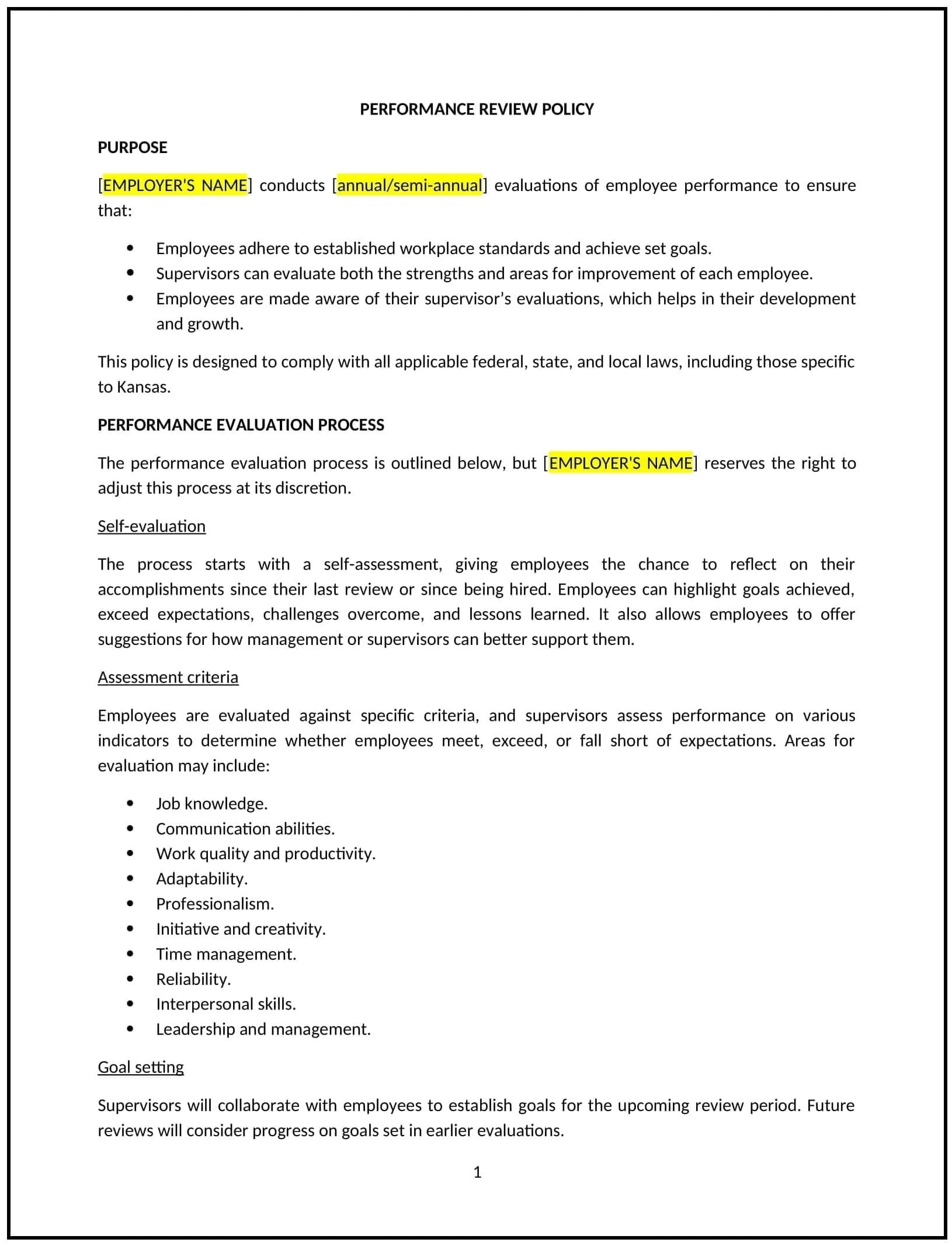
A performance review policy helps Kansas businesses establish a clear framework for evaluating employee performance. This policy outlines the processes for conducting performance appraisals, setting goals, providing feedback, and fostering professional development. It ensures that performance is assessed consistently and transparently, benefiting both employees and the organization.
By implementing this policy, businesses can promote growth, enhance communication, and maintain a motivated and productive workforce.
How to use this performance review policy (Kansas)
- Define performance evaluation criteria: Businesses should identify the key performance indicators (KPIs) that will be used to assess employee performance, such as job-specific skills, goal achievement, teamwork, and customer service.
- Set review frequency: The policy should specify how often performance reviews will take place, such as annually, semi-annually, or quarterly, and establish clear timelines for conducting reviews.
- Outline the review process: Businesses should detail how performance reviews will be conducted, whether through self-assessments, manager evaluations, peer feedback, or a combination of these methods.
- Establish goal-setting guidelines: Businesses should set clear expectations for setting performance goals, including SMART (Specific, Measurable, Achievable, Relevant, and Time-bound) goals for both individual and team performance.
- Provide constructive feedback: The policy should encourage managers to provide balanced feedback, highlighting strengths and areas for improvement, and offering actionable suggestions for development.
- Promote professional development: Businesses should outline how performance reviews will be linked to career development opportunities, training programs, or advancement paths to foster employee growth.
- Maintain documentation: The policy should require that all performance reviews be documented and stored in a secure manner for future reference and tracking progress.
- Review and update regularly: Businesses should periodically review the policy to ensure it reflects current practices, goals, and employee needs, as well as changes in company strategy.
Benefits of using a performance review policy (Kansas)
- Promotes employee growth: A structured performance review process helps employees understand their strengths and areas for development, enabling them to improve their skills and contribute more effectively to the organization.
- Increases transparency: Clear performance expectations and consistent feedback help ensure that all employees are evaluated fairly and equitably, promoting trust in management.
- Enhances communication: Regular performance reviews provide a platform for open communication between employees and managers, helping to clarify expectations, resolve issues, and foster a collaborative work environment.
- Aligns individual and company goals: Performance reviews help align employee performance with business objectives, ensuring that employees contribute to the company’s success.
- Boosts employee engagement: Employees who receive constructive feedback and understand their growth opportunities are more likely to feel engaged and motivated to perform at their best.
- Supports career advancement: By linking performance reviews with career development, businesses can identify high-potential employees and provide the training and resources necessary for their advancement within the company.
Tips for using this performance review policy (Kansas)
- Communicate the process clearly: Businesses should ensure that all employees understand the performance review process, including the criteria for evaluation, the timeline for reviews, and how feedback will be provided.
- Set realistic goals: When setting performance goals, businesses should work with employees to ensure the goals are challenging but achievable, and ensure that goals align with business objectives.
- Encourage regular feedback: Managers should provide regular feedback throughout the year, not just during the formal review process, to help employees stay on track and make continuous improvements.
- Foster a two-way dialogue: Performance reviews should be a conversation, allowing employees to share their own perspectives on their performance and discuss any challenges or areas where they may need additional support.
- Link performance to rewards: Businesses should connect performance evaluations to reward systems, such as raises, bonuses, or promotions, to motivate employees and recognize their achievements.
- Track progress over time: The policy should encourage tracking progress across multiple review periods, allowing businesses to identify trends and measure long-term employee development.