Performance review policy (Minnesota): Free template
Got contracts to review? While you're here for policies, let Cobrief make contract review effortless—start your free review now.
Customize this template for free
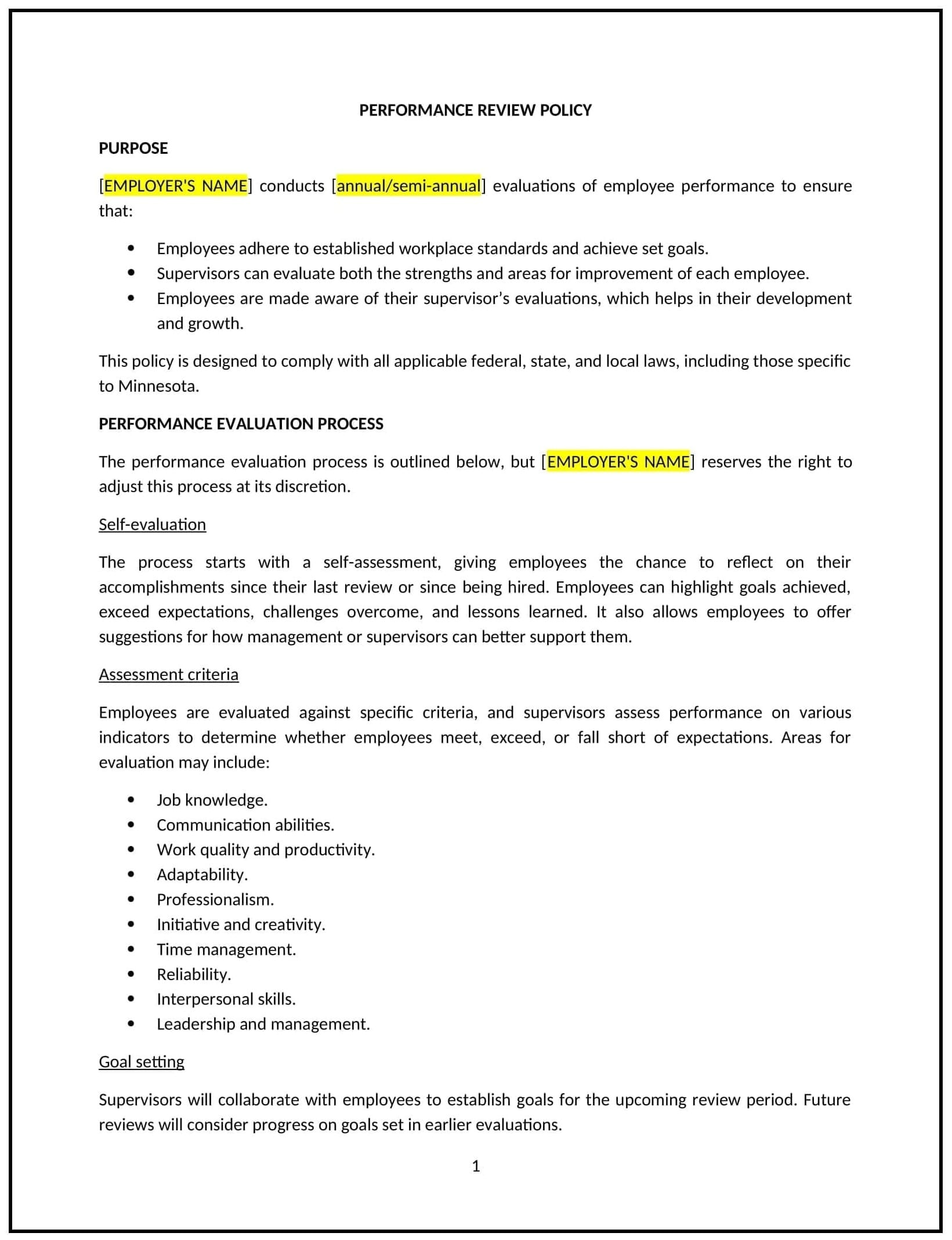
Performance review policy (Minnesota)
This performance review policy is designed to help Minnesota businesses establish a clear, structured process for evaluating employee performance. It outlines how performance reviews will be conducted, the criteria used for evaluations, and how feedback will be provided to employees. The policy emphasizes the importance of ongoing development, goal setting, and performance improvement.
By implementing this policy, businesses can foster a culture of continuous improvement, enhance employee engagement, and ensure alignment between individual performance and company objectives.
How to use this performance review policy (Minnesota)
- Define performance expectations: Clearly outline the key performance indicators (KPIs) and expectations for each role within the company. This ensures that employees understand what is expected of them and how their performance will be measured.
- Establish review frequency: Specify how often performance reviews will take place (e.g., annually, semi-annually, or quarterly) and the timeline for providing feedback.
- Set clear criteria for evaluation: Establish clear and objective criteria for evaluating performance, such as work quality, productivity, teamwork, adherence to company values, and personal development.
- Use a standardized format: Create a standardized format for conducting performance reviews, ensuring consistency across departments and roles. This could include a combination of self-assessments, manager assessments, and peer feedback.
- Provide constructive feedback: Ensure that feedback is constructive, specific, and actionable, focusing on both strengths and areas for improvement. Managers should set clear goals for employees and offer support for skill development and performance enhancement.
- Set goals for development: Include the setting of individual goals for employees during the performance review process. These goals should align with both personal development and organizational objectives.
- Address compensation and promotions: Include discussions of compensation adjustments, promotions, or bonuses as part of the performance review process, based on the outcomes of the evaluation and business needs.
Benefits of using a performance review policy (Minnesota)
Implementing this policy provides several advantages for Minnesota businesses:
- Promotes alignment: By clearly defining performance expectations and goals, businesses can ensure that employees are aligned with the company’s strategic objectives, leading to improved performance across the organization.
- Encourages professional development: Regular performance reviews allow employees to receive feedback on their strengths and areas for improvement, fostering personal and professional growth.
- Enhances employee engagement: Employees who receive regular feedback and understand their performance goals are more likely to feel engaged, motivated, and valued within the company.
- Reduces turnover: Transparent performance management can help identify employees who may be at risk of leaving the company, allowing managers to address issues before they lead to turnover.
- Reflects Minnesota-specific considerations: Tailors the policy to Minnesota’s work culture, addressing local workforce expectations and ensuring compliance with state labor laws regarding performance evaluations and compensation.
Tips for using this performance review policy (Minnesota)
- Communicate clearly: Ensure that employees are informed about the performance review process and the criteria on which they will be evaluated. This helps set expectations and reduces confusion.
- Provide regular feedback: Performance reviews should not be the only time employees receive feedback. Managers should provide ongoing, real-time feedback to help employees improve throughout the year.
- Set SMART goals: Encourage employees to set SMART (Specific, Measurable, Achievable, Relevant, and Time-bound) goals during their performance reviews to guide their development and provide clarity on expectations.
- Foster an open dialogue: Create a culture where employees feel comfortable discussing their performance openly, asking questions, and seeking clarification on feedback.
- Review regularly: The policy should be reviewed periodically to ensure that it remains aligned with evolving business objectives, employee needs, and any changes to Minnesota labor laws.