Got contracts to review? While you're here for policies, let Cobrief make contract review effortless—start your free review now.
Customize this template for free
Political activity policy (Iowa)
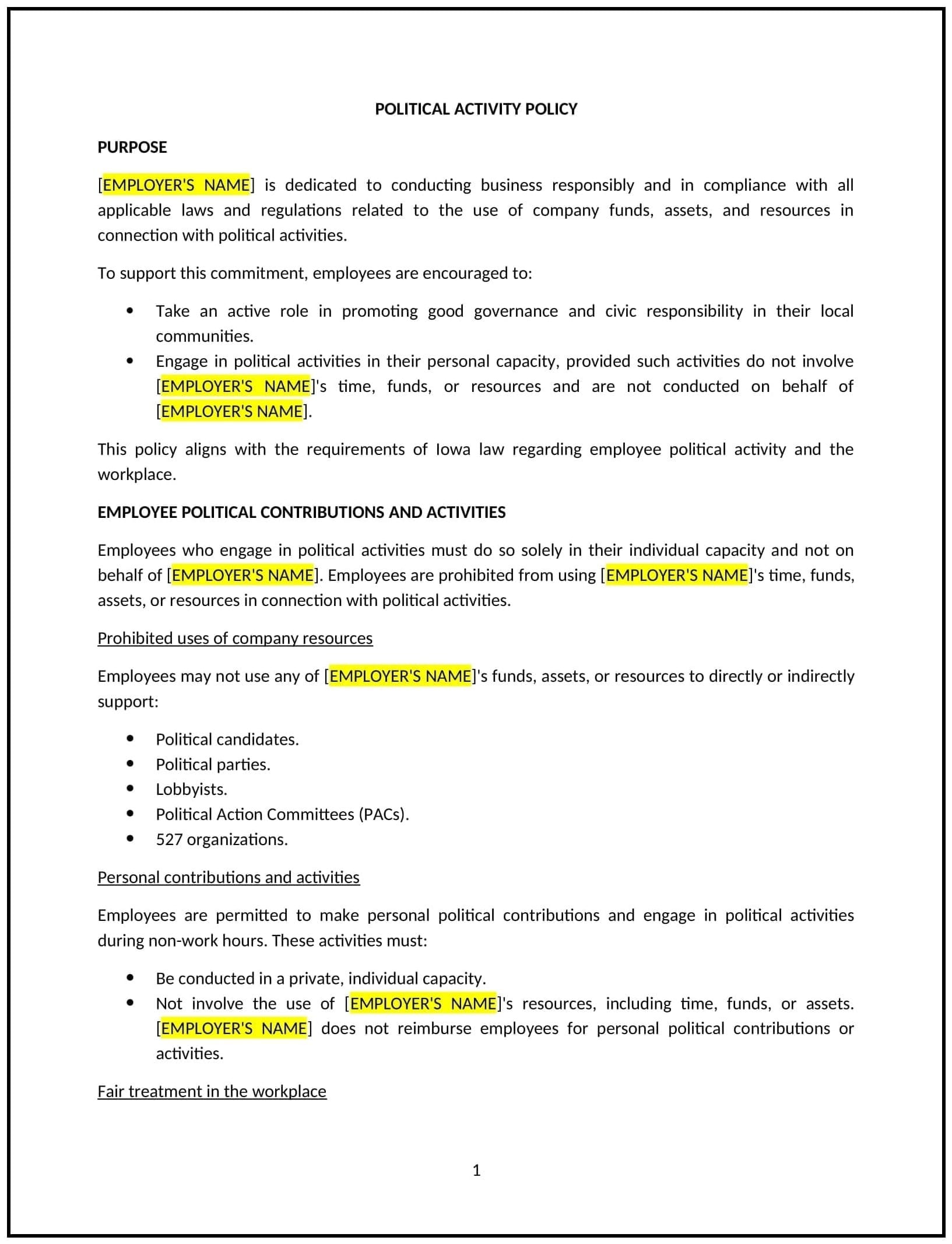
A political activity policy helps Iowa businesses manage employee involvement in political activities while maintaining a neutral, nonpartisan work environment. This policy outlines the expectations for employee political engagement, including activities like donations, campaigning, lobbying, and running for public office. It provides guidelines for separating personal political activities from the workplace to prevent any perception of favoritism, coercion, or conflicts of interest.
By implementing this policy, businesses can create a respectful, inclusive work environment, where employees' political views are respected but do not interfere with business operations or relationships.
How to use this political activity policy (Iowa)
- Define acceptable political activity: Specify what constitutes personal political activity and clarify that such activities should be conducted outside of work hours, using personal resources, and without using company time or assets.
- Set boundaries for political expression at work: Establish guidelines for political discussions or expressions in the workplace, ensuring that employees understand what is acceptable in terms of political speech, decorations, or materials displayed in company spaces.
- Address employee contributions: Clarify the rules around political donations and fundraising, including whether employees can donate or engage in fundraising during work hours, and whether they can use company funds or resources for political purposes.
- Prohibit political activities that conflict with business interests: Specify that employees should avoid engaging in political activities that might present a conflict of interest, such as lobbying on behalf of political candidates or causes that could affect the business or its operations.
- Set expectations for employees in leadership roles: Outline specific guidelines for employees in leadership positions, ensuring they understand the importance of maintaining a neutral stance on political matters while representing the company.
- Establish reporting mechanisms: Provide a process for employees to report concerns or conflicts related to political activity, ensuring that any issues are addressed promptly and fairly.
- Review and update regularly: Periodically review the policy to ensure it reflects changes in local, state, and federal regulations, as well as the evolving political climate.
Benefits of using this political activity policy (Iowa)
This policy offers several key benefits for Iowa businesses:
- Promotes workplace neutrality: By setting clear boundaries on political activities, businesses help ensure that the workplace remains neutral and focused on business operations, preventing divisiveness or favoritism.
- Reduces potential conflicts of interest: The policy helps prevent situations where employees’ political activities could conflict with business interests or create undue influence on decision-making.
- Protects employee privacy: The policy helps protect employees’ right to engage in political activity while maintaining their privacy and respecting the diverse political views within the workforce.
- Enhances employee morale: By establishing clear guidelines and respecting employees' personal political rights, businesses create an environment of trust and mutual respect.
- Minimizes legal risks: Having a clear policy reduces the risk of legal disputes related to political expression, discrimination, or perceived coercion in the workplace.
- Strengthens the company’s reputation: By demonstrating a commitment to neutrality and fairness, businesses can build a positive reputation both internally with employees and externally with clients and customers.
Tips for using this political activity policy (Iowa)
- Communicate the policy clearly: Ensure that all employees understand the policy, including what is expected of them in terms of political activity, and how the company will handle any issues that arise.
- Encourage respectful political discussions: While political activities should be kept separate from work, businesses can encourage respectful, open-minded political discussions, as long as they do not disrupt work or create a hostile environment.
- Separate company resources from personal activities: Make it clear that employees cannot use company resources, time, or funds for political activities, and that any political engagement should be conducted outside of work hours and using personal means.
- Be consistent in enforcement: Apply the policy consistently to all employees to prevent claims of favoritism or discrimination. Any political activity that violates company policy should be addressed promptly.
- Respect individual rights: While maintaining neutrality in the workplace, businesses should respect employees' rights to engage in political activities on their own time, free from coercion or undue influence from the company.
- Monitor for conflicts of interest: Regularly review employees’ involvement in political activities, particularly in leadership positions, to ensure that no conflicts of interest arise or affect business operations.