Got contracts to review? While you're here for policies, let Cobrief make contract review effortless—start your free review now.
Customize this template for free
Remote work policy (Alaska)
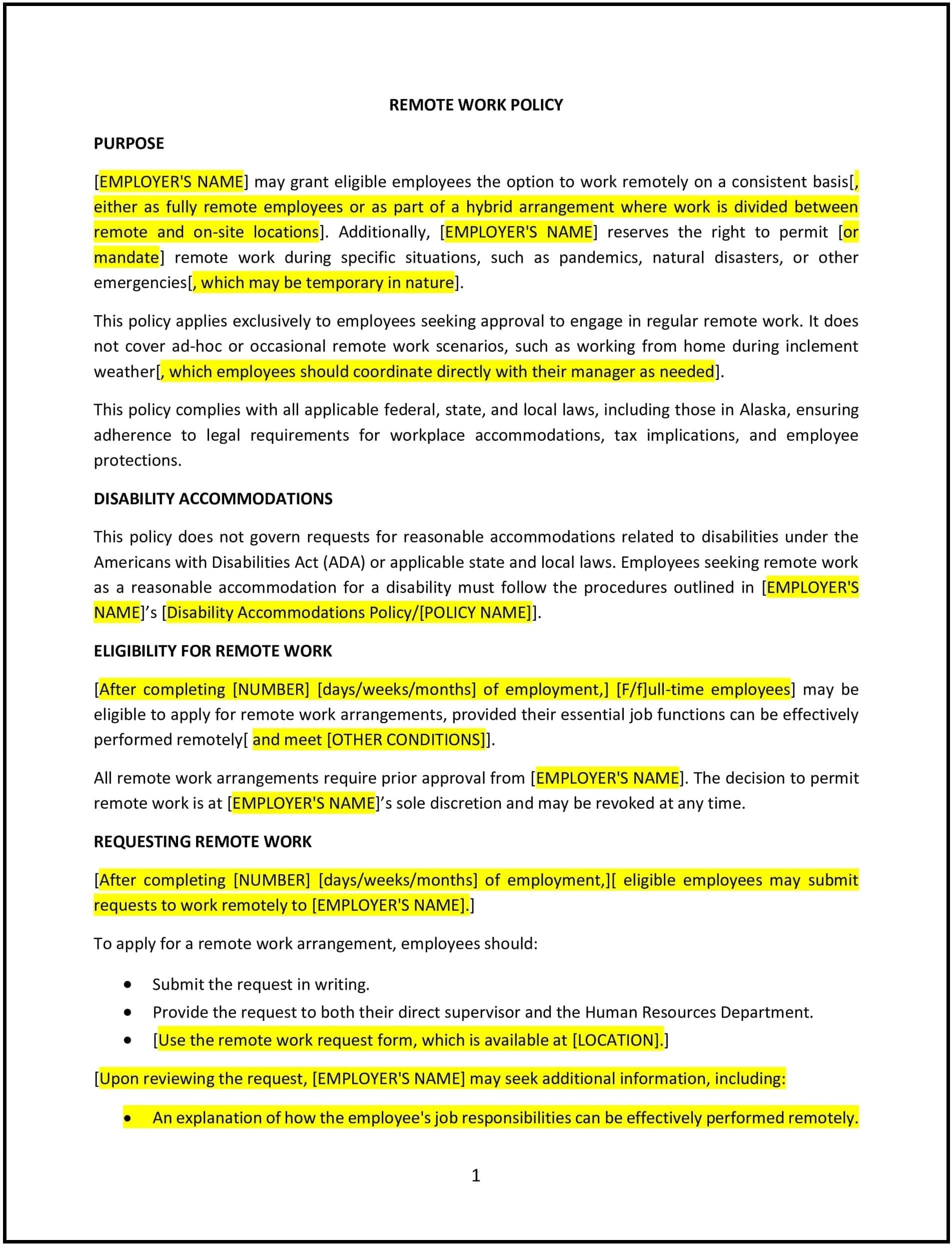
In Alaska, a remote work policy provides clear guidelines for employees working from locations outside the company’s physical office. This policy outlines expectations for productivity, communication, and use of company resources while addressing unique challenges associated with Alaska’s remote and rural settings. By implementing a remote work policy, businesses can maintain efficiency, support flexibility, and foster accountability.
How to use this remote work policy (Alaska)
- Define eligibility: Specify which roles and employees are eligible for remote work, considering operational needs and job responsibilities.
- Outline workspace requirements: Provide guidelines for employees to establish a safe, professional, and distraction-free workspace.
- Set productivity expectations: Clearly communicate performance standards, work hours, and deliverables for remote employees.
- Include communication protocols: Establish procedures for regular check-ins, team meetings, and use of collaboration tools to maintain connectivity.
- Address security measures: Require employees to follow data security protocols, such as using VPNs, secure networks, and company-approved devices.
Benefits of using a remote work policy (Alaska)
A remote work policy provides significant advantages for businesses in Alaska. Here’s how it helps:
- Enhances flexibility: Supports employees in balancing personal and professional responsibilities, leading to greater job satisfaction.
- Increases talent access: Expands recruitment opportunities by accommodating remote work, especially in Alaska’s rural and remote communities.
- Boosts productivity: Allows employees to work in environments that maximize focus and efficiency.
- Reduces overhead: Lowers costs associated with maintaining large office spaces by enabling flexible work arrangements.
- Supports compliance: Helps businesses align with labor laws and industry standards for remote work.
Tips for using a remote work policy (Alaska)
- Adapt for local conditions: Address unique challenges in Alaska, such as limited internet connectivity in rural areas, by offering solutions like stipends for connectivity improvements.
- Leverage technology: Use collaboration and project management tools to keep remote teams aligned and productive.
- Monitor performance: Implement regular performance reviews to ensure remote employees meet productivity and quality standards.
- Offer support: Provide training and resources for remote employees to address challenges, such as maintaining work-life balance.
- Update regularly: Revise the policy to reflect changes in technology, workforce needs, or operational requirements.