Time off for public duties policy (Kansas): Free template
Got contracts to review? While you're here for policies, let Cobrief make contract review effortless—start your free review now.
Customize this template for free
Time off for public duties policy (Kansas)
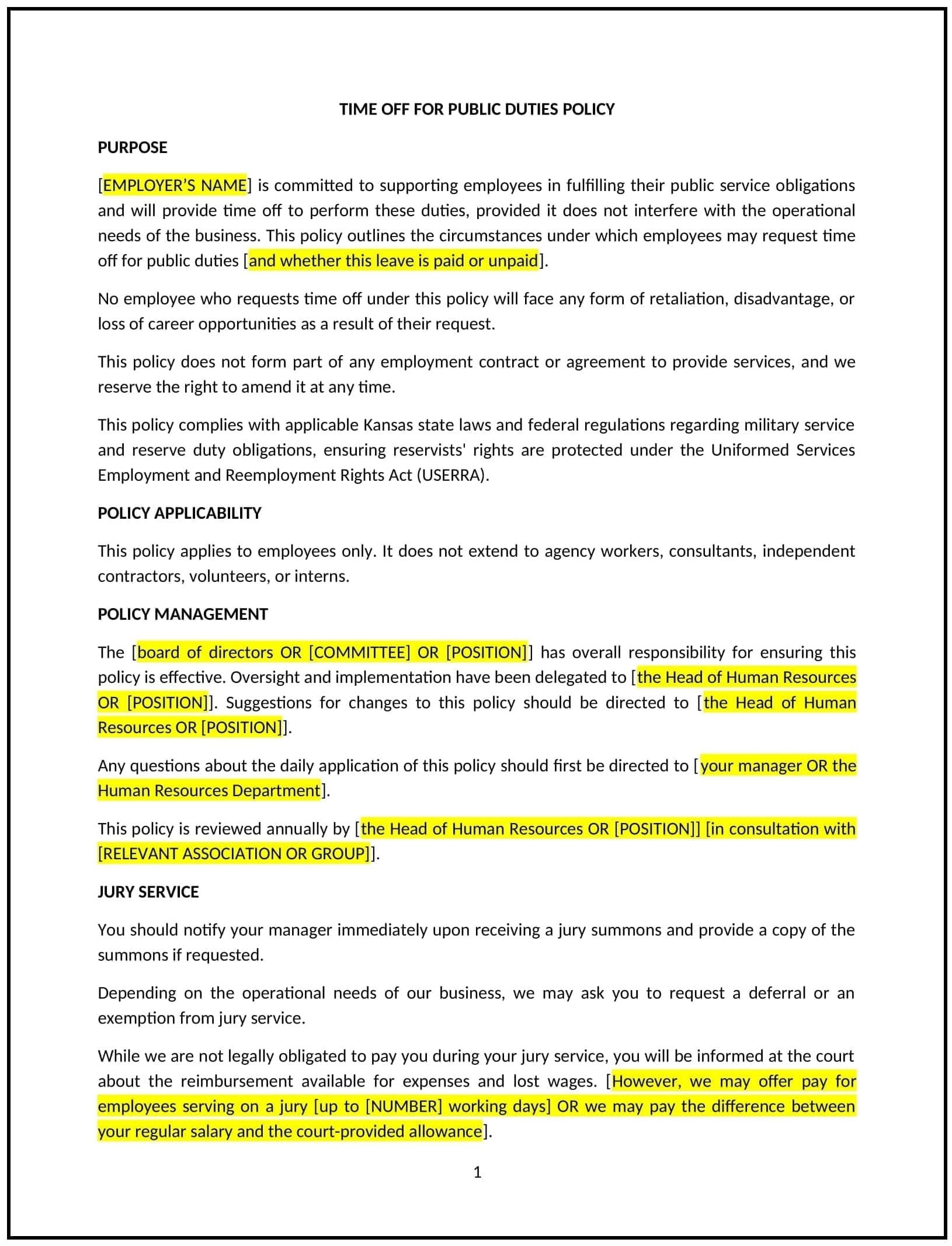
A time off for public duties policy helps Kansas businesses support employees who need to take time off to fulfill their civic responsibilities, such as jury duty, voting, or serving in government roles. This policy outlines how businesses will handle requests for time off, the pay entitlements for employees, and the procedures for requesting and approving time off for public duties.
By implementing this policy, businesses can promote civic engagement while maintaining a fair and consistent approach to time off for employees participating in public duties.
How to use this time off for public duties policy (Kansas)
- Define public duties: The policy should specify what constitutes public duties, such as jury duty, voting in local, state, or national elections, or serving on government-appointed boards or committees.
- Set eligibility criteria: The policy should define which employees are eligible for time off for public duties, ensuring clarity on whether this policy applies to full-time, part-time, or temporary employees.
- Outline time off procedures: Businesses should establish a clear process for employees to request time off for public duties, including how far in advance they must provide notice and what documentation is required (e.g., jury duty summons or voting confirmation).
- Specify pay entitlements: The policy should clarify whether employees will be paid during their time off for public duties or if the leave will be unpaid. It may also include partial compensation in some cases, such as for jury duty.
- Address job protection: Employees should be assured that they will be able to return to their position or a comparable one after completing their public duties, without fear of losing their job or facing adverse actions.
- Set limits on time off: The policy should define the maximum amount of time off employees are entitled to for public duties, balancing employees’ civic responsibilities with business needs.
- Review and update regularly: The policy should be periodically reviewed to ensure it aligns with state and federal laws, as well as the evolving needs of the business.
Benefits of using a time off for public duties policy (Kansas)
- Promotes civic engagement: By supporting employees in fulfilling public duties, businesses encourage greater civic participation, which can have a positive impact on the community.
- Ensures fairness: A formal policy ensures that all employees are treated consistently when requesting time off for public duties, helping to prevent misunderstandings or potential discrimination.
- Protects employee rights: Employees are guaranteed time off for public duties without fear of job loss or retaliation, promoting a sense of trust and security.
- Enhances employee satisfaction: Offering time off for public duties demonstrates a commitment to employees’ personal and civic responsibilities, improving morale and fostering goodwill.
- Reduces operational disruptions: With clear guidelines and procedures in place, businesses can manage requests for time off more efficiently and minimize disruptions to business operations.
- Strengthens company reputation: A business known for supporting employees’ public duties can enhance its reputation as a responsible, community-oriented employer, which can improve employee loyalty and attract top talent.
Tips for using this time off for public duties policy (Kansas)
- Communicate the policy clearly: Businesses should ensure that all employees are aware of the time off for public duties policy, including how to request time off, eligibility criteria, and any documentation required.
- Be flexible with scheduling: While public duties are often scheduled in advance, businesses should be flexible and accommodating in case of unforeseen or last-minute obligations.
- Maintain consistency: The policy should be applied consistently across all employees to avoid any perceived favoritism and ensure fairness in how time off requests are handled.
- Monitor time off usage: Businesses should keep track of the amount of time employees take off for public duties to ensure they do not exceed the company’s policy limits and maintain operational efficiency.
- Encourage employees to provide early notice: The policy should encourage employees to request time off as far in advance as possible to allow the business to plan accordingly and avoid disruptions.
- Review and update the policy regularly: Businesses should review the policy periodically to ensure it remains up to date with legal requirements, changes in business operations, and evolving employee needs.