Time off for public duties policy (Minnesota): Free template
Got contracts to review? While you're here for policies, let Cobrief make contract review effortless—start your free review now.
Customize this template for free
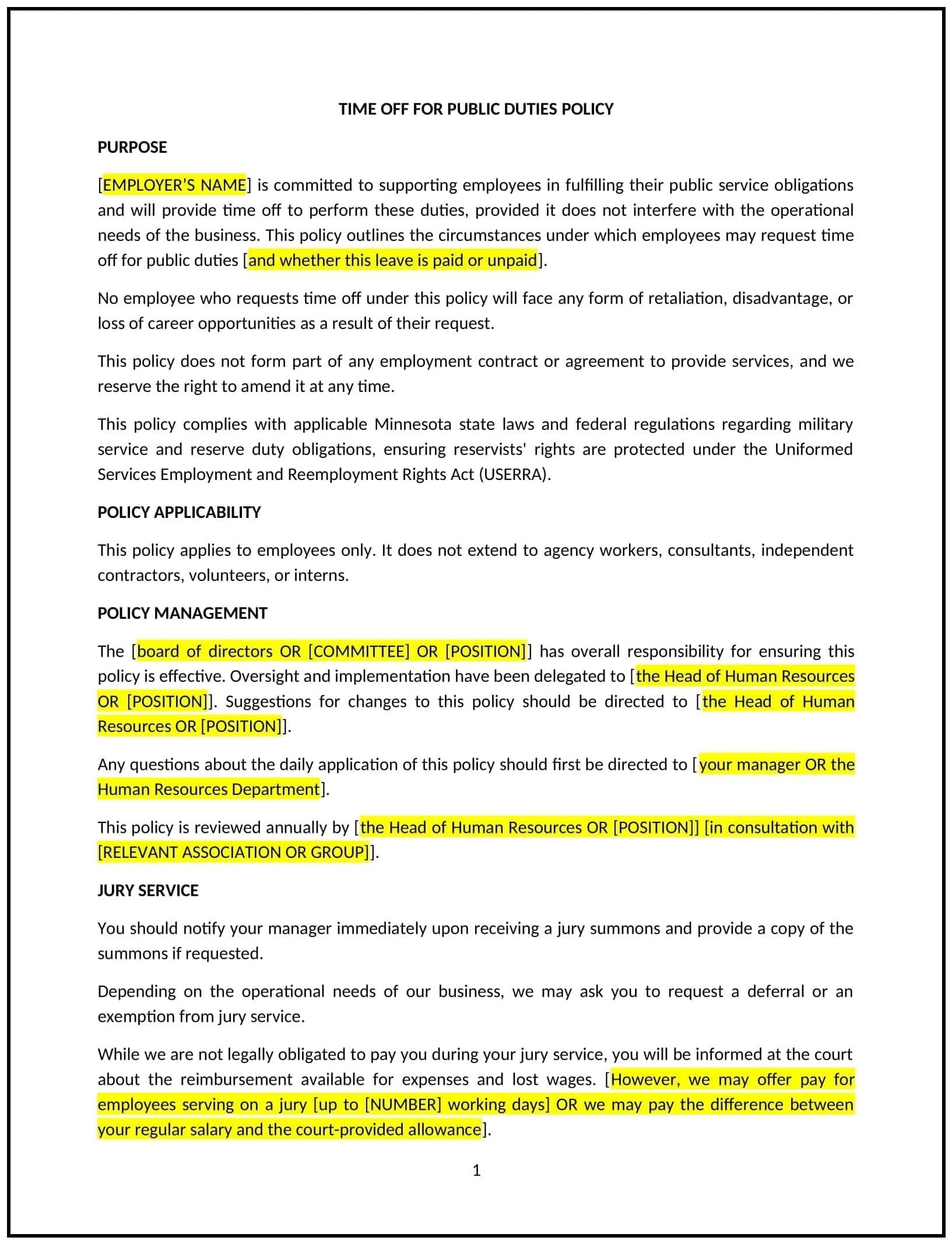
Time off for public duties policy (Minnesota)
This time off for public duties policy is designed to help Minnesota businesses accommodate employees who need time off to fulfill public service obligations, such as jury duty, voting, or serving in public offices. The policy outlines how employees can request time off for public duties, the compensation available during their absence, and the process for managing these types of leave.
By implementing this policy, businesses can support employee participation in civic duties while maintaining operational efficiency.
How to use this time off for public duties policy (Minnesota)
- Define public duties: Clearly outline what constitutes public duties that qualify for leave, such as jury duty, voting in public elections, or attending official government meetings or hearings.
- Establish eligibility criteria: Specify which employees are eligible for public duty leave, such as full-time, part-time, or temporary workers, and any eligibility requirements such as length of employment or status as an active voter.
- Set the leave duration: Define how much time off employees are entitled to for each type of public duty, and ensure the duration aligns with state laws, such as the time required for jury duty or voting periods.
- Address pay during leave: Specify whether public duty leave will be paid or unpaid. Businesses may choose to offer paid leave for certain types of public duties, or employees may need to use vacation or PTO.
- Provide for documentation: Outline the documentation employees need to provide when requesting time off for public duties, such as a jury summons or proof of voter registration, and the timeline for submitting these documents.
- Establish the request process: Define the procedure for requesting time off for public duties, including how much notice employees should give, to whom the request should be submitted, and any specific forms that need to be completed.
- Clarify employee obligations during leave: Ensure employees understand their obligations during time off, including expectations for returning to work promptly after fulfilling public duties and any restrictions on work during this period.
Benefits of using this time off for public duties policy (Minnesota)
Implementing this policy provides several advantages for Minnesota businesses:
- Promotes civic engagement: By providing time off for public duties, businesses support employees' right to engage in important civic responsibilities, such as serving on a jury or participating in elections.
- Reduces absenteeism: Clearly defined procedures for public duty leave reduce the likelihood of unplanned absenteeism, as employees understand the process and expectations around taking time off for public service.
- Enhances employee morale: Offering support for public duties shows that the company values its employees’ contributions to society, improving job satisfaction and fostering a sense of goodwill and respect within the workplace.
- Aligns with Minnesota laws: The policy is tailored to ensure compliance with Minnesota-specific regulations related to public duty leave, such as jury duty and voting rights, while maintaining a fair approach to employee time off.
Tips for using this time off for public duties policy (Minnesota)
- Communicate clearly: Ensure all employees understand the policy, including the types of public duties that qualify for leave, the request process, and the company’s stance on pay during leave.
- Ensure fair application: Apply the policy consistently to all employees to avoid perceptions of favoritism or discrimination. Each employee should have equal access to public duty leave.
- Monitor leave usage: Track public duty leave to ensure employees are not abusing the policy and that the business can plan for staffing needs during these absences.
- Be flexible: While managing public duty leave, businesses should be flexible with employees, especially when it involves time-sensitive duties like voting or last-minute jury summonses.
- Review regularly: Periodically review the policy to ensure it aligns with Minnesota’s evolving laws and reflects any changes in employee needs or business operations.