Got contracts to review? While you're here for policies, let Cobrief make contract review effortless—start your free review now.
Customize this template for free
Time off for training policy (Iowa)
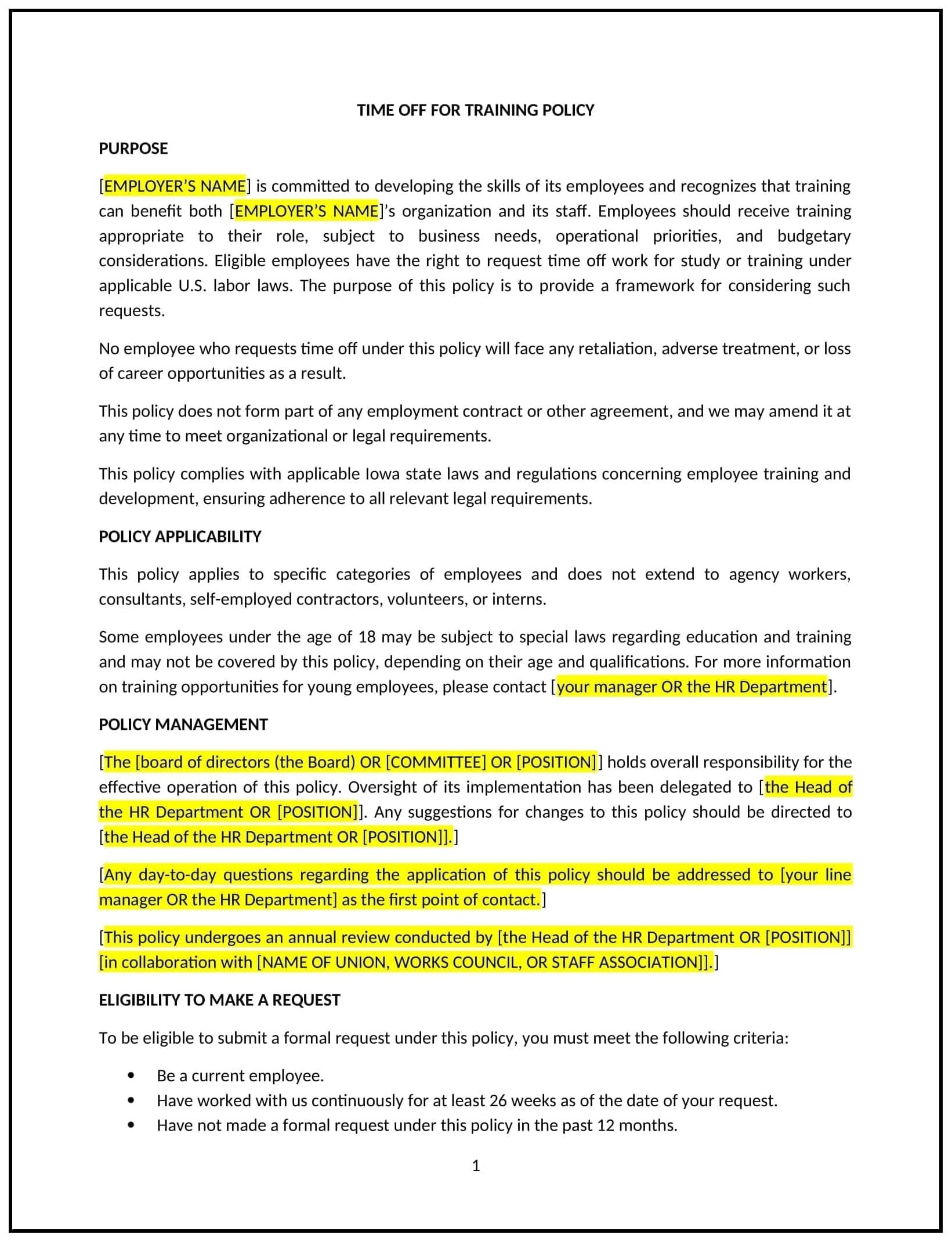
A time off for training policy helps Iowa businesses manage employee requests for time off to attend training, workshops, seminars, or other professional development opportunities. This policy outlines the guidelines for requesting time off, the approval process, and the expectations for employees attending training during or outside of regular work hours. It also addresses whether the business will provide compensation for time spent in training and the responsibilities employees have when attending training programs.
By implementing this policy, businesses can foster employee development, improve skill sets, and ensure that employees’ time away from work is properly managed to minimize operational disruptions.
How to use this time off for training policy (Iowa)
- Define eligible training activities: Clearly specify what types of training or professional development activities qualify for time off, such as job-related skills workshops, certifications, industry seminars, or educational courses that will directly benefit the employee’s role.
- Set the request process: Establish a clear process for employees to request time off for training, including how far in advance they should submit their requests and any necessary documentation or approvals required.
- Determine compensation: Outline whether employees will be paid for time spent attending training, whether training during work hours is paid, and how off-hour training will be compensated. Businesses may choose to provide full, partial, or no compensation depending on the training’s relevance.
- Address travel or lodging expenses: If the training requires travel, specify whether employees will be reimbursed for related expenses, such as transportation, lodging, or meals, and the process for submitting reimbursement claims.
- Set attendance and participation expectations: Clarify the expectations for employees attending training, including requirements for full attendance, participation, and any post-training reporting or follow-up required.
- Clarify the impact on job duties: Ensure that employees understand that time spent in training is considered time away from regular job duties and that arrangements should be made to minimize disruptions in workflow or productivity.
- Review and update regularly: Periodically review the policy to ensure it reflects any changes in business needs, employee feedback, or the availability of new training opportunities relevant to employees' roles.
Benefits of using this time off for training policy (Iowa)
This policy offers several key benefits for Iowa businesses:
- Promotes employee development: Offering time off for training helps employees acquire new skills and knowledge, which can improve their performance and productivity at work.
- Increases employee satisfaction: Providing opportunities for professional growth demonstrates that the business is invested in employees' long-term development, which can lead to greater job satisfaction and loyalty.
- Enhances business performance: Well-trained employees are more likely to perform at a higher level, reducing errors, increasing efficiency, and contributing to overall business success.
- Reduces turnover: Employees who feel supported in their career development are more likely to stay with the company, reducing turnover and recruitment costs.
- Supports succession planning: Offering training opportunities helps develop the skills necessary for employees to advance within the organization, ensuring a stronger internal talent pool for future leadership roles.
- Ensures competitiveness: Businesses that invest in employee training are better equipped to adapt to changes in the industry, keep up with new technologies, and remain competitive in the marketplace.
Tips for using this time off for training policy (Iowa)
- Communicate the policy clearly: Ensure that all employees understand the policy, including the types of training that qualify for time off, the approval process, and compensation arrangements.
- Align training with business goals: Choose training programs that directly align with the company’s objectives and the employee’s role to ensure a return on investment in both time and money.
- Set clear expectations for participation: Communicate to employees that full participation in the training is expected and that any missed sessions must be rescheduled or made up.
- Monitor training outcomes: After employees return from training, assess how the knowledge gained can be applied to their job and the company’s goals. Encourage employees to share key takeaways with their team.
- Be flexible with scheduling: Recognize that some training opportunities may require employees to attend outside of regular working hours. Ensure the policy allows for flexibility while balancing the needs of the business.
- Offer a mix of in-person and virtual training: Consider offering a combination of in-person and online training to accommodate employees' schedules and business operations.