US export and trade compliance policy (Idaho): Free template
Got contracts to review? While you're here for policies, let Cobrief make contract review effortless—start your free review now.
Customize this template for free
US export and trade compliance policy (Idaho)
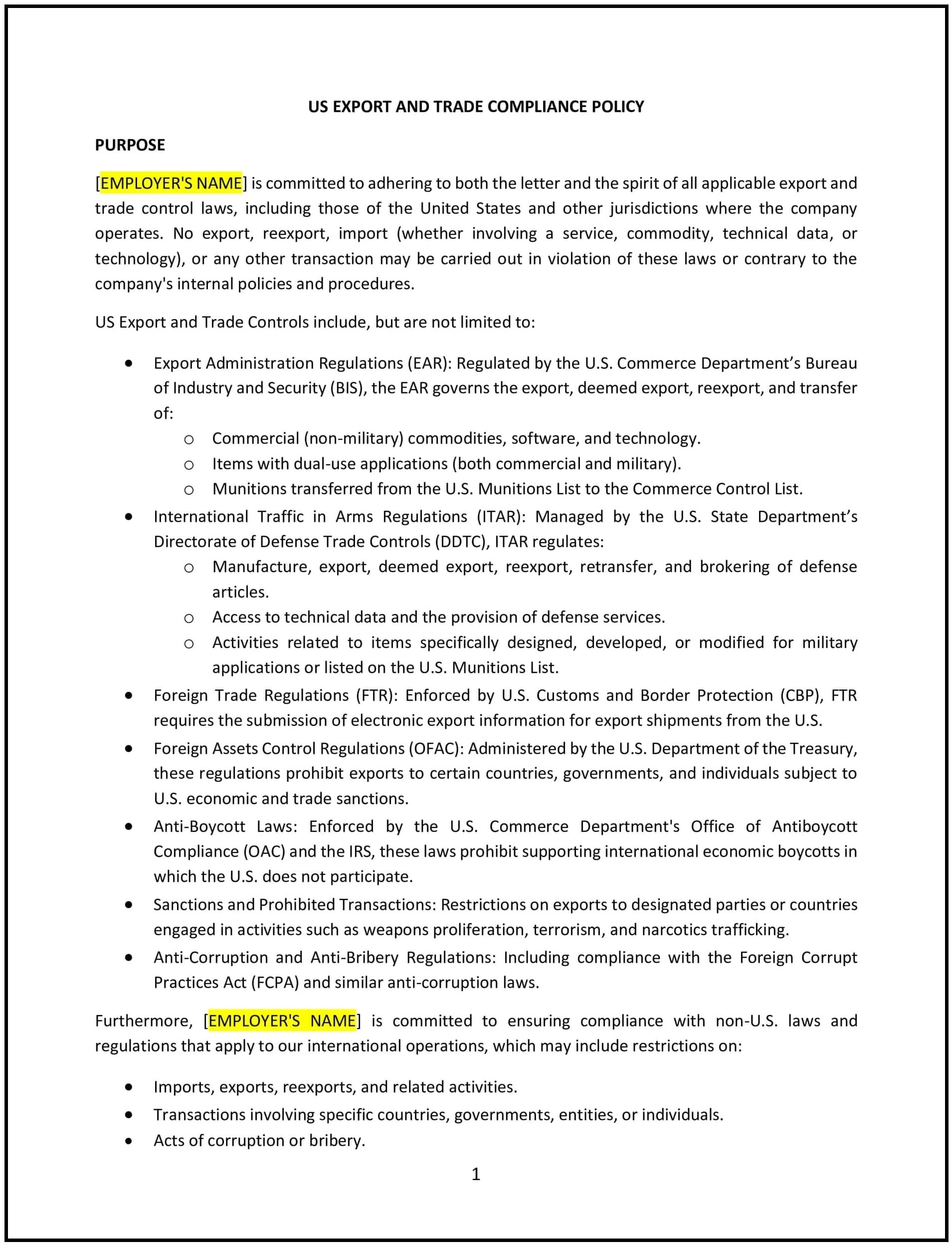
A US export and trade compliance policy helps Idaho businesses establish guidelines for adhering to federal regulations governing the export of goods, services, and technology. This policy outlines procedures for classifying products, obtaining necessary licenses, and conducting restricted party screenings. It also emphasizes the importance of maintaining accurate records and avoiding violations of export control laws.
By implementing this policy, businesses can minimize legal risks, protect their reputation, and ensure smooth international trade operations.
How to use this US export and trade compliance policy (Idaho)
- Define scope and applicability: Specify which business activities are covered by the policy, such as exporting goods, services, or technology, to ensure clarity and consistency in applying the policy.
- Establish product classification procedures: Outline the process for classifying products under the Export Administration Regulations (EAR) or International Traffic in Arms Regulations (ITAR), including the use of Harmonized System (HS) codes.
- Address licensing requirements: Explain the steps for determining whether an export license is required and how to apply for one through the appropriate federal agencies.
- Conduct restricted party screenings: Provide guidelines for screening customers, partners, and transactions against restricted party lists, such as the Denied Persons List and Entity List.
- Maintain accurate records: Outline the types of records that must be kept, such as export licenses, shipping documents, and screening results, and the retention period required by law.
- Train employees: Provide training for employees on export control regulations, the policy’s procedures, and the importance of compliance.
- Review and update the policy: Periodically assess the policy’s effectiveness and make adjustments based on changes in federal regulations, business needs, or Idaho laws.
Benefits of using this US export and trade compliance policy (Idaho)
This policy offers several advantages for Idaho businesses:
- Reduces legal risks: Clear guidelines help businesses comply with federal export control laws, minimizing the risk of penalties, fines, or legal disputes.
- Protects business reputation: Adhering to export regulations demonstrates the business’s commitment to ethical practices and international trade compliance.
- Enhances operational efficiency: Structured procedures streamline export processes, reducing delays and ensuring smooth international transactions.
- Supports international growth: Compliance with export regulations enables businesses to expand into global markets with confidence.
- Encourages accountability: Clear expectations and consequences help employees understand their responsibilities and the importance of adhering to the policy.
- Fosters a culture of compliance: The policy reinforces the business’s commitment to maintaining high standards of export and trade compliance.
Tips for using this US export and trade compliance policy (Idaho)
- Communicate the policy clearly: Share the policy with employees through onboarding materials, training sessions, or internal communication platforms to ensure awareness and understanding.
- Train employees: Provide training on export control regulations, the policy’s procedures, and the importance of maintaining accurate records.
- Monitor compliance: Regularly review export transactions and documentation to ensure adherence to the policy and identify areas for improvement.
- Stay informed about regulatory updates: Keep up-to-date with changes to federal export control laws and update the policy as needed.
- Encourage transparency: Foster a culture where employees feel comfortable reporting potential compliance issues or seeking clarification on export regulations.
- Document everything: Maintain detailed records of export licenses, shipping documents, and screening results to ensure accountability and transparency.