Got contracts to review? While you're here for policies, let Cobrief make contract review effortless—start your free review now.
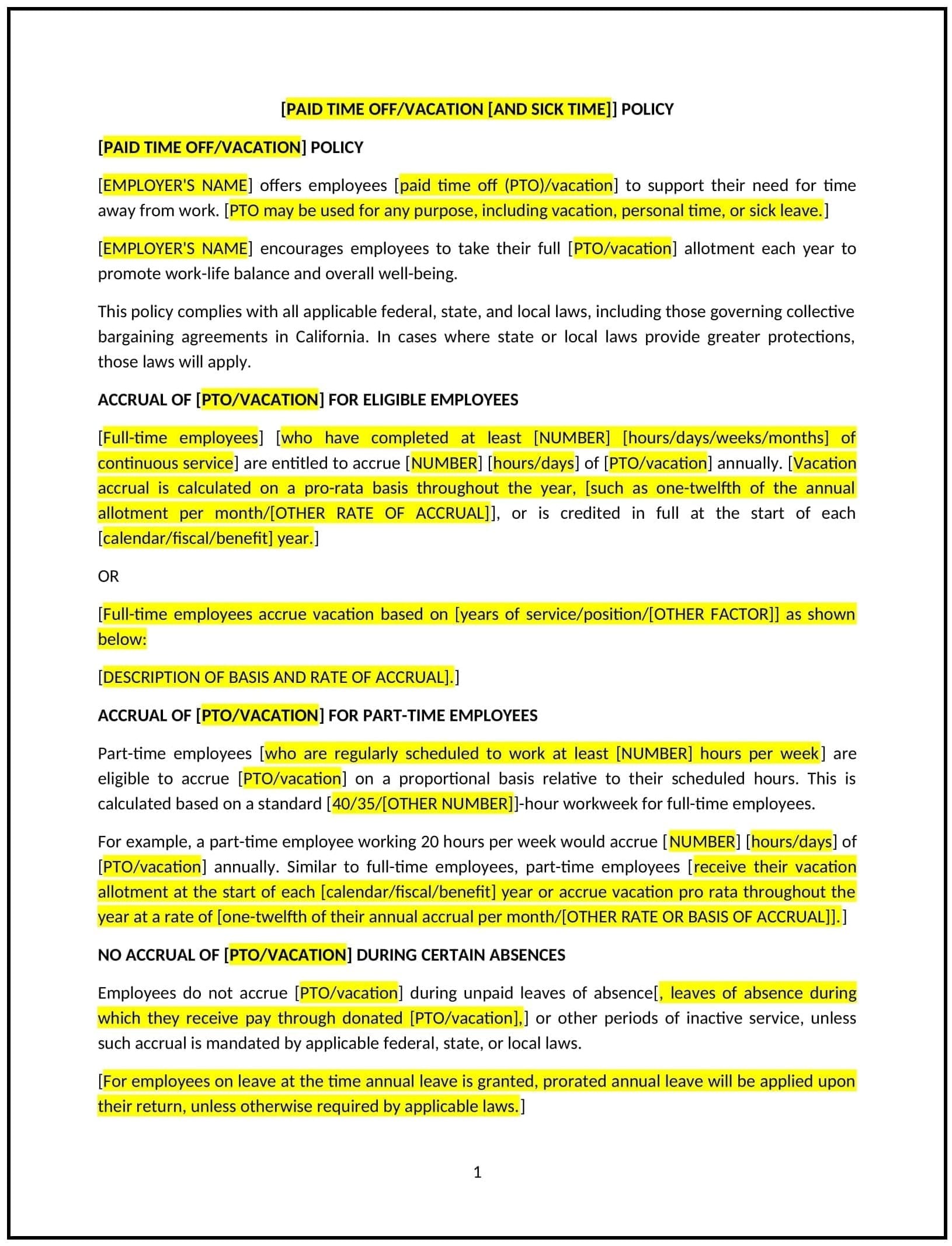
Customize this template for free
Vacation policy (California)
In California, a vacation policy provides businesses with guidelines for managing employee vacation time, including accrual, usage, and payout. This policy ensures compliance with California labor laws, such as those prohibiting the forfeiture of accrued vacation time and regulating payouts upon termination.
This policy outlines eligibility, accrual rates, request procedures, and the business’s expectations for vacation scheduling. By implementing this policy, California businesses can support work-life balance while maintaining operational efficiency and adhering to legal requirements.
How to use this vacation policy (California)
- Define eligibility: Specify which employees are eligible for vacation time, considering factors such as full-time or part-time status.
- Explain accrual: Outline how vacation time is accrued, including rates and any caps on accumulation, in compliance with California law prohibiting "use-it-or-lose-it" policies.
- Communicate request procedures: Provide clear steps for requesting vacation, including advance notice and approval processes to ensure minimal disruption to operations.
- Address scheduling: Establish guidelines for prioritizing vacation requests during peak periods or when conflicts arise.
- Outline payout rules: Clarify that unused vacation time will be paid out upon termination, as required by California law.
Benefits of using this vacation policy (California)
This policy offers several advantages for California businesses:
- Supports compliance: Reflects California labor laws governing vacation accrual, usage, and payouts upon termination.
- Enhances morale: Encourages employees to take time off for rest and rejuvenation, improving job satisfaction and productivity.
- Promotes fairness: Provides consistent guidelines for managing vacation time across the organization.
- Reduces risks: Minimizes potential legal disputes by adhering to California’s vacation-related requirements.
- Improves planning: Helps the business manage employee absences effectively to maintain workflow.
Tips for using this vacation policy (California)
- Reflect California-specific laws: Ensure compliance with regulations prohibiting forfeiture of accrued vacation and requiring payout upon termination.
- Train managers: Provide guidance on handling vacation requests fairly and minimizing scheduling conflicts.
- Use tracking systems: Implement tools to track vacation accrual and usage accurately for compliance and transparency.
- Encourage usage: Promote a culture where employees feel supported in taking their accrued vacation time.
- Review regularly: Update the policy to reflect changes in California laws or business operations.