Digital patient engagement platform proposal: Free template
Got contracts to review? While you're here for proposals, let Cobrief make contract review effortless—start your free review now.
Customize this template for free
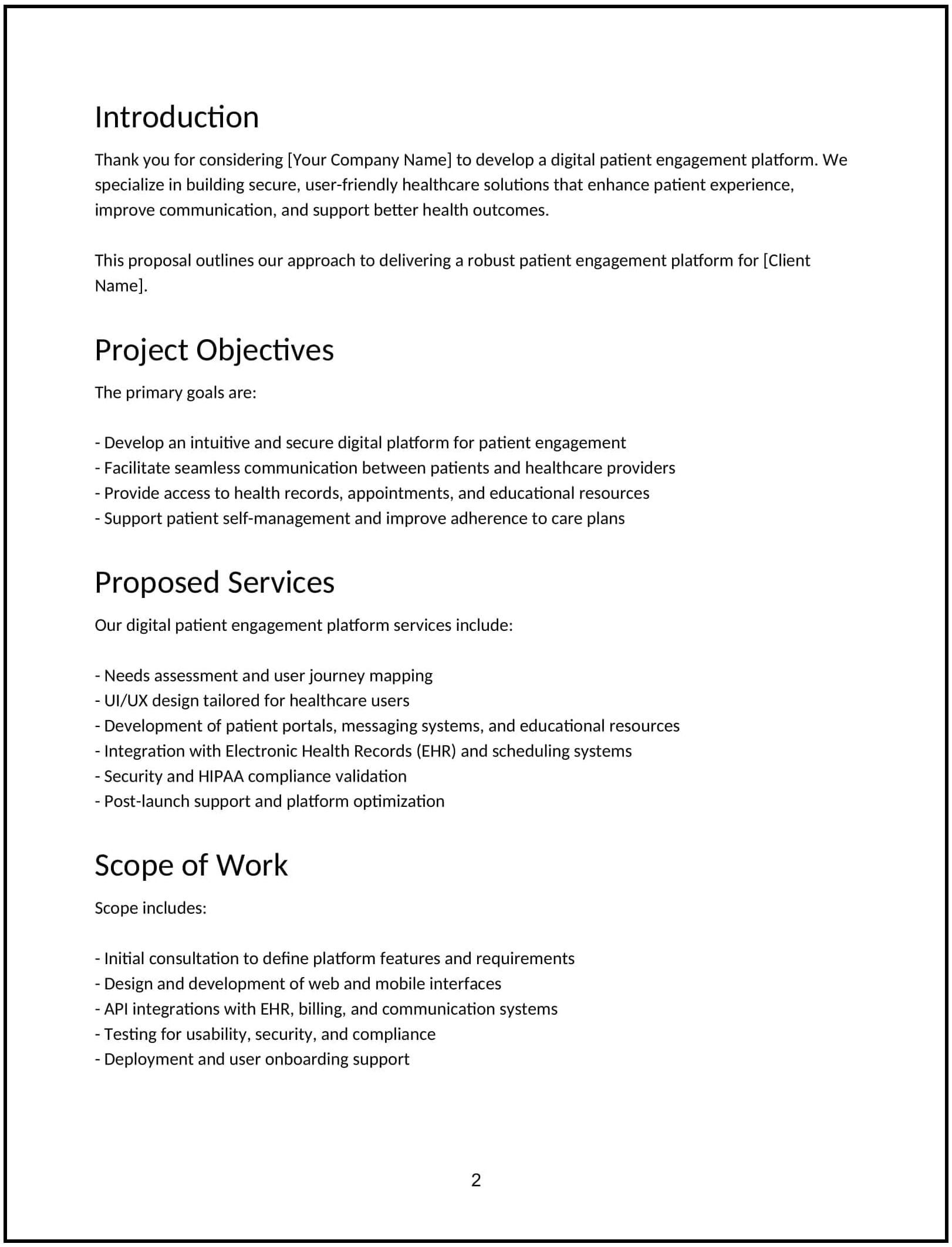
Customize this free digital patient engagement platform proposal with Cobrief
Open this free digital patient engagement platform proposal in Cobrief and start editing it instantly using AI. You can adjust the tone, structure, and content based on your client’s clinical workflows, patient communication goals, and technology environment. You can also use AI to review your draft — spot gaps, tighten language, and improve clarity before sending.
Once you're done, send, download, or save the proposal in one click — no formatting or setup required.
This template is fully customizable and built for real-world use — ideal for helping healthcare organizations implement digital tools that support outreach, education, scheduling, and follow-up. Whether you’re working with clinics, hospitals, or digital health startups, this version gives you a structured head start and removes the guesswork.
What is a digital patient engagement platform proposal?
A digital patient engagement platform proposal outlines your plan to implement or optimize a system that enables providers to communicate with patients, automate touchpoints, and improve health outcomes through digital tools. It typically includes platform selection, integration support, workflow mapping, content setup, and staff onboarding.
This type of proposal is used by digital health consultants, implementation teams, and operations strategists helping healthcare providers strengthen connections with patients between visits.
Use this proposal to:
- Improve communication and follow-up without adding administrative burden.
- Automate outreach like reminders, education, or pre-visit instructions.
- Increase patient satisfaction, adherence, and retention.
- Streamline platform adoption with minimal disruption to care delivery.
This proposal helps clients build a scalable patient engagement system that drives better outcomes.
Why use Cobrief to edit your proposal
Instead of copying a static template, you can use Cobrief to tailor and refine your proposal directly in your browser — with AI built in to help along the way.
- Edit the proposal directly in your browser: No setup or formatting required — just click and start customizing.
- Rewrite sections with AI: Highlight any sentence and choose from actions like shorten, expand, simplify, or change tone.
- Run a one-click AI review: Get instant suggestions to improve clarity, fix vague sections, or tighten your message.
- Apply AI suggestions instantly: Review and accept individual AI suggestions, or apply all improvements across the proposal in one click.
- Share or export instantly: Send your proposal through Cobrief or download a clean PDF or DOCX version when you’re done.
Cobrief helps you create a polished, persuasive proposal — without wasting time on formatting or second-guessing your copy.
When to use this proposal
This digital patient engagement platform proposal works well in situations like:
- When launching a new communication platform or portal for patient use.
- When consolidating multiple point solutions (SMS, email, in-app chat) into one.
- When trying to reduce no-shows, increase adherence, or automate follow-up.
- When patient satisfaction scores are low or inconsistent.
- When providers want a centralized way to push education, reminders, and forms.
Use this proposal to help clients move from reactive communication to proactive patient engagement.
What to include in a digital patient engagement platform proposal
Each section of the proposal is designed to help you explain your offer clearly and professionally. Here's how to use them:
- Executive summary: Frame patient engagement as a critical driver of outcomes, efficiency, and retention — and the platform as a tool to deliver that at scale.
- Scope of work: Include workflow review, platform selection or configuration, EHR/integration planning, outreach logic setup (reminders, education modules, surveys), staff training, patient communication templates, and rollout support.
- Timeline: Break into phases — audit, platform setup, content configuration, internal training, and go-live. Most implementations run 3–6 weeks depending on scope.
- Pricing: Offer flat-fee or milestone-based pricing. Optional add-ons: multilingual messaging packs, health literacy review, campaign performance reporting, HIPAA consent flows.
- Terms and conditions: Clarify data access, vendor responsibilities (if third-party software is involved), PHI handling, UAT expectations, and ongoing support limits.
- Next steps: Include a CTA like “Approve to begin platform configuration and message flow mapping” or “Schedule kickoff to align on outreach priorities and touchpoint frequency.”
How to write an effective digital patient engagement platform proposal
Use these best practices to show confidence, clarity, and healthcare fluency:
- Make the client the focus: Show how the platform supports their patients and goals — e.g., fewer missed appointments, better medication adherence, stronger patient reviews.
- Personalize where it matters: Reference their care model (e.g. primary care, behavioral health, specialty clinic), patient mix (age, language needs), and existing platform stack.
- Show results, not just features: Use examples like “Reduced no-show rate by 34% after implementing 2-day SMS reminders” or “Increased post-discharge follow-up completion to 91%.”
- Be clear and confident: Avoid vague phrases like “improved engagement” — explain what touchpoints are being delivered and what the patient sees.
- Keep it skimmable: Use phases, timelines, and deliverables so clinical and ops leads can review and approve quickly.
- End with momentum: Recommend starting with one clinic or patient journey (e.g., pre-visit onboarding) to validate the flow before scaling across departments.