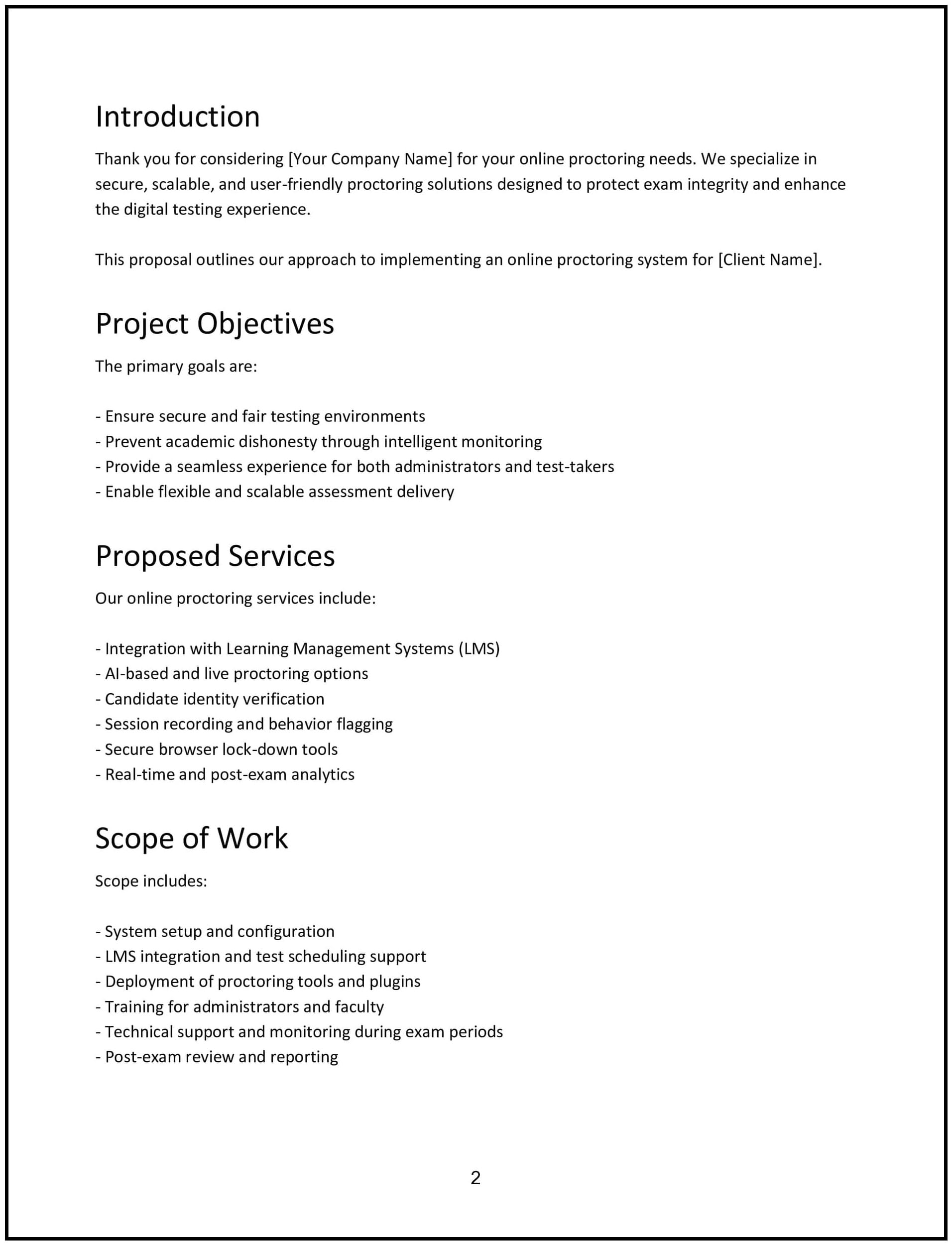
Online-proctoring system proposal: Free template
Proposes an online proctoring system, outlining technology features, security measures, user experience, and integration with existing learning platforms.
- Proposal
Customize this free online-proctoring system proposal with Cobrief
Open this free online-proctoring system proposal in Cobrief and start editing it instantly using AI. You can adjust the tone, structure, and content based on the institution type, test environment, and privacy requirements. You can also use AI to review your draft — spot gaps, tighten language, and improve clarity before sending.
Once you're done, send, download, or save the proposal in one click — no formatting or setup required.
This template is fully customizable and built for real-world use — ideal for pitching online test proctoring solutions to universities, certification boards, schools, or training providers. Whether you’re offering a software platform, live monitoring, or AI-based proctoring, this version gives you a structured head start and removes the guesswork.
What is an online-proctoring system proposal?
An online-proctoring system proposal outlines your plan to implement and support remote exam monitoring for an educational or credentialing organization. It typically includes the platform features, security protocols, exam integrity safeguards, integration options, user support, and pricing.
This type of proposal is commonly used:
- When institutions shift from in-person to remote testing
- To replace outdated proctoring tools or reduce cheating risks
- As part of an RFP process for high-stakes exam delivery
It helps decision-makers evaluate how your solution protects test integrity while balancing student experience, privacy, and scalability.
A strong proposal helps you:
- Clearly explain how your proctoring system works across exam types
- Address privacy, accessibility, and fairness concerns up front
- Clarify what’s automated, what’s human-monitored, and how data is handled
- Set expectations for implementation, training, and support
Why use Cobrief to edit your proposal
Cobrief helps you write and polish your proposal faster — with built-in AI tools and live editing designed for clarity and speed.
- Edit the proposal directly in your browser: No formatting headaches — just write, review, and adjust instantly.
- Rewrite sections with AI: Adapt language for academic tech teams, testing administrators, or procurement managers.
- Run a one-click AI review: Let AI catch missing features, vague compliance language, or gaps in onboarding and support.
- Apply AI suggestions instantly: Accept edits line by line or apply changes across the entire proposal.
- Share or export instantly: Send your proposal directly or download a clean PDF or DOCX for delivery.
You’ll go from draft to decision-ready in less time — and with more clarity.
When to use this proposal
Use this online-proctoring system proposal when:
- Quoting for proctoring software or monitoring services in academic or professional settings
- Responding to an RFP for remote exam security
- Supporting live, recorded, or AI-based proctoring for high-stakes tests
- Proposing platform integration with LMS, test delivery, or ID verification tools
- Helping institutions transition to hybrid or fully remote assessments
It’s especially useful when trust, privacy, and exam integrity are top concerns.
What to include in an online-proctoring system proposal
Use this template to walk the client through the system’s capabilities, setup process, and safeguards — in plain-smart, actionable language.
- Project overview: Describe the need for secure online testing and how your solution supports integrity, access, and flexibility at scale.
- System features: Outline core functions — browser lockdown, webcam monitoring, ID verification, AI flagging, live intervention, and data analytics.
- Proctoring model: Clarify if the service is AI-only, human-only, or hybrid — and how incidents are flagged, reviewed, and resolved.
- Compliance and privacy: Explain how your platform meets FERPA, GDPR, or institution-specific privacy requirements. Include details on data handling, storage, and student consent.
- Accessibility and fairness: Describe how your system supports accommodations (e.g., extended time, screen readers) and avoids bias or false flags.
- Integrations and compatibility: Note support for LMS platforms (e.g., Canvas, Moodle), exam software, single sign-on, or API access.
- Onboarding and training: Detail your process for user setup, faculty onboarding, and student walkthroughs or practice exams.
- Support and reliability: Describe tech support hours, uptime guarantees, issue escalation, and response times during live exams.
- Timeline and rollout: Provide a phased plan — from pilot to full deployment — with durations for testing, training, and review.
- Pricing: Present a clear model — per exam, per student, or flat licensing fee. Include optional features like analytics dashboards or 24/7 support.
- Next steps: End with a clear CTA — such as scheduling a demo, reviewing a sample exam flow, or starting a pilot program.
How to write an effective online-proctoring system proposal
This proposal should feel secure, scalable, and student-aware — especially for academic institutions balancing exam integrity with accessibility and privacy.
- Speak to risk and reassurance: Focus on what you prevent (cheating, impersonation) and how you protect users (data, fairness).
- Be clear about the human/AI balance: Clients want to know what’s reviewed by people vs. software — and what happens after a flag.
- Anticipate privacy pushback: Show how data is protected, deleted, or anonymized — especially for global or public institutions.
- Offer flexibility: Not all clients want 24/7 AI plus live monitoring — highlight configurable options or modular plans.
- Emphasize ease of use: Reinforce that your system minimizes friction for students and is easy for staff to administer.
- Close with action: Help the client move forward confidently — demo, test run, or quote approval.
Frequently asked questions (FAQs)
Similar templates
Where deals go from offer to paid
