Start a new document with this content. Open the editor to build from scratch — paste in what you need and keep writing.
Departing employee checklist
Managing an employee’s departure—whether voluntary or involuntary—requires a clear, structured approach to protect the company’s legal and operational interests. This departing employee checklist covers everything from collecting essential documents to securing company assets and addressing any post-employment obligations. By using this checklist, you’ll ensure compliance with legal requirements, safeguard company data, and minimize any risks during the transition.
This checklist will help you collect necessary employment records and documents, handle all financial and legal responsibilities such as final paychecks and benefits, protect against security breaches by revoking access to systems and retrieving company property, and ensure a smooth transfer of job duties to maintain business continuity.
How to use this departing employee checklist
Here’s how to use the departing employee checklist effectively:
- Follow the process: This checklist takes you through each step of handling an employee’s departure, from collecting records to managing post-employment obligations. Use it to ensure all tasks are completed efficiently and nothing is overlooked.
- Adapt to your situation: Tailor the checklist to your company’s specific policies, employee agreements, and the nature of the departure (whether voluntary or involuntary). Make sure to account for any legal or contractual obligations.
- Engage key stakeholders: Ensure that HR, legal teams, and managers are involved throughout the process, especially when handling sensitive documents, legal requirements, or any potential security risks.
- Stay organized: Mark off each completed task to keep track of the process and ensure smooth coordination across departments. This helps prevent delays and ensures a thorough exit process.
- Review and update: Make sure to review this checklist periodically to ensure it aligns with any updates in employment laws, company policies, or internal processes.
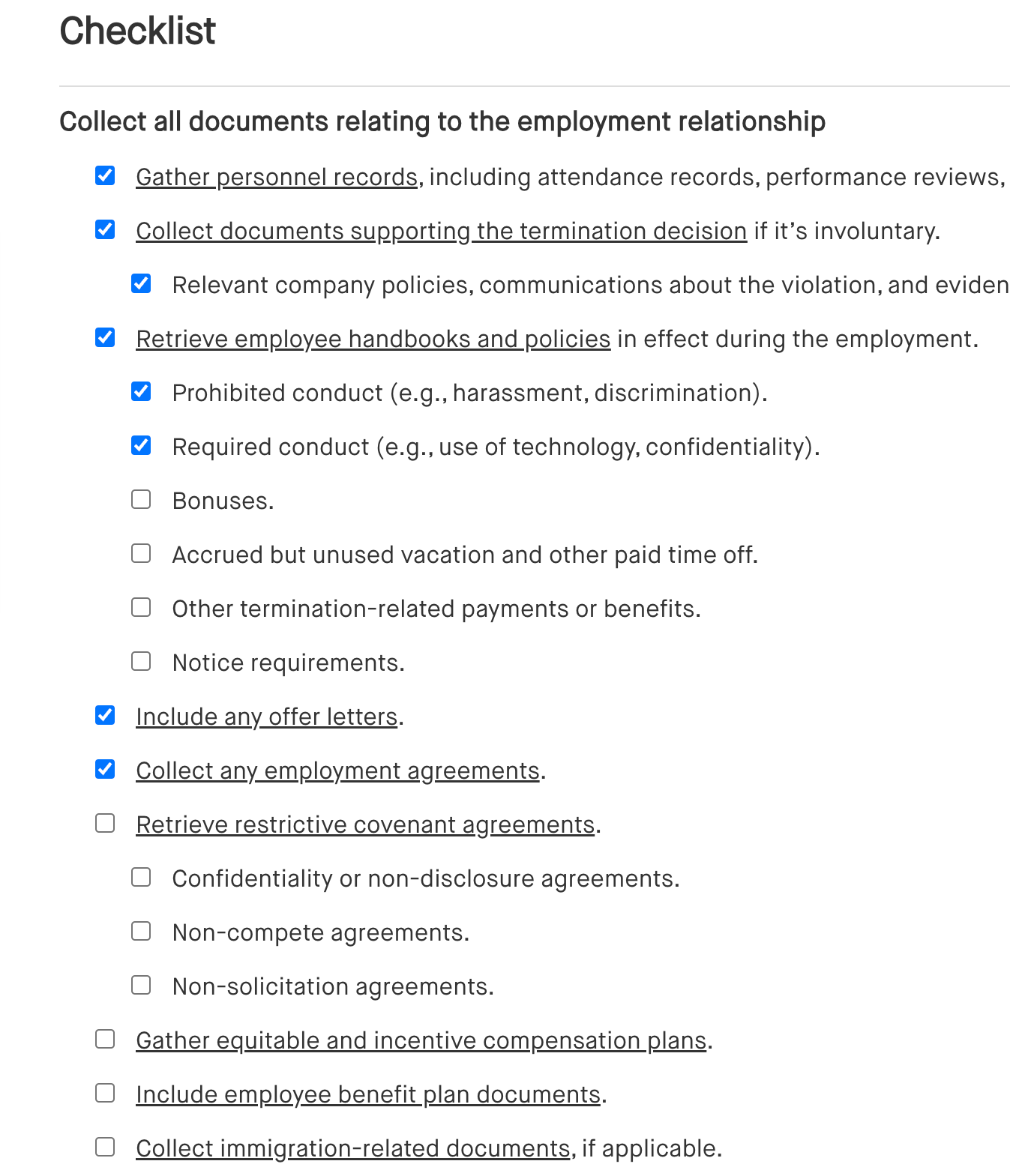
Checklist
Collect all documents relating to the employment relationship
[ ] Gather personnel records, including attendance records, performance reviews, and disciplinary records.
[ ] Collect documents supporting the termination decision if it’s involuntary.
[ ] Relevant company policies, communications about the violation, and evidence of policy violation.
[ ] Retrieve employee handbooks and policies in effect during the employment.
[ ] Prohibited conduct (e.g., harassment, discrimination).
[ ] Required conduct (e.g., use of technology, confidentiality).
[ ] Bonuses.
[ ] Accrued but unused vacation and other paid time off.
[ ] Other termination-related payments or benefits.
[ ] Notice requirements.
[ ] Include any offer letters.
[ ] Collect any employment agreements.
[ ] Retrieve restrictive covenant agreements.
[ ] Confidentiality or non-disclosure agreements.
[ ] Non-compete agreements.
[ ] Non-solicitation agreements.
[ ] Gather equitable and incentive compensation plans.
[ ] Include employee benefit plan documents.
[ ] Collect immigration-related documents, if applicable.
[ ] Gather other documents related to the employment relationship.
[ ] Internal complaints made by or about the employee.
[ ] Related investigation files.
[ ] Leave requests and employer responses.
[ ] Requests for reasonable accommodation and related responses.
Determine the employee and employer’s rights and responsibilities
[ ] Assess at-will or for-cause employment status.
[ ] Check if the employee can be let go at any time for any reason or if there are specific rules that apply.
[ ] If restrictions apply (like for-cause employment or required progressive discipline):
[ ] Ensure all requirements are met before termination.
[ ] Verify that any obligations triggered by the termination (such as severance payments) are fulfilled.
[ ] Check notice period requirements in employment agreements or policies.
[ ] Handle pay in lieu of notice if required.
[ ] Consider paying in lieu of notice if immediate termination is needed.
[ ] Have the employee acknowledge in writing that pay in lieu satisfies the requirement.
[ ] Calculate final wages.
[ ] Ensure final paycheck includes all wages, bonuses, commissions, and other compensation.
[ ] Check state or local laws on payment for unused vacation or other paid time off.
[ ] Review state or local laws on when and how final wages must be paid.
[ ] Check if the employee must return sign-on or retention bonuses.
[ ] Review severance pay obligations.
[ ] Determine if the employee qualifies for severance pay based on contract or company rules.
[ ] Assess if severance must be paid based on company practice to avoid claims.
[ ] Review benefit plan documents to determine coverage end and COBRA eligibility.
[ ] Review immigration status of the employee if employer-sponsored.
[ ] Address restrictive covenants and post-employment obligations.
[ ] Check if the employee is subject to post-employment restrictions (e.g., non-compete, non-solicitation).
[ ] Remind the employee in writing of ongoing obligations.
[ ] Investigate any suspected breach of post-employment obligations.
Document the end of the employment relationship
[ ] Ensure employees who resign provide a resignation letter. This is useful if there’s ever a dispute over whether the termination was voluntary.
[ ] Prepare terminating documentation.
[ ] If terminating an employee involuntarily, document the reasons for the termination in a clear and objective manner.
[ ] Ensure you have enough supporting documents to justify the decision.
[ ] Provide written notice of termination.
[ ] Check if state or local laws require written notice of termination or information about unemployment insurance benefits.
[ ] Provide any required notice to comply with applicable laws.
Disable access to employer systems to protect against theft, misuse and security
[ ] Disable the departing employee’s access to all company systems to prevent unauthorized access and protect confidential information.
[ ] Ensure email access, voicemail access, passwords, credentials, and remote log-in permissions are revoked.
Ensure employee returns employer property and records
[ ] Ensure the departing employee returns items such as:
[ ] Desktop or laptop computers.
[ ] Computer peripherals (e.g., external drives, printers, webcams).
[ ] Cell phones and electronic devices.
[ ] Building key cards and passes.
[ ] Electronic key fobs.
[ ] Documents and files (physical or electronic).
[ ] Corporate credit cards.
[ ] Ensure the property is returned by or before the termination date, or another agreed-upon date based on the employee handbook or policy, a written agreement between with the employer and employee, or arrangements made during the exit interview.
[ ] Have the employee verify in writing that all company property and records have been returned.
Determine social media ownership
[ ] Check if there’s a policy or agreement that outlines ownership of work-related social media accounts.
[ ] Identify any policies or agreements that restrict the employee's social media use after leaving the company.
[ ] Inform the employee of any restrictions regarding:
[ ] Posting on employer-owned social media accounts.
[ ] Using contacts obtained through employer-managed social media.
[ ] Using social media to solicit clients or employees post-employment.
Address employee debts or outstanding loans
[ ] Check if the departing employee owes any debts or has unpaid loans to the employer.
[ ] Request immediate payment or establish a voluntary repayment schedule with the employee if amounts are owed.
[ ] Structure any repayment agreements to follow wage and hour laws. Some states do not allow employers to deduct debts from paychecks. Consult state-specific laws to ensure compliance.
Plan the transition of job duties
[ ] Confirm the departing employee’s final day in the office.
[ ] Decide if the employee will help select or train their replacement.
[ ] Ensure the employee’s duties and project knowledge are handed over to a replacement or coworkers.
Conduct an exit interview for a resigning employee
[ ] Ask about their work experience, supervisors, and co-workers.
[ ] Inquire about the reason for resignation, and gather feedback to identify any issues like harassment or discrimination.
[ ] Determine if the employee is considering legal action and address concerns, if possible.
[ ] Remind the employee about continuing responsibilities, in particular competition, solicitation of clients or employees, and confidentiality and trade secrets.
[ ] Ask about the employee’s future plans, particularly if they plan to work for a competitor. Assess any risks of non-compete or non-solicitation agreement violations.
[ ] Explain the timing of the final paycheck, bonuses, accrued leave, and when benefits will end.
[ ] Provide information about COBRA notices for continuing health coverage.
Develop a strategy for post-termination communications
[ ] Decide who will announce the employee’s departure. The best choice depends on the departing employee's role, the reason for leaving, and the organization’s size.
[ ] Evaluate the best method to communicate the departure to employees, balancing transparency with professionalism.
[ ] Consider the impact of the employee’s departure. If the employee was well-liked or in a key leadership role, provide reassurance about the organization’s transition plans or hiring a suitable replacement, if applicable.
Benefits of using a departing employee checklist
Using a departing employee checklist helps your company manage the exit process efficiently, protecting both legal and operational interests. Here’s how it helps:
- Compliance with legal obligations: Ensures you meet state and local laws regarding final paychecks, benefits, and notice requirements, reducing the risk of legal claims.
- Data security: Safeguards company information by revoking access to systems and ensuring the return of company property like computers and access cards.
- Clear documentation: Helps you document every step of the exit process, ensuring you have a record of the termination or resignation in case of future disputes.
- Business continuity: Guides you through the transition of job duties, ensuring that projects are transferred smoothly and that there's no disruption to business operations.
- Minimized risks: By addressing post-employment obligations like non-competes and confidentiality agreements, the checklist helps reduce the risk of legal or reputational damage.
Frequently asked questions (FAQs)

Outlines guidelines for employee use of social media, including setting clear boundaries, monitoring activity, and ensuring alignment with company values and policies.
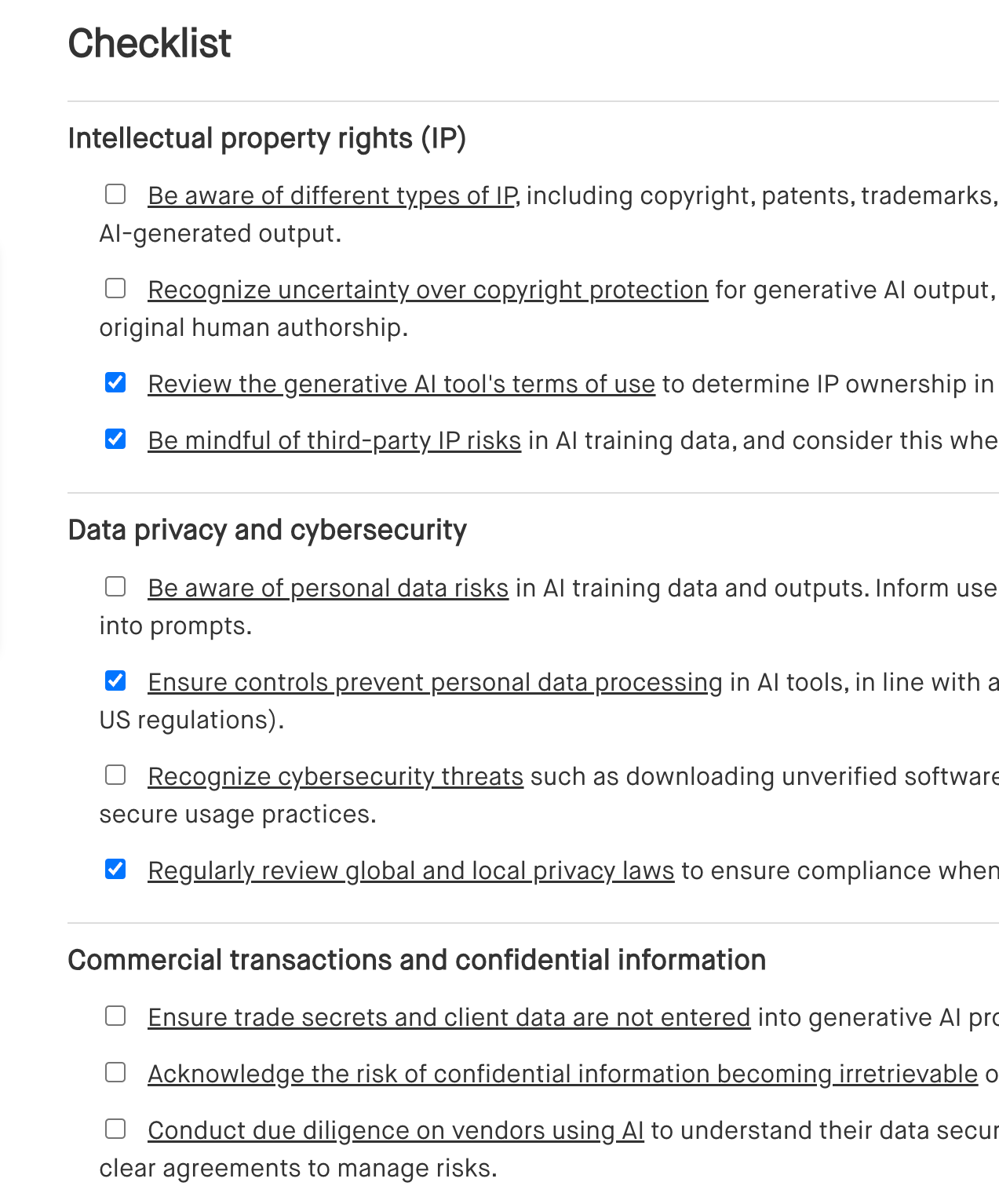
Lists key considerations for using generative AI in the workplace, including data privacy, ethical guidelines, employee training, and potential impact on productivity.
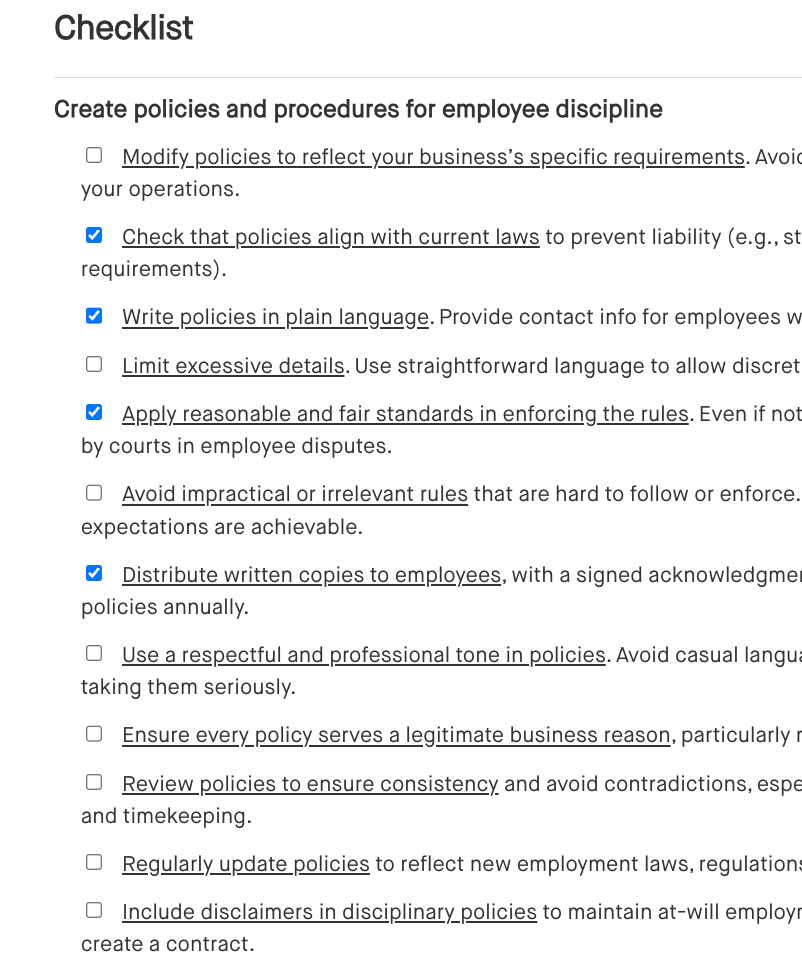
Outlines steps to address employee behavior or performance issues, ensuring fair, consistent, and documented disciplinary actions.