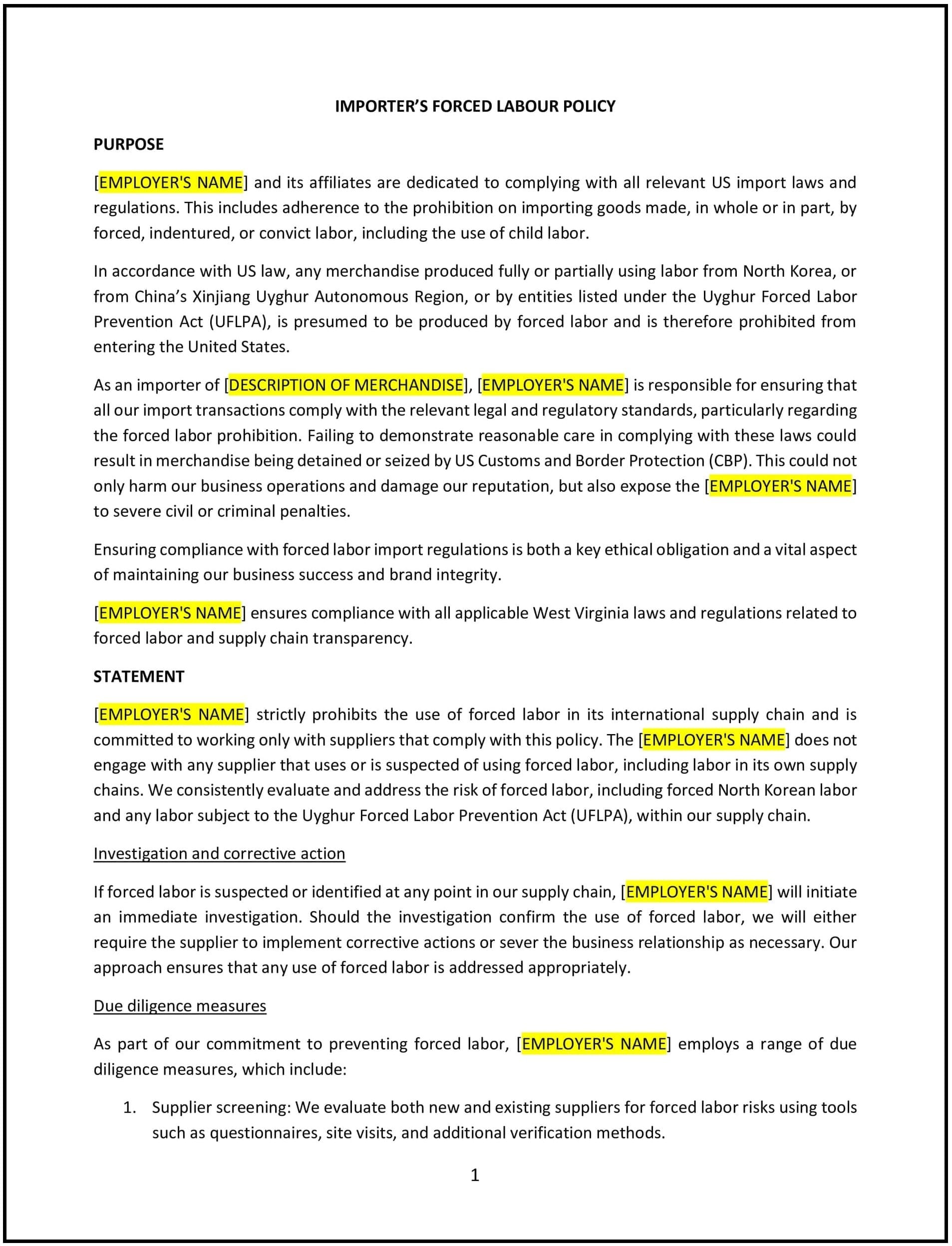
Importer’s forced labour policy (West Virginia): Free template
Prohibits the use of suppliers associated with forced labor and affirms ethical sourcing commitments.
- Policies
- West Virginia
Importer’s forced labour policy (West Virginia)
In West Virginia, an importer’s forced labour policy outlines the organization’s commitment to ensuring that imported goods and materials are free from forced labor. This policy supports compliance with federal and international regulations, such as the U.S. Tariff Act of 1930, and promotes ethical supply chain practices.
The policy provides guidelines for supplier engagement, due diligence, and corrective actions to mitigate the risk of forced labor in the supply chain.
How to use this importer’s forced labour policy (West Virginia)
- Define forced labor: Clearly explain what constitutes forced labor, referencing legal definitions provided by U.S. Customs and Border Protection (CBP) or the International Labour Organization (ILO).
- Outline supplier expectations: Communicate expectations to suppliers, requiring them to adhere to ethical labor practices and certify that their operations are free from forced labor.
- Establish due diligence processes: Detail the steps for assessing suppliers, such as audits, risk assessments, and supply chain mapping, to identify and address forced labor risks.
- Specify reporting procedures: Provide employees and stakeholders with a process for reporting suspected forced labor in the supply chain.
- Support compliance: Align the policy with federal regulations, including the U.S. Tariff Act of 1930 and West Virginia-specific requirements, to avoid legal risks.
Benefits of using an importer’s forced labour policy (West Virginia)
- Ensures compliance: Helps businesses comply with federal regulations, such as the prohibition of goods produced with forced labor under the U.S. Tariff Act.
- Promotes ethical practices: Demonstrates the organization’s commitment to ethical sourcing and human rights.
- Mitigates risks: Reduces the risk of supply chain disruptions, legal penalties, and reputational damage associated with forced labor violations.
- Enhances transparency: Provides stakeholders with clear guidelines on the company’s anti-forced labor efforts.
- Strengthens supplier relationships: Encourages suppliers to adopt ethical labor practices, fostering long-term, sustainable partnerships.
Tips for using an importer’s forced labour policy (West Virginia)
- Communicate with suppliers: Share the policy with all suppliers and require them to certify compliance with ethical labor standards.
- Conduct regular audits: Use third-party or internal audits to assess suppliers’ labor practices and identify potential risks.
- Provide training: Train employees and suppliers on forced labor risks and how to identify and address them in the supply chain.
- Collaborate with stakeholders: Work with industry groups, NGOs, and other stakeholders to strengthen anti-forced labor efforts.
- Update the policy: Review and revise the policy periodically to reflect changes in laws, regulations, or supply chain practices.
Frequently asked questions (FAQs)
Similar templates
Where deals go from offer to paid
