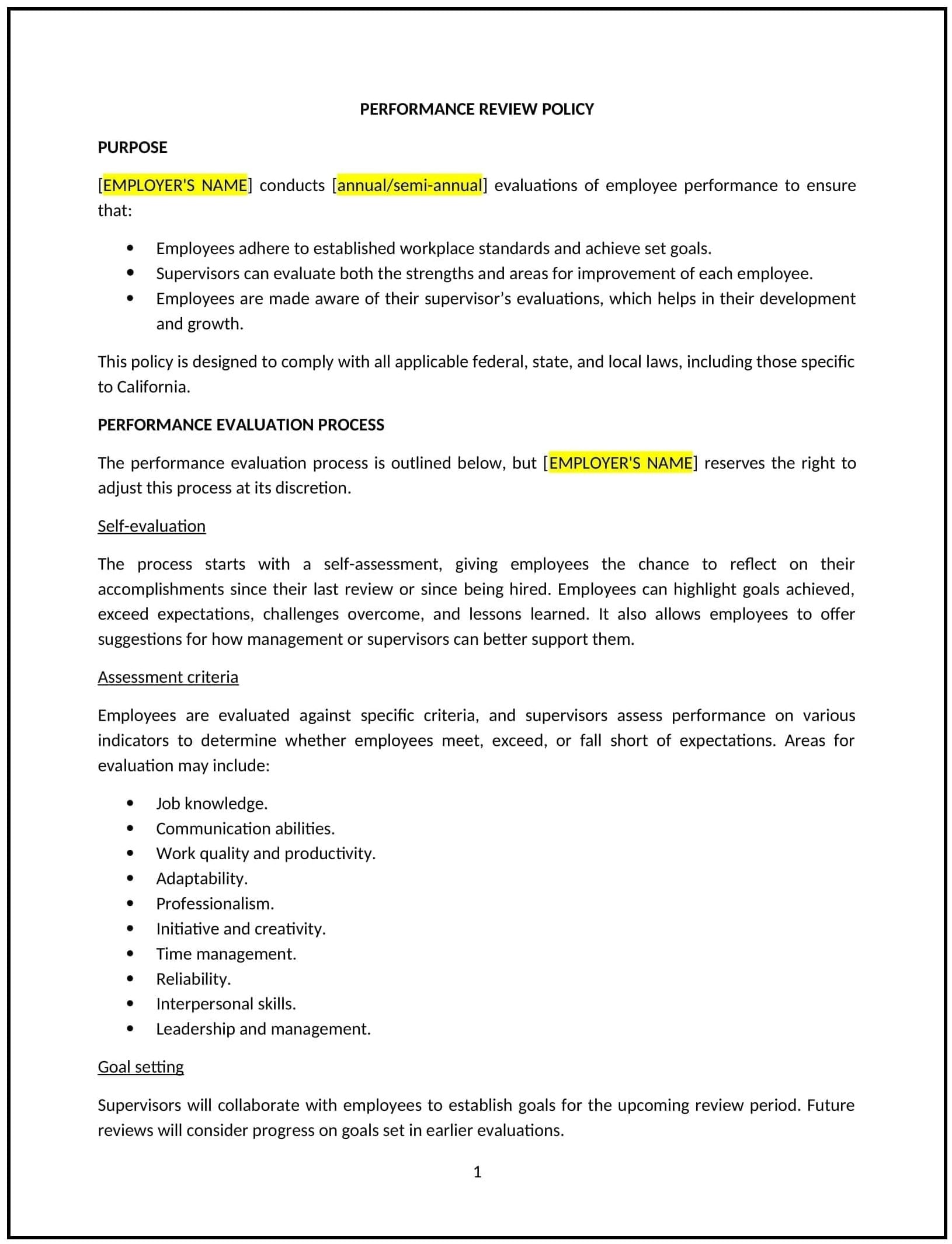
Performance review policy (California): Free template
Describes regular evaluation cycles to support development and objective decisions within California workplaces.
- Policies
- California
Performance review policy (California)
In California, a performance review policy provides businesses with guidelines for evaluating employee performance consistently and fairly. This policy helps businesses align individual contributions with organizational goals, identify areas for improvement, and support compliance with California labor laws, including anti-discrimination regulations under the Fair Employment and Housing Act (FEHA).
This policy outlines the purpose of reviews, the process for conducting evaluations, and the business’s expectations for managers and employees. By implementing this policy, California businesses can foster growth, enhance transparency, and maintain legal compliance.
How to use this performance review policy (California)
- Define review frequency: Specify how often performance reviews will occur, such as annually, semi-annually, or quarterly, to ensure consistency.
- Set clear criteria: Outline the standards and metrics used to evaluate employee performance, ensuring alignment with job descriptions and business goals.
- Provide training: Train managers on conducting reviews that are constructive, unbiased, and compliant with California labor laws.
- Document evaluations: Require written records of performance reviews, including feedback, goals, and improvement plans, to support transparency and accountability.
- Communicate expectations: Ensure employees understand the review process, their performance goals, and how evaluations will impact career growth or compensation.
Benefits of using this performance review policy (California)
This policy offers several advantages for California businesses:
- Supports compliance: Reflects California labor laws, including requirements for fair and unbiased evaluations.
- Enhances transparency: Clarifies the performance review process for employees and managers, reducing misunderstandings.
- Promotes development: Helps employees understand their strengths and areas for improvement, fostering professional growth.
- Aligns goals: Ensures individual performance aligns with the business’s objectives, driving overall success.
- Reduces risks: Minimizes potential legal disputes by documenting evaluations and ensuring fairness.
Tips for using this performance review policy (California)
- Reflect California-specific laws: Address requirements under FEHA to ensure performance reviews are free from discrimination or bias.
- Use objective criteria: Develop measurable and job-relevant performance standards to maintain fairness and consistency.
- Provide constructive feedback: Ensure reviews focus on actionable feedback that supports employee development and engagement.
- Document thoroughly: Maintain records of reviews and related communications to support transparency and defend against potential claims.
- Review regularly: Update the policy to reflect changes in California laws or business needs.
Frequently asked questions (FAQs)
Similar templates

Where deals go from offer to paid
