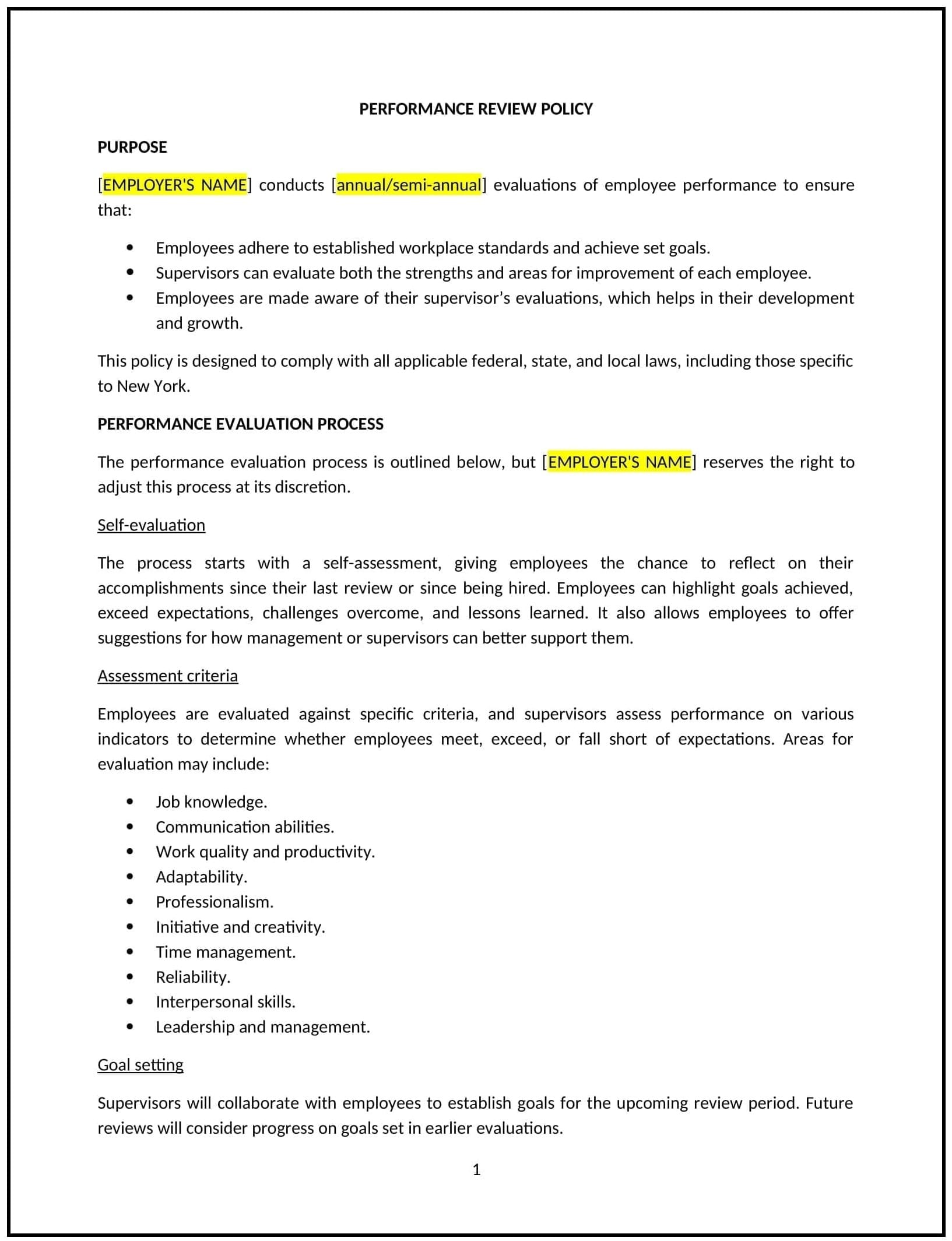
Performance review policy (New York): Free template
Describes the evaluation process for employee performance, goal setting, and feedback cycles.
- Policies
- New York
Performance review policy (New York)
This performance review policy is designed to help New York businesses establish clear guidelines for conducting employee performance evaluations. Whether businesses are assessing employee performance, providing feedback, or determining compensation adjustments, this template provides a structured approach to ensure fairness, transparency, and alignment with business goals.
By adopting this template, businesses can foster a culture of continuous improvement, support employee development, and maintain consistent performance standards.
How to use this performance review policy (New York)
- Define performance criteria: Clearly outline the performance metrics and expectations for employees based on their roles, job descriptions, and organizational goals.
- Set review frequency: Specify how often performance reviews will be conducted (e.g., annually, semi-annually, or quarterly) and the timeline for feedback delivery.
- Include self-assessments: Encourage employees to complete self-assessments as part of the review process to promote reflection and open discussion.
- Provide feedback and development plans: Ensure that performance reviews include constructive feedback and actionable steps for employee growth, including training or development opportunities.
- Address performance ratings: Outline how employees will be rated (e.g., numerical scores, qualitative ratings) and the criteria for each performance level.
Benefits of using a performance review policy (New York)
This policy offers several benefits for New York businesses:
- Promotes fairness: Clear guidelines ensure that performance reviews are consistent, objective, and based on measurable criteria.
- Enhances employee development: Regular reviews provide employees with constructive feedback, helping them grow in their roles and align with business objectives.
- Supports compensation decisions: Performance evaluations can inform decisions related to raises, bonuses, and promotions.
- Improves communication: Performance reviews provide an opportunity for open dialogue between employees and managers, fostering better understanding and collaboration.
- Increases employee engagement: When employees receive feedback and see clear paths for growth, they are more likely to be engaged and motivated in their roles.
Tips for using this performance review policy (New York)
- Communicate expectations: Ensure employees understand the criteria and process for performance reviews well in advance, so they know what is expected of them.
- Provide regular feedback: Foster a culture of ongoing feedback throughout the year to avoid surprises during performance reviews and address issues as they arise.
- Involve managers: Train managers to conduct fair and constructive reviews and provide feedback that supports employee development.
- Encourage employee participation: Empower employees to take an active role in the performance review process by completing self-assessments and discussing career goals.
- Review the policy regularly: Ensure the policy stays aligned with company goals, industry best practices, and New York State labor laws.
Frequently asked questions (FAQs)
Similar templates
Where deals go from offer to paid
