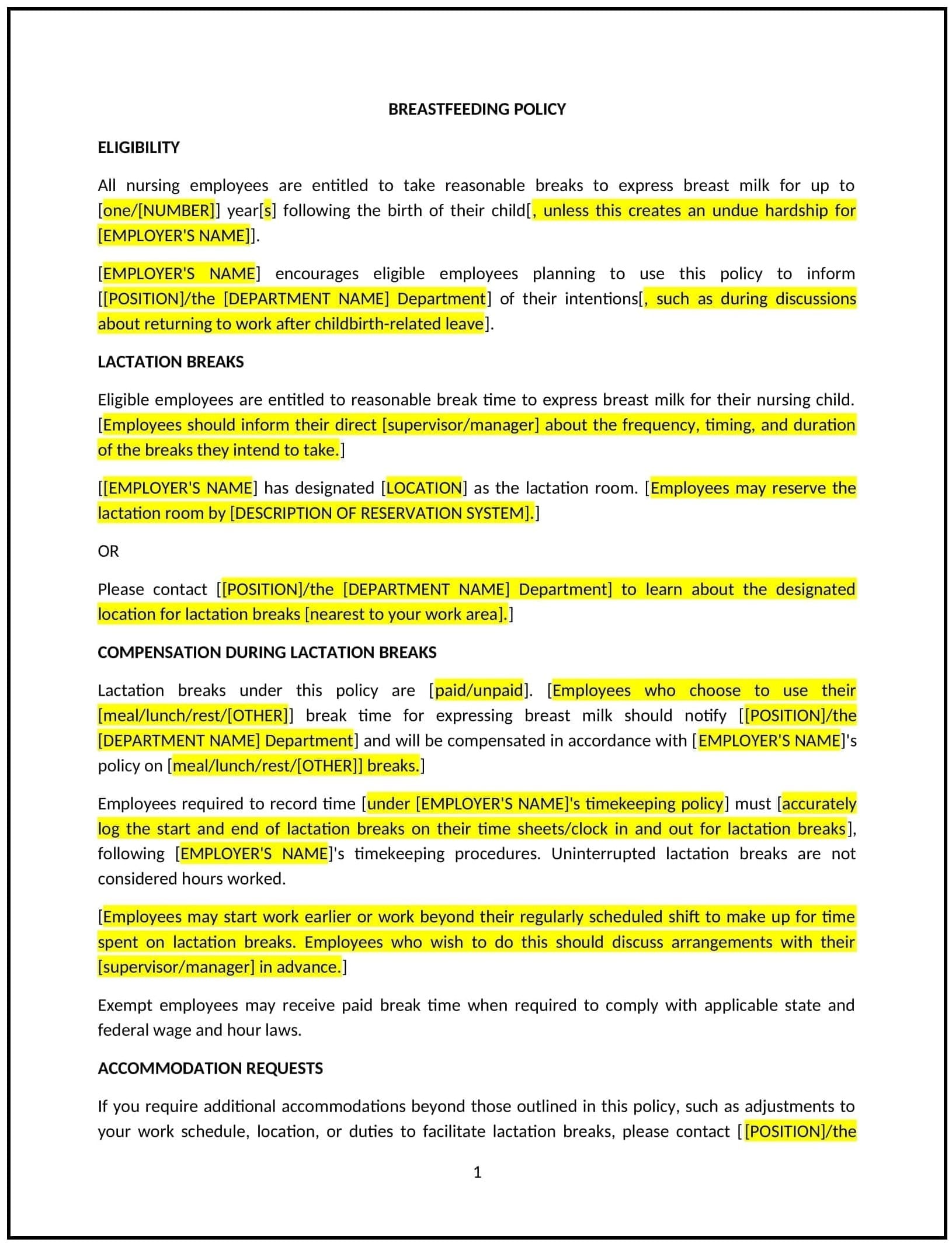
Breastfeeding break policy (Kentucky): Free template
Allows nursing employees break time and private space, aligning with federal and Kentucky breastfeeding requirements.
- Policies
- Kentucky
Breastfeeding break policy (Kentucky)
A breastfeeding break policy provides Kentucky businesses with a framework for supporting nursing employees by allowing reasonable break time and access to a private space to express breast milk during work hours. This policy outlines the rights and responsibilities of both employers and employees, fostering a supportive workplace that promotes work-life balance and employee well-being.
By adopting this policy, businesses can demonstrate a commitment to accommodating employees' needs and maintaining a positive and inclusive work environment.
How to use this breastfeeding break policy (Kentucky)
- Define employee rights: Clearly explain that nursing employees are entitled to reasonable break times and a private, non-bathroom space to express breast milk during the workday.
- Outline break scheduling: Specify how breaks can be arranged, whether through designated times or flexible scheduling, to accommodate the employee’s needs while minimizing disruption to work.
- Describe private space requirements: Provide details about the lactation space, which should be clean, private, and equipped with a chair, a flat surface, and an electrical outlet for breast pumps.
- Address communication with managers: Encourage open communication between nursing employees and their managers to determine suitable break times and accommodations.
- Clarify payment for breaks: State whether breastfeeding breaks are paid or unpaid, in accordance with Kentucky and federal labor laws.
- Include confidentiality guidelines: Emphasize the importance of respecting the privacy of nursing employees and ensuring lactation accommodations are handled discreetly.
- Promote a supportive workplace: Highlight the role of management in fostering a positive environment where nursing employees feel comfortable requesting accommodations.
Benefits of using this breastfeeding break policy (Kentucky)
This policy provides several key benefits for Kentucky businesses:
- Supports employee well-being: Accommodates nursing employees, helping them balance work responsibilities with personal needs.
- Promotes retention: Demonstrates care and understanding, encouraging employees to remain with the business after parental leave.
- Enhances workplace morale: Fosters a supportive and inclusive work culture where employees feel valued and respected.
- Aligns with legal requirements: Helps businesses comply with Kentucky and federal laws regarding breastfeeding accommodations.
- Increases productivity: Enables nursing employees to focus better on their work by addressing their needs effectively.
Tips for using this breastfeeding break policy (Kentucky)
- Communicate the policy: Share the policy with employees during onboarding and through regular workplace communication channels to ensure awareness.
- Provide suitable facilities: Ensure the designated lactation space meets the necessary requirements for privacy, cleanliness, and accessibility.
- Train managers: Educate managers on the policy’s provisions and the importance of supporting nursing employees in the workplace.
- Monitor policy application: Regularly assess how the policy is implemented to ensure it meets employee needs and workplace requirements.
- Review periodically: Update the policy as necessary to reflect changes in Kentucky laws, workplace practices, or employee feedback.
Frequently asked questions (FAQs)
Similar templates
Where deals go from offer to paid
